
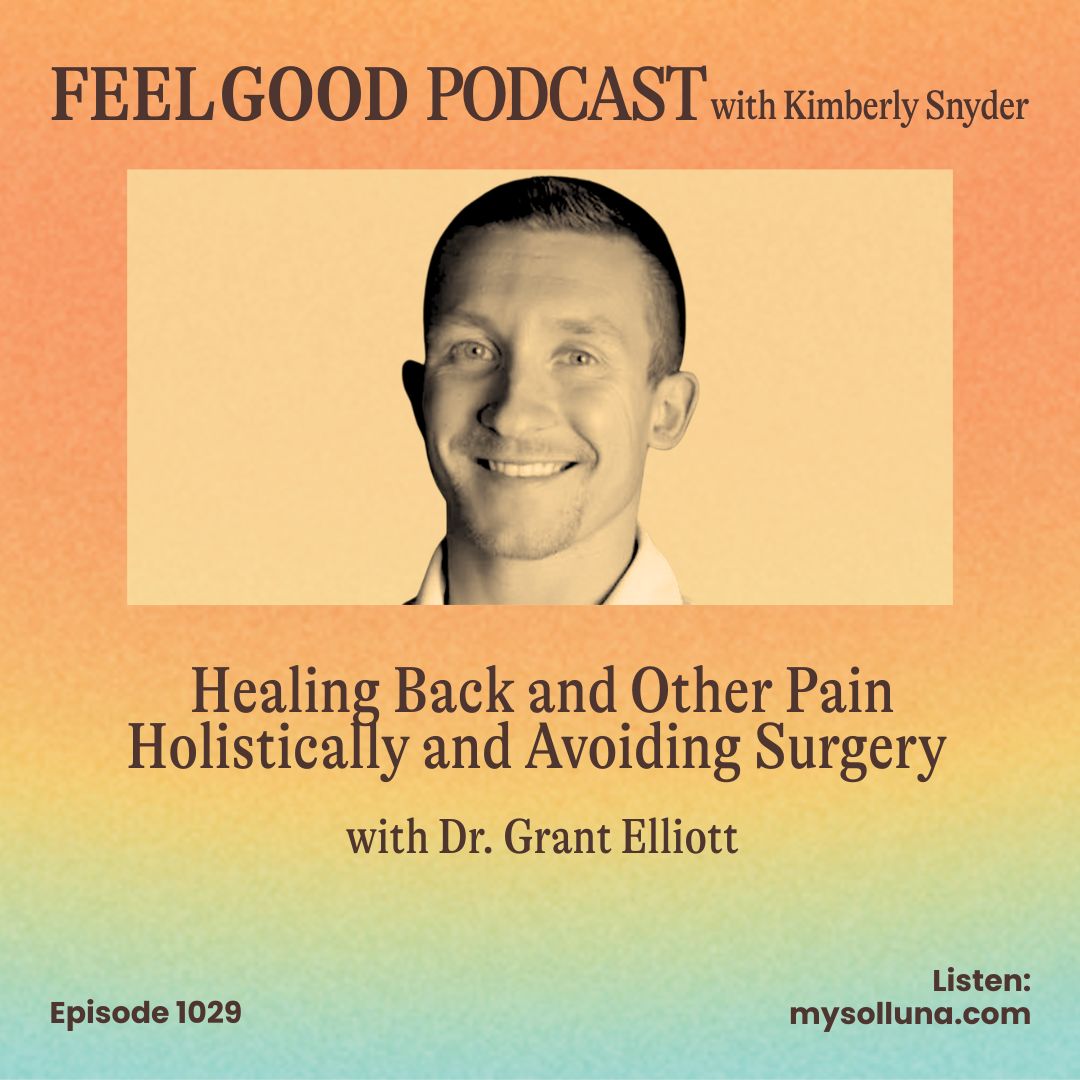
This Week’s Episode Special Guest: Dr. Grant Elliot
Episode Summary
In this episode, Dr. Grant discusses his personal journey from being a competitive athlete to becoming a chiropractor focused on pain management. He emphasizes the importance of movement as a form of medicine, the impact of beliefs on pain perception, and the need for a holistic approach to treatment. The discussion covers the complexities of lower back pain, the risks associated with surgery, and the significance of unique movements in rehabilitation. Dr. Grant also highlights the emotional factors that contribute to pain and offers insights into managing hip pain, particularly in relation to pregnancy. He concludes by providing practical advice on time commitment for pain management and resources for further assistance.
Sponsors:
LMNT
OFFER: Right now, for my listeners LMNT is offering a free sample pack with any LMNT drink mix purchase at DrinkLMNT.com/FEELGOOD. That’s 8 single serving packets FREE with any LMNT any LMNT drink mix purchase. This deal is only available through my link so. Also try the new LMNT Sparkling — a bold, 16-ounce can of sparkling electrolyte water.
USE LINK: DrinkLMNT.com/FEELGOOD
Feel Good Digestive Enzymes
OFFER: Go to mysolluna.com and use the CODE: PODFAM15 for 15% off your entire order.
USE LINK: mysolluna.com CODE: PODFAM15 for 15% off your entire order.
Dr. Grant Elliot Resources:
Website: therehabfix.com
Social: @rehabfix
Chapters
00:00 Introduction and Setting the Stage
00:13 Exploring Wellness and Nutrition
00:16 Introduction to Pain and Healing
03:21 The Journey to Chiropractic Care
06:23 Understanding Lower Back Pain
09:12 The Mechanics of Movement
12:26 The Role of Perception in Pain
15:18 Surgery vs. Conservative Care
18:22 Movement as Medicine
20:44 Understanding Pain: Beyond Posture
24:29 The Emotional Impact on Pain
29:05 The Multifactorial Nature of Back Pain
29:57 Exploring Hip Pain and Its Connections
34:14 Efficient Movement Protocols for Pain Relief
37:12 Resources for Pain Management and Assessment
[RESOURCES / INFORMATION]
SOLLUNA PRODUCT LINKS
- Glowing Greens Powder™
- Feel Good SBO Probiotics
- Feel Good Detoxy
- Feel Good Digestive Enzymes
- Feel Good Starter Kit
- Feel Good Skincare
KIMBERLY’S BOOKS
- Chilla Gorilla & Lanky Lemur Journey to the Heart
- The Beauty Detox Solution
- Beauty Detox Foods
- Beauty Detox Power
- Radical Beauty
- Recipes For Your Perfectly Imperfect Life
- You Are More Than You Think You Are
OTHER PODCASTS YOU MAY ENJOY!
- Wellness Insights: How to Listen to Your Body for Nutritional Guidance [Episode 878]
- How the Power Foods Diet helps with Weight Loss with Dr. Neal Barnard EP. 877
- How Not to Age with New York Times best-selling author Dr. Michael Greger [Episode #873]
- How to eat to reduce anxiety with Harvard nutritional psychiatrist Dr. Uma Naidoo [Episode #867]
Powered and Distributed by: PodcastOne
Transcript:
speaker-0 (00:00.257)
Welcome to the Feel Good Podcast, which is all about heart led living and wellness. When we awaken the power of our hearts and let that guide us through our daily choices and decisions, through our four cornerstones, food, body, emotional well-being and spiritual growth, we will experience the most incredible results and create more vitality, health, strength, peace, abundance and love in our lives.
I am your host, Kimberly Snyder, New York Times bestselling author, founder of Saluna, creator of the research-based Heart Aligned Meditation, wellness expert, nutritionist, and international speaker. I am passionate about supporting you on your unique heart and wellness journey. Let’s get started.
speaker-1 (00:57.518)
Hi everyone and welcome back to our Monday Interview Show. Very excited to share a conversation with you here today with Dr. Grant Elliott, who is a pain rehab specialist. He is the founder of RehabFix and he specializes specifically in back pain, sciatica, avoiding surgery. In fact, he says 97 % of people don’t actually need the back surgery that they’re prescribed.
He’s worked with many different prominent wellness and other types of people, including Dr. Andrew Huberman, helping to relieve pain through simple lifestyle practices and movement, which we’ll get into today. Now, I was interested in doing the show because I think pain is really pervasive. If you start to listen to loved ones, to friends, colleagues, you’ll start to notice a lot of people complaining about pain.
And so the strategies we talk about today are accessible and again, can be a really powerful way to avoid surgery. So I’m really excited to share today’s show with you. Whether you have pain or not, this is information that can really be useful to you and also loved ones around you. Before we get into the conversation though, a little reminder that our notes are at mysaloonit.com. We will link to our…
links and research that we talk about on today’s show, as well as other podcasts, articles that I think you would enjoy. You can also sign up for our newsletter on there to stay on top of our community happenings. We send out so much amazing information, including free recipes, promotions for our saluna digestion focused supplements, which are a really powerful way to elevate your lifestyle. Also,
Free community Zooms, we’ll have one coming up in January. I’m doing a couple of retreats next year. So it’s a great idea to come deeper into our community by joining our newsletter. I also thank you in advance for taking just a minute out of your day to leave us a review on Apple, Spotify, wherever you listen, which is an amazing way to support the show. Also by sharing this episode or the show in general with anyone that you think would benefit.
speaker-1 (03:17.57)
All right, all that being said, let’s get into our conversation today with pain specialist, Dr. Grant Elliott. Grant, thank you so much for being here with us today. I’m very excited to chat with you.
Yeah, likewise. Thank you so much for having me.
I think your work is fascinating because you’re working with a body in such an intelligent, integrated way that many of your clients are not only reducing pain, but they’re also reducing their amounts of surgery that they have to get. So I think it’s really fascinating what you’re doing, but before we dive in, I’m interested how you even were drawn to this line of work in the first place. Did you experience a lot of pain? Did you have it around you?
What did your path entail?
a few series of interconnected events. I would say the first one was, you know, growing up, me and my brothers were boys in athletics, always, you know, fitness aware, health aware, I would say. And I saw a common trend amongst pretty much all of my grandparents, which were declining health, pill for this, pill for that, injection for this, injection for that, surgery for this. And even at a younger age, I kind of observed that and I was like, you know, what if like you tried
speaker-0 (04:35.8)
getting healthy, know, novel concept. But I kind of like saw that even at a younger age. once I was in like middle school, high school, and I kind of was starting to think about what do I want to do? And I knew I wanted to go into some form of health fitness related thing. Well, when I was in high school, I was a competitive cyclist and I was doing cross country mountain bike racing and I was good. I was doing scholarship opportunities.
and I was, I was competitive. I was good. I started dealing with a little back pain and this back pain started insidiously, which is the most common way back pain comes up. Kind of we, we kind of start to notice it. We wake up with it one day and it starts to last a little bit longer, a little bit longer. And then a few weeks, a few months go by and we realize, Hey, this thing is kind of not going away. This is a majority of scenarios. And that was kind of me. It hurt the most during my races.
during my highest output, I’m gonna bend over position, pushing myself hard. And it started to get to the point where within 15, 20 minutes into my race, which they were normally an hour and a half to two hours, my low back just felt so like swelled up and pumped and stiff and achy. had to get off the course, I had to get off the trail, go into the woods, start doing some stretches in the woods to be able to get back on and continue. And I was doing that over almost every 10 minutes. And as you can imagine,
you’re not competitive anymore if you do that. So I went from winning almost every race, usually first or second every race, to going worse and worse and worse and worse and worse. And so my dad was like, hey, chiropractors, they’re the low back specialists. Let’s go see one. And what I know now is that we went to see what we would consider a old school, traditional type chiropractor where it’s the
here’s your x-ray, your spine’s crooked. You got to come see me multiple times a week. And we didn’t know any better. A lot of people don’t. And not that there’s anything wrong with that, but it’s not the most effective form of care. And which is what we’re going to talk about today. And so I did that and surprise, surprise, did not get relief, didn’t get better. So my performance continued to decline. And so I eventually just stopped racing, lost my scholarships.
speaker-1 (06:55.264)
It’s so hard mentally.
Yeah, it’s, it’s frustrating. Like with anyone, if you’re a, you know, a hundred percent into something and you’re finding identity in that and you’re viewing that as, Hey, this is going to pay for my school. Yeah. Well, you know, there’s some attachment to the hat. Um, so that was difficult and yep, that’s kind of where I found myself. And then I just had to find a different outlet for athleticism and fitness. So just started working out, just went to a gym. never had a formal gym membership. Uh, at that point I was just in sports.
So I joined a local gym, was working out, and I started to notice this one individual there who was doing unique movements, unique like warm-up drills, mobility drills, like activation drills, just unique movements that I hadn’t seen before. So I approached him, talked to him, developed a relationship, and he ended up being a chiropractor. So I made the comment to him. I was like, hey, you know what? Like, the things you’re doing, like, I’ve never seen them before, the way you talk, just the things you talk about.
seemed completely different than my experience with a chiropractor. And he was like, well, I think he should come shadow me. So I went and shadowed him. And I saw my first example of an evidence-based chiropractor, which is, you know, including rehab and manual therapies and a lot of education, movement education, helping people to become independent as quickly as possible by teaching them how to fix themselves. I witnessed that and I realized, okay, if this is what I had had,
probably wouldn’t have quit racing. I probably wouldn’t have lost my scholarships and my situation would be different. And so that motivated me to become a chiropractor to ensure that I could prevent as many people as possible from having the situation that I did. And that is what ultimately led me to this field.
speaker-1 (08:44.238)
What an amazing journey, know, the saying the wounded healer, if you hadn’t gone through those experiences, maybe you wouldn’t be so passionate about the work that you’re doing because you lived through that loss and that attachment and pain for so long.
Yeah, it definitely creates motivation to say the least. And so it was really just the drive for like, Hey, I wasn’t a success. I was a failure. And so I just want to make sure I can go into this, be the best version of this so I can help as many people as possible and reduce the number of failures. Because I quickly realized, and this applies to any profession, any profession of any kind, the majority of any profession is average.
I’m seeing all these individuals with low back pain specifically go to their general provider and get general advice and go to general chiro, chiros and general PTs and just get like, you know, kind of just generic stuff. And I was like, yeah, well, this isn’t working because low back pain is the number one disability in the world. And so that just, you know, made me put my a hundred percent focus into being a rehab evidence movement based provider for that to do my part of making a dent in it, so to speak.
So a couple of things in your story that were interesting, one is that you were a super athlete, sounded like you were training all the time and you got lower back pain. And sometimes we hear, sitting is the new smoking. So lower back pain can affect people that are very active and on the flip side, people that aren’t moving very much at all. Is that right?
Absolutely. Yeah. And, the term sitting is the new smoking. Actually not a huge fan of that term because there’s really, there’s really nothing wrong with sitting. The issue is if we stay in the same position too long and we don’t move enough, that’s the main issue. If you sit for eight hours straight and you don’t move, you don’t exercise. All right. Yeah. You’re smoking, but if you happen to sit at work throughout the day, but you take frequent breaks and you have an exercise routine and you get your walks in, then there’s nothing wrong with, you know,
speaker-0 (10:51.352)
But to your point, yes, obviously anyone who is moving more is healthier, in better shape. That’s going to reduce their incidence of injury and chronic disease and all the things that go with it. That is obviously a given, but that does not mean they’re immune to it. Not at all. And so we see two main things as know, individuals who are very active, who are pushing themselves, there’s usually common patterns that they either fell into or doing that can still perpetuate.
low back issues, can still create these symptoms to occur. And then on the other side, like you said, people who are not moving enough, who are just sitting all day, not getting the right movements, don’t have mobility routines, yeah, they’re also suffering. And what we do know is that, yes, the healthier you are, the more like you are, that the easier these things are to overcome. it’s, you know, the couch potatoes, frankly, that have the highest incidence of injury for sure. And yeah, that’s not a good recipe for any form of health.
Can you share with us anatomically, you say lower back is where a lot of people feel pain. Why is it the lower back, the couch potatoes and all kinds of athletic people versus let’s say the shoulders and the upper back since we might be looking down a lot on our phones or computers or driving. What is it about the lower back do you think?
Yep. There’s two main components here. One is a mechanical perspective and then the other one is a societal conditioning belief perspective. And so what I mean by this is one, our lower back, it’s the primary lever arm for all movement. So if I sit, that’s where majority of the force is going. If I stand and I bend forward, that’s where a majority of the leverage is going. If I’m reaching out to, you know, pick something off the ground or catch something that’s still pulling on my lower back, it’s the
It’s a primary lever arm. We use it for everything. It is involved in every position. So therefore it has the most amount of stress on it. Now, one thing I want to say there is don’t hear what I’m not saying. I’m not saying that stress is bad for your lower back. Stress is good for us. Stress is good for our muscles, for our bones. When our muscles are under stress, they grow and they get stronger. When our bones are under stress, they grow and get stronger. When our low back is under stress, it can still grow and adapt and get stronger.
speaker-0 (13:12.46)
It is still a primary lever and it still is stressed the most. You combine that with a societal belief, a societal narrative that’s very, very negative about lower back pain and that creates the number one disability in the world, which it is. 80 % of human beings alive will experience low back pain at some point in their life. It is the number one disability. It costs over $100 billion in healthcare expenses and everything. It’s massive. It is massive.
What I mean by the second point there is if someone, let’s just say hurts their elbow, they’re telling their friends, they’re telling their family, nobody’s freaking out. They’re probably just saying, that sucks. I’m sure it’ll be better in a week or two. Right. You know, it’s, no big deal. But the belief system, the narrative about low back pain is such that as someone says, I hurt my low back, then people are responding. my gosh. Should you go get imaging? my gosh. My.
My aunt Susie got a back issue and she was never the same for 10 years. She’s using a walker now. She didn’t get surgery. It’s there’s all these really, really negative narratives about lower back pain because it’s so misunderstood. So well, people don’t realize is pain is common. And to a certain extent, pain is normal. It’s a part of the normal human experience, but it’s how we interpret that pain. And it’s what we do with that pain that determines
where we go and determines the level of disability and suffering we might occur. So, yeah, somewhat out there, let’s say for the last 10 years, they’ve heard all these horror stories about people and their family who dealt with low back issues or their friends, families who dealt with low back issues. Let’s just say that’s ingrained in their mind of, my gosh, back issues, super bad, super serious life altering. And that’s ingrained in their mind. That’s their belief system. Okay, now let’s take a very normal incident. Someone is,
let’s say moderately active. And then there’s a particular day where they’re working in the garden two extra hours. They sit at work a couple extra hours. They’re not moving as much as they normally would have. They have had a really stressful week. They ate maybe a few more inflammatory foods than they otherwise should have. And then, my gosh, I gotta go, you know, move all these boxes, help my friends move. It’s a lot of work that maybe their lower back is not used to. And they go to bed and they wake up and…
speaker-0 (15:39.278)
They’re a little back sore. No big deal. No big deal. But because of their belief system, what they’ve heard for years, they take that very normal, very common experience and they catastrophize it. It’s, my gosh, it’s doomsday. I just woke up and I’m experienced back pain. This is bad. I need to run to the hospital. I need to run to my doctor. I need to run to imaging.
option.
It’s the perception and that creates an avalanche and a spiral that people get trapped into and it leads them to the wrong forms of care extremely quickly. And that’s what turns it into a chronic issue.
speaker-1 (16:27.872)
Even in these winter months, hydration cannot be forgotten. We don’t want our skin and hair to become dried and frayed and for our energy to start to lag. Hydration is about water and also electrolytes, which need to be replenished regularly. You can do that through your diet and also by the insurance of drinking a daily element electrolyte pack. This is something I do as part of my morning practice. Now, in the morning when I drink my room temperature water,
I add a element packet in, usually watermelon or raspberry, which are my favorite flavors. And what I find is that it supports consistent energy. It wards off fatigue and it helps my skin to glow. I love the element brand because it contains a science-backed mix of magnesium, sodium and potassium. It doesn’t have added sugars or fillers or preservatives. And right now for our amazing community to get in on this.
Element is offering a free sample pack with any Element Drink Mix purchase. Please go to www.drinkelement.com slash feelgood. That’s eight single serving packets for free with any Element Drink Mix purchase. That’s www.drinkelement.com slash feelgood.
We are not what we eat, we are what we digest. And to support you each day, Saluna’s Digestive Enzyme Supplements support your highest levels of health and beauty and youthful vitality, which is really the life force running through you, your aliveness. Created to aid the body’s natural digestive process, these unique digestive enzymes work directly on the food you eat to help break down macronutrients, protein, fat, and carbs, and fiber.
into a form that can easily pass through your digestive system and be utilized by your body to benefit your health and beauty. In other words, these saluna digestive enzymes save your body energy, which over the long term helps to preserve your own life force and keep you youthful. Key benefits and ingredients include enhancing digestion and assisting in the absorption of critical nutrients, delivering two to three times more lipase versus other top formulas,
speaker-1 (18:49.784)
for optimal fat metabolism, including specialized enzymes to help break down plant fiber, helping to reduce bloating, gas, and other sources of digestive distress, providing powerful anti-Candida enzymes for faster healing and detox. Please go to mysaluna.com and use code PODFAM15 for 15 % off your entire order, including these amazing digestive enzymes. Once again, that’s mysaluna.com with the code PODFAM15.
MySOLLuna.com, code PODFAM15 for 15 % off your entire order.
speaker-1 (19:35.63)
It’s also kind of scary how, I don’t want to say knife happy or prone to recommending surgery. A lot of doctors are right off the bat. I have heard, I know people who have gotten back surgery and it said that they said it didn’t really help their pain. They still had the same issues. But to your point, when you perceive that something’s really scary and wrong, you can be more susceptible to agreeing to surgery without exploring some of these other means. And that is
Oof, that is pretty scary.
Yep. So we’re the number one online low back program in the world. We have over 200 consultations a week with people all over and we get clients every single week who have had one to three surgeries already on their lower back and are in the exact same position or worse positions. Wow. And if we look at what the evidence shows, the evidence is really clear. They call it the third, third, third rule. The goal of a good surgeon is that 30 % of the individuals that undergo low back surgery
would be deemed success, which just means their outcomes improve. 30 % of people improving is a good goal. About 30 % will stay the same. No change, just as much pain, no change. But now they’ve undergone an irreversible procedure. Yeah. And then about 30 % will be worse. So when we average these out, the failure rate is around 50 % or more.
my god.
speaker-0 (21:04.204)
And then what we see is that with every consecutive surgery that is performed, the risk of chronic pain and the outcomes only go down. They get worse and worse and worse with every consecutive surgery. But how does this contrast with what the evidence shows us? And this is why it’s so important to understand the evidence and to be an evidence-based provider so that you can have the knowledge and be equipped to make the right decisions. We know that
97 % of lumbar disc herniations, which is one of the most common lower back issues that are operated on, 97 % can recover without surgery. No surgery needed. Wow.
the movements that you were talking about.
Yes, conservative therapy. only about 3 % of people with painful lumbar disc herniations will require surgery. But I’m telling you this, there’s no way, there’s no chance if you take the average percentage of lumbar surgeries performed across the world, there is no way it’s 3 % of individuals. It is way more than that. Way more. So, surgeons are performing surgeries that are not indicated.
Surgeons do not know the clinical indication for surgery, which is crazy to think about, but a lot of them don’t. And yeah, it’s, you know, this is what I do. This is what I get paid to do, which there’s nothing wrong doing what you get paid to do. There’s nothing wrong with that. But if, you know, they’re not taking into consideration clinical protocols and clinical indications and any MRI they get, that shows a disc, regardless of if the disc is symptomatic or not, they’re saying, hey, it’s my job to cut this out.
speaker-0 (22:39.384)
then we’re gonna get a lot of really, really poor outcomes. And this is what we’re seeing in healthcare.
Wow. So going back to, I like this phrase you used earlier, unique movements. And in our society, the way we move is very linear front and back. You mentioned you having a healthy lifestyle moving in general. Some of your videos on your Instagram channel are unique. And I think, know, interesting, but also a lot of them are quite accessible. There’s some
circular movements, there’s different ways in which we move. So can you talk a little bit about your philosophy? I know there’s so many different exercises, but moving with in unique ways and how that can help the pain.
Yeah, here’s the most important and easiest lesson we can, you know, describe in a verbal format. So first and foremost, we all need to understand that movement is medicine. Movement is medicine. Now, with that being said, different movements are different forms of medicine. There’s going to be certain movements that are beneficial to someone, and right now I’m primarily talking about people who have pain.
They have sciatica, they have a disc herniation, they’re symptomatic. Certain movements will make them feel better and certain movements will make them feel worse. So movement is medicine, but different movements are different forms of medicine. And we want to find the right medicine for that person at the right dosage and at the right frequency. Just like your pharmacist would do for an alternative condition, you want to treat movement the same. So yes, movement is medicine, but just understand
speaker-0 (24:19.448)
my gosh, I tried movement and I’m flared up and I’m worse and my gosh, movement won’t help me. That is not true. That is not true. You have to find the right medicine, just like you would for any particular condition. Now, with that being said, the easiest way to evaluate one’s movement is to think, okay, what are we doing the most of throughout our day? We need to think about this. So for a majority of individuals, they’re going to fall into a category where we are sitting most of the day, which once again, there’s
Nothing inherently wrong with that. It’s if we don’t do anything about it that creates the issue. But if we’re sitting most of the day, think about the position that that puts our body in and various joints. So most of us are probably sitting right now. Let’s think about this. Your knees are bent. Your hips are flexed, meaning your knees are closer to your torso. So there’s a short angle in your hip flexors.
Your lower back is probably rounded forward. Your mid back is probably rounded forward. Your shoulders are probably rounded forward. This is a position the majority of us are going to be in. So here’s how we think about it is if that is the position that our joints and our muscles are getting the most of throughout the day, we want to do the opposite of those motions to undo the stress and the forces that are placed on them.
It’s like, I’m, imagine I’m bending, this might be a silly example, but sometimes silly and basic examples work the best. Imagine there’s a moldable piece of aluminum, let’s say, okay? And we’re kind of pushing it one direction. We’re pushing a little bit more, a little bit more, a little bit more. And it’s slowly bending to the side. You’re thinking, okay, that piece of aluminum, that’s not very straight anymore. How do we straighten it back up? By bending it the other way. So,
If our low back and our hips, let’s say, if they’re getting a whole lot of one motion, one motion, one motion, one motion, a majority of the day, you’re putting stressors on that that are, you know, might eventually put it in a position where, hey, we can’t tolerate this anymore. So we got to start to bend it back the other way to get it straight. And that’s the concept of doing more of the opposite, doing more of the opposite. So if my low back is in a flexed, rounded position most of the day,
speaker-0 (26:37.144)
I need to do more of the opposite. need to stand up straight. I need to put my back in an extended position. I need to get on the floor, perform a Cobra pose for repetitions, get my back into an arch position. I need to do extension-based movements in the gym for my hips. Okay, if my hips are in a flex position, same thing. I need to get more hip flexor stretches. I need to do hip extension-based movements. I need to do glute motions that involve pushing my hip into extension. This is gonna do the opposite.
reverse the motions that are being overdone on these regions to help undo a majority of the stress. And so there’s many different movements that can satisfy this protocol. But the easiest way to look at one’s situation, because remember, people have different lifestyles and they might be in different positions throughout the day, is if you can analyze your body and think, okay, what position are my joints in eight hours a day, start to do more of the opposite.
You mean while you’re so there’s the movements that are the opposite. But what about grant our posture and manipulating how we’re sitting for those hours? Is that part of your protocol too? Well,
Not necessarily. Because if we look at the evidence, we know that the evidence does not support a causational relationship between posture and pain.
Really? That is interesting.
speaker-0 (27:57.302)
Yep, doesn’t exist. Posture is very commonly a narrative that is inappropriately pushed on a lot of people and is blamed when it otherwise should not be. posture, think about it this way. If I’m sitting down, if I had been forward and I had been back, I was just in like 30 different postures. A posture is just one position at one moment in time. To take someone’s entire pain experience and to stamp the label, it’s because of your posture.
is a huge disservice, it’s incredibly negligent to your job as a healthcare provider and to the person who’s dealing with pain. Because here’s what I mean by this. Pain is influenced by so many things. Yes, it’s influenced by mechanical stressors, what we’re doing and what we’re putting on our body throughout the day and the positions we’re in. But also it’s influenced by interpersonal relationships. It’s influenced by stress at work. It’s influenced by diet. It’s influenced by sleep.
It’s influenced by our belief systems. It’s influenced by all of these things. So if someone has, you know, situations where it would involve multiple facets and we take all those things, we don’t analyze their sleep. We don’t analyze their lifestyle. We don’t analyze their emotional impact. We don’t analyze their belief system. We don’t analyze anything. We don’t analyze their exercise. We don’t analyze their movement. Nothing. And we go, yeah, your back hurts because your posture. man.
That’s one of the worst things you could tell someone because you’re isolating them into a box. It’s fractured. Yeah, you’re segmenting them. You’re fracturing them. And so if you’re labeling them with that, and so now the only thing they’re doing is, you know, obsessing about their posture, but all these other things are occurring in their life. They’re movements off. They’re not getting the right movements. They are getting bad sleep. They have bad to all these things. And that’s not being adjusted. Then they’re going to stay trapped in this box for a really, really long time.
Wow.
speaker-0 (29:51.95)
So we don’t want to make that mistake. So posture is only important in the context of being aware of the position you’re in too long. So if I sit in a bent position for a really, really long time, that is one posture I’m in for too long. That’s not going to feel good. But also if I sit perfectly straight, shoulders back, my gosh, I look beautiful. Okay. If I stay in that position for a long straight, that’s not going to feel good either.
We don’t want to be in any one posture for too long. We want to be in as many different postures as possible as frequently throughout the day because the best posture for you is the one you’re in for the next five minutes.
It was really interesting too. You just mentioned talking about emotional impact or state. Do your clients self-report that, saying, you know, I’m feeling frazzled or I’m going through a lot of turmoil in my life? How do you measure that?
Yeah, this is more of a delicate concept because some people don’t believe that emotions, stress, mindset can play a in their pain. Some people don’t believe that. They might interpret that as being, you’re telling me the pain’s in my head. And we say, no, but also, yes, 100 % of our pain.
is created by our brain. All pain is created within your brain. All pain is real. Pain is an experience. So one, people might have a belief that, these things aren’t involved, so don’t even suggest that to me. And that can become a bit of a friction point, if you will. Other people might agree with that, but might be withholding that form of information. There could be a certain level of comfortability that might be needed to disclose those things. So the manner in which
speaker-0 (31:49.058)
we can breach these topics needs to be delicate. So there’s usually a few signs or symptoms that we can identify that usually relate to more of an emotional origin or a stress origin or a mental origin related to it to some capacity. There’s many different variables when I say mental origin. There’s many different places. But if we hear some things that we think could be related, then
some very, very simple questions that could open some doors could just be, hey, do you notice more pain at work? Okay, well, they’re going to say yes for one of two reasons. Either one, because the position they’re in while they work actually increases their pain, or just the environment they’re in increases emotional stressors, increases mental stressors, and therefore that increases their pain. And we can identify that through a little bit of questioning. If not, we might say,
Is your pain worse at home? Maybe they feel completely fine at work and maybe they’re sitting at work and then they go home and sit and they’re not fine. Why would that be? Is there something about your home environment that causes increased emotional stress or anxiety or things that relate to that? Outside of that, additional questions are, when this pain began, was there anything substantial that changed in your life? That’s an open question. Other deeper questions could be,
Has anything significant happened recently to any close friends or close family members? And there are many scenarios where a loved one to any capacity was either in an accident or was very ill or passed away. And that was in direct relationship with that individual’s pain experience. And once we were able to identify that and relay that education and help the individual realize that, that sort of autonomy
over their pain experience and that understanding and feeling independent and more in control. That was all they needed to start the healing process. That can be very powerful.
speaker-1 (33:54.03)
It’s so powerful because people do fracture. Like we said, there’s a lot of specialists that are like, well, I only treat, you know, your nose and throat and forget about everything else or only your liver, only your bones. But seeing we’re whole beings, right? And we have the mind, we have emotions, we have the physical body and they do interplay and they do, they do affect. And there’s so many studies now, seeing how stress affects hormonal regulation, affects digestion. So it makes sense that
different factors, it’s multifactorial when you’re looking at back pain. And I’m really happy to hear that you’re taking that holistic approach, which some practitioners don’t, obviously.
Yep. It’s, you look at back pain as a whole, 90 % is called non-specific low back pain, which is exactly what, you know, that the title says non-specific. You cannot trace it back to one specific thing. And that’s not to say that there can’t be a clear mechanism of injury for low back pain. Like a really common presentation is, you know, we’ll work with someone who’s active, common gym goer. They might have done a heavy squat, done a heavy deadlift, or maybe they just…
Maybe they weren’t working out, they’re in their home and just bent over to pick up their phone and they felt a pop in their lower back or it seized up. And now they’re speaking with us. Yes, in that scenario, you might think, that seems pretty specific. It was that one thing they did. But even in that scenario, it’s not that clear cut. Yes, that tells us the mechanism of injury. But we have to trace the steps back to, well, why did that thing create the injury? And then we have to look back at
everything else that we’ve discussed up until this point. is nonspecific. It’s multifactorial. There’s many, many different things involved. So looking at those things, figuring out what might be missing, and then combining that with the proper rehab plan that does address the actual joints, muscles, disc, nerve in the way that they need, that’s the recipe.
speaker-1 (35:53.528)
Sounds like a good recipe. So, Grant, thankfully, not going to go here, I don’t have lower back pain except for when I was pregnant twice, right? I think that’s pretty common in women. But I have experienced hip pain, and I believe that’s fairly common in women, and I don’t know if that’s related to the lower back and the other factors you were mentioning, if there’s a relationship, if it’s separate, if it also has to do with hamstrings. Can you share a little bit about hip pain?
Yeah. First off, pregnancy is a very, very common period of life for low back, hip or sciatica induced pain. There are things that you can do to manage symptoms in the later stages of pregnancy. But this is a really common onset. There’s obviously a lot of stress and a lot of changes going on within your body. you can find symptom management. You can find significant symptom reduction. It’s usually difficult.
Let’s just say, for example, like my wife, I’ve had three young kids. I got a four year old, a three year old and a seven month old. And my wife, you know, I’m the low back guy, but even still she developed on and off sciatica around, you know, month seven, month eight, you know, month nine. At that point, there’s only so much you can do. There’s still a lot you can do, but there’s only so much you can’t, you know, eliminate it. There’s stresses going on in your body. So.
The main reason for this is not only the force distribution within your body, but then of course the hormone relaxin that relaxes all of your ligaments, increases ligament laxity as a whole, joint laxity throughout your body that can therefore create pain in various places. So the pelvic floor is related to this as well. Pelvic floor strength, pelvic floor integrity, that relates to your hip and the low back relates to your hip. Two things that are affected during So when we look at the hip, we look at above and below.
We look, okay, what does the ankle do? What does the knee do? What’s the integrity of the pelvic floor, especially as it relates to women primarily who have gone through labor and then the low back, the low back and the hips, they’re like best friends. If one isn’t happy, usually the other one isn’t either. So really the two main things to look at in any area of the body, but primarily the hip would be, okay, is there a joint restriction? Is there a position of your hip that you’re not getting enough of? Is the joint itself essentially locked up?
speaker-0 (38:19.534)
and not going a direction otherwise should be. And then what is the stability of the hip as a whole? That would be impacted by muscular strength and muscular function in different ways. So usually we see a few common patterns of the type of stability that’s missing. So to keep things super generic, if someone has hip pain, we want to focus on the lower back because that’s a relationship. We want to rule out the lower back, make sure the lower back is not referring to the hip. And then once that
Okay.
speaker-0 (38:49.568)
is checked, okay, then we’re focusing on the mobility of the hip that is primarily deficient and then stability of the hip that is deficient. And that’s sort of the blueprint approach to addressing hip pain.
I remember I went to see a, not a chiropractor grant, but a fascia specialist and he was having me do clam shells to try to stabilize the hip. You’re smiling. didn’t probably, a bit basic.
Well, it’s all relative to where the person is at. I clamshells are very basic exercises. It’s this minimal load. But if the individual performing them cannot tolerate more load than that, then it would be appropriate for that situation. The only issue is a majority of individuals who are given that exercise, they can usually handle more load than that. The vast majority of individuals dealing with pain are significantly under loaded, which means not enough weight is placed on their body, not enough
like stress is placed. So imagine I’m in the gym and I’m double curls with one pound. That’s not going to do anything. I should probably do more weight than that. So that’s load. So if we look at a healthy individual who’s remotely active, clam shell is not going to be enough load most of the time.
Yeah. Okay. So if someone’s listening to this and they’re interested in learning about these movements and they’re also saying, which to be honest, I say to myself, Hey, you know, I’m a pretty busy working mom. How much time would I need to a lot? And of course the, you know, the higher the pain, you’re, you’re, you’re more willing to do more. But in general grants, someone’s doing your protocols, seeing your videos, doing, you know, going on your website, making consultations.
speaker-1 (40:34.702)
How much time in general, I know this is a really blanket statement, would one have to dedicate to these movements?
You shouldn’t be dedicating more than 10 to 15 minutes a day if you have the right plan.
Wow, that is not what I expecting her to say. That is amazing. 10 to 15 minutes. Okay, sign me up. That is, it’s precise, it’s specific, and it’s effective. You don’t need more time than that.
Think about it this way. I used an analogy earlier of movements medicine. You got to find the right medicine. imagine if I walked into a pharmacy and I was like, I don’t really know what I’m dealing with, but I got symptoms. I don’t really know the names of these medications or what they do, but I’m just going to kind of take everything and like walk around and guess. Okay.
That’s what it’s like for a lot of people dealing with back pain or other pain who are just searching the internet for various exercises, trying random things. That’s what they’re doing. Now, once again, movement is good. Movement is good, but movement is medicine. And if you have pain, you will do movements that hurt. You will do movements that are better. You’ve got to identify the right ones. So what we do is we help someone accurately identify their situation. We walk into the pharmacy, know, theoretically, we’re not actually doing this.
speaker-0 (41:56.994)
We clear all the shelves and we say, yep, these are the two that you need to take the first week. These are the two. This is how often, this is how many, just do that. So now we have the most targeted approach towards that specific condition. So they’re not wasting their time doing 30 minutes, 60 minutes, two hours of stuff that is not specific or targeted to that particular issue. So when you have a very, very targeted approach, you can do a lot less and get way more significant of a result. once again, don’t hear what I’m not saying. I’m not saying people can be super healthy for the rest of their life, only 10 minutes a day. That’s not what I’m saying. I’m saying if we have pain and you have a rehab plan, 10 to 15 minutes is all that’s necessary. But of course, when we get people healthy and they can get back into the gym and do things, obviously we want to spend more time exercising and moving and investing into our health.
Yes, of course, it’s the whole lifestyle. Like we said, sleep and food and everything. are you saying, Grant, I can put some weight on my knees and keep doing my clam shelf?
Yeah, you can load yourself up. Put a barbell on your back, rip a barbell off the ground. Do some weight, baby. That’s good for everybody.
So, Dr. Grant, thank you so much for sharing your wisdom with us. I love your holistic approach and the evidence-based and the fact that you’re including emotional well-being and the specific, the targeted, pain from a very wide palette. So where can we learn more about your work? And if someone’s interested in doing your program, where do we go?
speaker-0 (43:40.398)
So you can find me and my team and all of our content searching RehabFix on all platforms. I’d like to provide anyone listening or watching is if you go to my Instagram,And you just message us the word podcast. Nothing else. Just message us the word podcast. I will actually send you a do it yourself assessment, which is a process that we normally take our one-on-one clients through. And this isn’t shared anywhere. This isn’t posted anywhere. This is only going to be exclusive to the people who listen to this podcast where you just message the word podcast. I’ll send you a video. It’ll take you through a do it yourself assessment. I’ll walk you through the tests you should do. I’ll walk you through the exercises you should do. And the majority of people see real time diagnosis, real time relief during that so that you can get a direction where to go. And of course, at the end of it, if you want more help and a more plan based on your findings, you’ll have the opportunity to reach out for us for that.
pain reduction and also as we just spoke about reducing unnecessary surgery. So please share the episode. Please go to mysolluna.com for the show notes. We will also link directly to Dr. Grant’s website and his handles. And you can also find me on Instagram at at underscore Kimberly Snyder. We will be back here in just a few days. So till then take great care and sending you all so much love.
0 Comments