
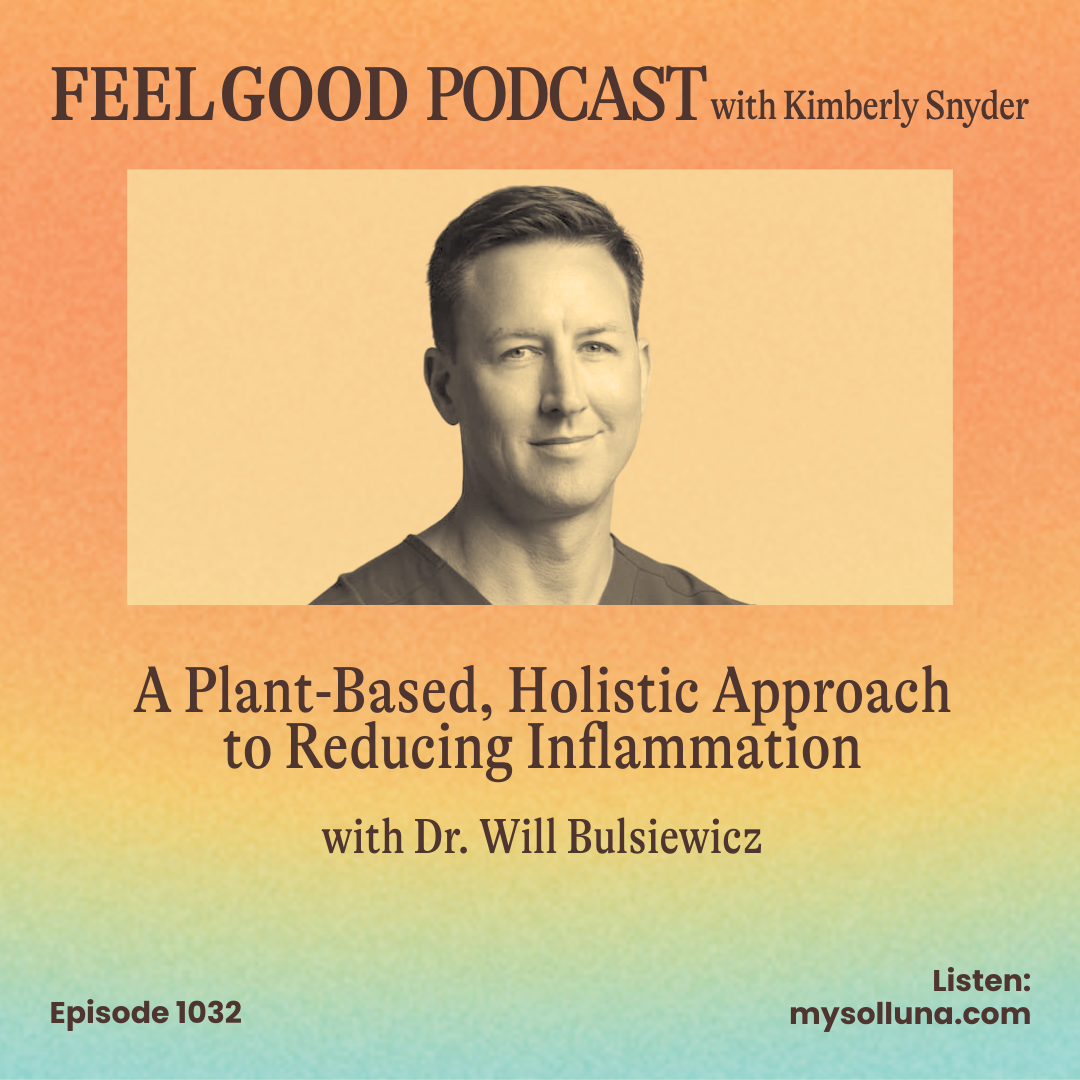
This Week’s Episode Special Guest: Dr. Will Bulsiewicz (known as Dr. B)
Episode Summary:
In this episode, Dr. B discusses his new book, ‘Plant Powered Plus,’ which delves into the multifactorial nature of inflammation and the importance of a holistic approach to health. He emphasizes the interconnectedness of gut health, lifestyle choices, and emotional well-being, while also addressing the confusion surrounding dietary guidelines and the role of plant-based nutrition. The discussion highlights the significance of personal journeys in healing, the impact of circadian rhythms on health, and the importance of addressing root causes of health issues rather than solely relying on medications. Dr. B. shares insights on the role of coffee and alcohol in gut health, encouraging listeners to embrace a balanced and informed approach to their wellness journey.
Dr. Will Bulsiewicz Resources:
Website: theguthealthmd.com
Book: Plant Powered Plus: Activate the Power of Your Gut to Tame Inflammation and Reclaim Your Health
Social: IG: @theguthealthmd, TikTok: theguthealthmd_
YouTube: @theguthealthmd
Bio: Will Bulsiewicz, MD MSCI (known as Dr. B), is an award winning gastroenterologist, gut health expert and New York Times bestselling author. He received his medical degree from Georgetown University and a Master’s in Clinical Investigation from Northwestern University. He earned the highest clinical honors in both his residency at Northwestern and his gastroenterology fellowship at UNC—recognition reserved for the top physician in each graduating class. He also completed an NIH-funded fellowship in epidemiology at UNC.
He has authored more than twenty five scientific papers, his work has been cited more than 5000 times by other scientists, and he has delivered numerous keynotes as well as briefings to Congress, the USDA, and the NFL Alumni. His books Fiber Fueled and The Fiber Fueled Cookbook have over 500,000 copies in print and are translated into 20 languages. His highly anticipated third book, Plant Powered Plus, is scheduled for publication on January 13, 2026.
He lives in Charleston, South Carolina with his wife and four kids and offers free resources at theguthealthmd.com.
EPISODE SPONSORS:
Solluna SBO Probiotics
OFFER: Go to mysolluna.com and use the CODE: PODFAM15 for 15% off your entire order.
USE LINK: mysolluna.com CODE: PODFAM15 for 15% off your entire order.
Chapters
00:00 Introduction and Book Overview
02:10 The Multifactorial Nature of Inflammation
06:19 Personal Journey and Healing
10:04 Holistic Health and Connection
12:31 Navigating Dietary Confusion
18:06 The Importance of Gut Health
20:29 Four Essential Elements for Health
25:45 The Gut-Immune Connection
30:18 Inflammation and Fertility
32:41 Addressing Root Causes of Health Issues
36:02 The Role of Medications and Lifestyle Changes
39:19 Circadian Rhythms and Gut Health
53:52 Coffee, Alcohol, and Gut Health
[RESOURCES / INFORMATION]
SOLLUNA PRODUCT LINKS
- Glowing Greens Powder™
- Feel Good SBO Probiotics
- Feel Good Detoxy
- Feel Good Digestive Enzymes
- Feel Good Starter Kit
- Feel Good Skincare
KIMBERLY’S BOOKS
- Chilla Gorilla & Lanky Lemur Journey to the Heart
- The Beauty Detox Solution
- Beauty Detox Foods
- Beauty Detox Power
- Radical Beauty
- Recipes For Your Perfectly Imperfect Life
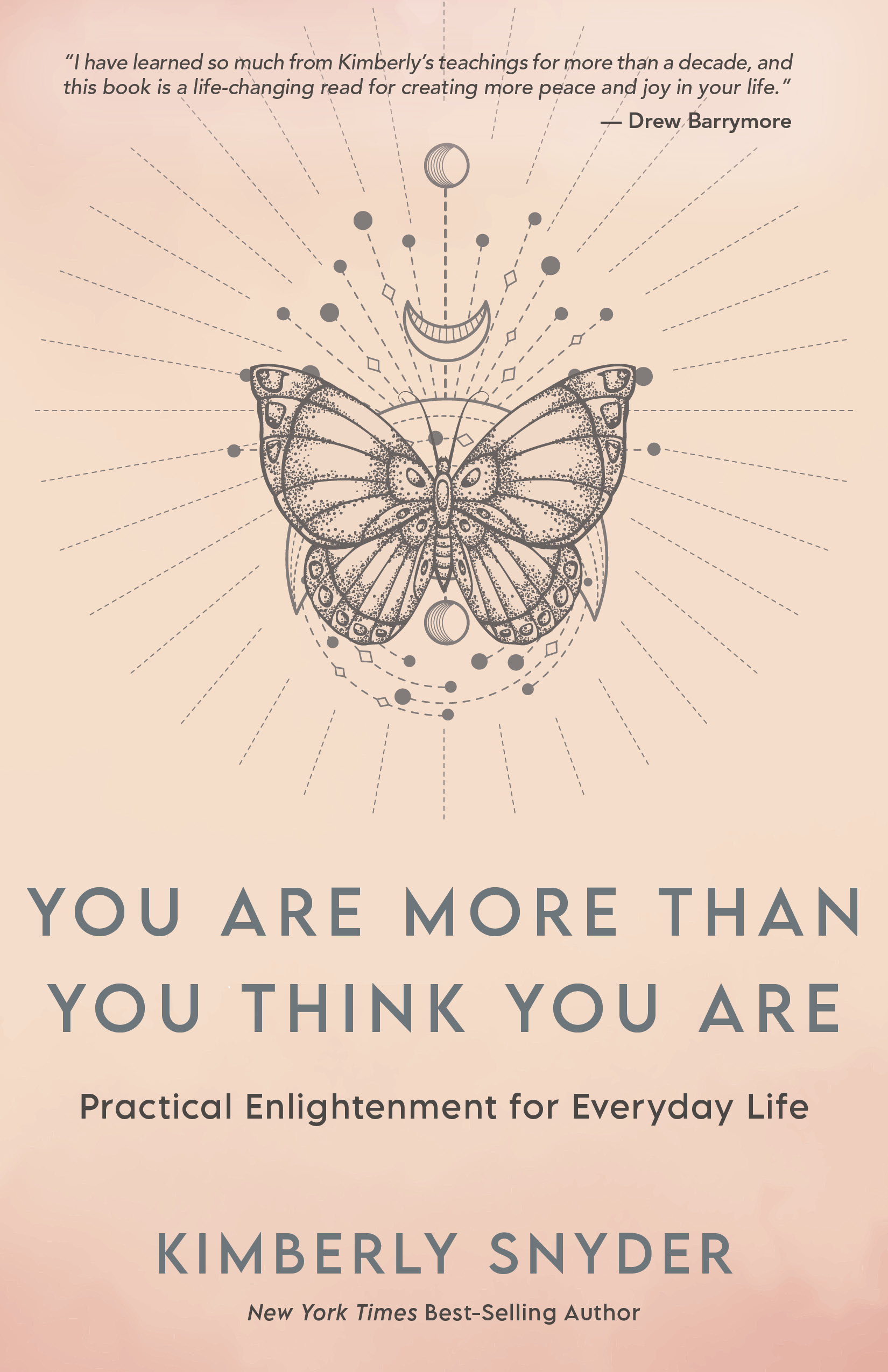
- You Are More Than You Think You Are
OTHER PODCASTS YOU MAY ENJOY!
- How the Power Foods Diet helps with Weight Loss with Dr. Neal Barnard [EP. # 877]
- How Not to Age with New York Times best-selling author Dr. Michael Greger [EP. #873]
- Simple Ways to Use the Power of Herbalism in Your Daily Life with Rachelle Robinette [Episode #1026]
- The Importance of Nitric Oxide and How to Optimize our Body’s Production of it with Dr. Nathan S. Bryan [EP. #1022]
- Heart Healthy, Plant-Based Eating with Dr. Jenneffer Pulapaka [Ep. #1021]
- The Science of Longevity: Plaque Heart Scans, Cancer Screening, Glutathione & More with Dr. Julianna Lindsey [EP#1018]
Powered and Distributed by: PodcastOne
Transcript:
Kimberly (00:00.686)
Hello and welcome back to our Monday interview show. I’m really excited to share my conversation with Dr. Will Bulsiewicz, also known as Dr. B, who is a plant-based gastroenterologist. He’s the New York Times bestselling author of Fiber Fueled. He happens to be a dear friend of mine who has come to my house several times and we have a very brother-sister-like relationship.
And he has a new book out called Plant Powered Plus. Activate the power of your gut to tame inflammation and reclaim your health. So in this new book, he’s focusing on inflammation. He and I share a great passion for the real power of plants and a plant-forward diet. Whether you’re fully plant-based like Dr. B and I, or you are adding more plants to your diet in general, there’s so much power in eating this way.
as we’ll talk about in today’s show. I also want to call out if you are interested in this topic of inflammation gut health, if you aren’t aware, my brand, Solluna has an amazing line of digestion-focused supplements, which are aligned with nature and backed by science. Our SBO probiotics, for example, have proper ratios and strains. They’re hardy enough to get through your stomach acid to implant in your gut.
And I can’t tell you what a difference these supplements have made in my life personally, detoxing the digestive enzymes as well to make sure you’re getting the maximum amount of nutrition from your food and reducing bloating, getting rid of aging waste. So please head over to mysalunawith2lz.com to check out our amazing line of digestion focused supplements. All right, all that being said, let’s get right into our show today with Dr. B.
Kimberly (00:01.64)
Dr. B, Will, my dear friend, repeat podcast guest, welcome back and congratulations on your new book.
Dr. Will Bulsiewicz (00:11.33)
Thank you, Kim. It’s always a pleasure to be with you and your audience. So thanks for having me.
Kimberly (00:16.628)
And this is your third book, if I’m correct? it?
Dr. Will Bulsiewicz (00:21.294)
This is my third book, baby. It’s hard to keep track of because we have four children at home and then I have three book babies. So yeah, this is my third book, baby. First was Fiber Fueled in 2020, the Fiber Fueled Cookbook in 22, and then here we are Plant Powered Plus in 2026.
Kimberly (00:36.48)
I feel like it’s been this journey, know, collectively in your career and also between you and I, I feel like we met around when your first book came out. And I think that’s when you first came on the show and we connected on so many different levels, sharing, of course, our passion for plant-based eating, for fiber. So we’ve been on our own little journey now six years.
Dr. Will Bulsiewicz (01:03.276)
We have, and it’s a beautiful journey. And I love that. You’re like a sister to me. You have lot of that. I don’t have any actual sisters in my life. So you sort of helped to fill that void. But also I feel like as I look at your career, it’s actually played out. You’re a little bit more advanced than I am on some levels. But the way it’s played out for you feels a little bit similar to me, which is that you started off really nutrition oriented.
Dr. Will Bulsiewicz (01:33.42)
And then the conversation expanded and grew into other places. And that’s kind of where I’m at now is of course, I’m going to talk to you about nutrition. And do I think it’s important? Of course, I think it’s important. It’s really important, but it’s not the only thing.
Kimberly (01:35.753)
Yes.
Kimberly (01:48.168)
Yes. I felt that in this new book, which we’ll get into right now, The Plant Powered Plus, and you’re really talking about this huge topic, which is so pervasive and multifactorial inflammation. And I love how you get into in this book, lifestyle so much, which we’ll talk about circadian rhythms, meal time, stress, lifestyle, connecting to purpose.
Because like you said, it’s not just this narrow granular approach that’s going to heal us, but this whole body, whole being, whole heart, whole soul approach, which is so important for it to be sustainable and work.
Dr. Will Bulsiewicz (02:29.122)
You know, one of the things, a hundred percent. And one of the things that I love about when you and I get to connect is that we come from our own sort of angle into the conversation, but we end up meeting in the same place and we might have our own ways of, of like understanding how we got there, but we’re using the same language, the same words to talk about the same paths to healing.
Kimberly (02:58.089)
Yes.
Dr. Will Bulsiewicz (02:58.862)
And, you know, I think some people have been surprised Rich Roll was taken aback by some of the things in my new book, because he’s like, I really didn’t expect, like as a scientific guy, I really didn’t expect you to go into some of these places. But you know what the truth is, Kim? Everything that has been taught to us by traditional medicine, everything that you’ve been talking about for years, ahead of the curve.
Kimberly (03:24.512)
Mm.
Dr. Will Bulsiewicz (03:27.732)
science has validated. And the pathways, the physiology, which I, of course, I’d love to see and I love to talk about and we can talk about today. The pathways are now proven. So things that people used to dismiss years ago as being, that’s like kind of woo woo, right? Here we are today. This is real. These are real conversations about healing. And I can show you the exact physiology.
Kimberly (03:30.335)
Yes.
Kimberly (03:48.534)
Yeah.
Dr. Will Bulsiewicz (03:57.816)
that involves the brain and the gut and the hormones in between that explains how these different things affect our life.
Kimberly (04:07.112)
I love how you chose to write this book in terms of a lot of health books feel very disruptive. You can’t get through a sentence without all the different footnote, you know, numbers and just parentheses. And instead you write a chapter and then with confidence you say at the end, there’s 428 citations to support this material. It’s all on the website.
And I found that so refreshing. I could actually read the book and glean the subject matter. I think that’s what makes a lot of health books hard to read is there’s just so many references. For the average person, it becomes confusing and it dilutes the message. So there’s a real power in how you did that. I also love how you start the book with a dedication to your mother. It already started from a very heart-based place and it felt very personal.
the way you wrote this one.
Dr. Will Bulsiewicz (05:06.028)
Yeah, well, one of the things that happens in this book is I start to open up about some of the challenges that I’ve had in my life, some of the mistakes that I’ve made, but also some of the challenges that we faced as a family when I was a kid. And that involves both of my parents and my dad is deceased. And I, I dedicated fiber fueled to my dad, but, we,
Kimberly (05:13.992)
Mm-hmm.
Kimberly (05:26.891)
Yeah.
Kimberly (05:31.891)
Hmm.
Dr. Will Bulsiewicz (05:35.768)
had a complex relationship, my father and I. And when I wrote Fiber Fueled, it was very easy for me, Kim, to write in a way where it makes it sound like, hey, in 2012, I was this 32-year-old guy who was struggling with my health, and all I had to do was start drinking some smoothies.
And all of a sudden everything fell into place and everything was beautiful, right? It’s so easy to do that. There’s the part of me that there’s some shame there. There’s processing that is still occurring to this day. There’s complex familial dynamics that like in 2020, I wasn’t, I wasn’t going to write about that. It’s not, I wasn’t ready to share that. And, and
Kimberly (06:06.73)
Yeah.
Kimberly (06:16.853)
Mm.
Kimberly (06:26.847)
Yeah.
Kimberly (06:32.703)
Yeah.
Dr. Will Bulsiewicz (06:33.59)
You get a little further along and here we are, you know, six years later and I think that there’s opportunities for healing for people in this place through our relationships and also through our connection to other things, to a purpose, to a higher power. I really believe that this is what the world needs right now. And as a medical doctor, if I believe that, if that, if
If deep inside of myself, my heart tells me that’s what people truly need to heal. I’m a coward if I don’t come forward and say it. And so, but as a person who is deeply committed to what I set off to do as a teenager, which was to be a medical doctor and help people. That commitment basically says, Hey dude, like this is uncomfortable. You have to step forward and be willing to talk about this.
Kimberly (07:08.469)
Mm-hmm.
Dr. Will Bulsiewicz (07:32.578)
So here we are.
Kimberly (07:34.494)
It’s so beautiful how it’s like the opening of the heart through the different layers. We are so concerned with how we’re perceived by others and our identity. I’m the smart, I’m the medical doctor. I have all the studies behind me, which is really important as a pathway for many people to come in. But then, like you said, there’s more to it. And I love how you’re really talking about that, the complexities, the things that can’t be ignored.
know, people kind of put stress in a bucket and then we try to put band-aids on it. But why are we feeling stressed in the first place? Why are we so disconnected? We’re disconnected from our foods and we’re disconnected from our own hearts. We’re disconnected from people around us. We’re disconnected from our communities. And we’re going to be more disconnected. We’re going have disconnection in our gut microbiomes. Like it’s so many different layers that interconnect.
Dr. Will Bulsiewicz (08:28.002)
Well, if you think about it, like this word holistic.
Number one, the body does not care that we want to fragment it and talk about it as different things and different compartments of the body. Right? Gut health versus metabolic health versus immune health. Like the body doesn’t care. It’s all part of one body. It’s all interconnected. And there are things that are occurring inside of us.
right now as you and I speak to one another, as we speak to one another on a microscopic level that are influencing an entire cascade of physiology, right? But also, we are not separate from our environment. I grew up believing that I was, I grew up believing that, look, like, look in the mirror, this is what you see, this is the person and everything else out there, that’s just the surroundings and I can go out and I
Kimberly (09:10.676)
Mm-hmm.
Dr. Will Bulsiewicz (09:32.586)
I can manipulate that I can change that. And now what I realize is actually no, what’s happening is the other way around. The environment is changing me. And the gut microbiome is the story. The gut microbiome is actually the story of my life. And from that, it’s influencing my physiology throughout my entire body. So
Kimberly (09:39.785)
Yes.
Mm-hmm.
Kimberly (09:46.997)
Mm.
Dr. Will Bulsiewicz (09:59.178)
So we are we are part of this, you know, this concept of like oneness, this concept of like, something bigger. We can’t we can’t pull ourselves out of that. We are the product. We are the product of the people that we surround ourselves with. We are the product of our home and our environment that we live in. We are we are the product of our relationships. We are the product of all of these different factors.
Kimberly (10:06.165)
Yes.
Kimberly (10:19.798)
And like you said, in keeping with ancient medicinal practices, you talk so much about plant power and the diversity and taking all these different superpowers, the polyphenols and the antioxidants and the different vitamins and supercharging our bodies. When I read your book and when I, know, as from the start and we started connecting, it’s, seems obvious, but also just
common sense. And then our mutual friend Dan Buenior has studied these blue zones. And we say, yes, we need plants, we need fiber. But what do you think? Well, now there’s just so much, I feel confusion still and misdirection, you we’re on the heels as you and I chat, the government dietary protocols have just been redone to sort of reflect this collective over emphasis on protein.
A lot of people are getting, picking up little tidbits of information on social media and around. And now so much emphasis on beef jerky, beef tallow, know, protein bars, protein shakes all day long. And it’s moving us away. Like we’re talking about this environmental connection, gut health, soil diversity.
I mean, I don’t know, the question it’s more just a, you know, a statement or reflection back because sometimes I just think, wow, there’s a, there’s a, there’s a lot of confusion to muddle through for many.
Dr. Will Bulsiewicz (11:57.964)
Yeah, well, and unfortunately, I don’t know that the world is going to make that any easier for us anytime soon, right? Because the truth and the reality, so let me, I would love to frame it this way. And then we can talk about the dietary guidelines and some of my thoughts around that. So getting back to what we were discussing a moment ago of this idea of like, you are one person, you are one body.
Kimberly (12:04.426)
Yeah.
Kimberly (12:13.129)
Yes, please.
Dr. Will Bulsiewicz (12:25.506)
There is a way in which your body is functioning and interacting with the surrounding world. And those are facts. Those are the laws of nature. And the laws of nature do not care what you want to believe. Right? And when we conduct science,
Kimberly (12:39.606)
Mm.
Dr. Will Bulsiewicz (12:52.364)
And this word science, it makes me sad that this has become a charged word. It really shouldn’t, it really should not be. Because ultimately this is the tool that we need in order to understand and interpret these laws of nature. And so if the laws of nature are the truth, literally the truth, indisputably, and they’re, and they’re working right now, whether we want to acknowledge them or not, it’s happening as we sit here.
Kimberly (12:57.055)
Right.
Kimberly (13:15.327)
Yes.
Dr. Will Bulsiewicz (13:22.496)
Science is our approach getting closer to the truth. And that’s not to say that it’s, you know, flawless, clearly mistakes get made. But this is the technique that we’re using to try to ultimately get there. And the more that we can lean into that, the closer that we will get to the truth, and the closer that we get to the truth, the better that we will become at being able to observe the laws of nature and use them to our advantage. So I would, I would actually make an argument that
you 5,000 years of Ayurveda, right, or traditional Chinese medicine. They’re not randomized control trials, but there is tremendous wisdom in 5,000 years of information that is human observation. That’s science, right? So anyway, and I think that the problem is, the problem is that
Kimberly (14:01.961)
Right.
Kimberly (14:08.98)
Yep, wishin’.
Dr. Will Bulsiewicz (14:17.24)
We live in a world where like I’m actually taken aback and appalled by how much the information can vary depending on where you, what is your entry point? Right? So you click one thing and next thing you know, you will be fed all of these different things. And my wife might be sitting next to me on the couch. She clicks something different and she ends up in a totally different place. And our perspective on the exact same thing is radically divergent.
Kimberly (14:27.286)
Totally.
Dr. Will Bulsiewicz (14:47.436)
Right? So, and this is the problem that we have is that this is now like, affected nutrition and science. And this has become a, like nutrition should not be political at all. It should not matter. We’re trying to make people healthy period, but now it’s become a political thing. So anyway, with regard to the dietary guidelines, there was a lot about the, there are some things that they got right. And I was grateful that they got right. Right. For the first time, they mentioned gut health.
Kimberly (14:47.573)
Yeah.
Kimberly (15:02.57)
Yes.
Kimberly (15:07.638)
Yeah.
Dr. Will Bulsiewicz (15:16.812)
right? But how can you mention gut health and talk about the value? They actually said the right thing, which is gut health is important. You need more plant based food, you need fermented food. I’m like giving a standing ovation. And then I look at the rest of the guidelines and I’m like, so you’re not going to talk about the fiber deficiency in America at all, right? But then you’re going to reorganize the food pyramid to prioritize
Kimberly (15:34.867)
Exactly.
Dr. Will Bulsiewicz (15:44.79)
animal-based foods, specifically red meat and butter and beef tallow. And these are the highest sources of saturated fat. And so here’s the like thing that it just, it doesn’t make sense. You don’t have to be a nutritionist to hear this and hear that it makes no sense. Because in their recommendation, if you actually read the document, they said with total clarity,
Kimberly (15:46.986)
Yes.
Dr. Will Bulsiewicz (16:12.436)
your goal should be less than 10 % of your calories from saturated fat. And Kim, that was the same recommendation that they made in 2020. They haven’t changed that. And the average American gets 12 % of their calories from saturated fat. So if you’re recommending to us that we get less than 10 % of our calories from saturated fat, but you’re simultaneously making recommendations that increase our saturated fat intake, you’re
you’re actually making us less likely to fulfill what you’re asking us to do. It doesn’t make any sense.
Kimberly (16:42.582)
Exactly. just leads to this, you know, kind of honing in on inflammation now. It leads to this chronic confusion, I think that’s out there about what we’re to focus on. I was at my son’s chess tournament the other day and we went next door. It’s convenient. We went to Starbucks and I haven’t been there in a while. And I was amazed, Dr. B, how many drinks you can just add.
protein too. It’s everything. Everything is protein, protein, protein. And when we emphasize protein, we have no choice. The average person can’t emphasize so many things at once. So then there’s a de-emphasis on the very things that you’re talking about in your book, this diversity of plants and fiber and all the things that have been proven through these hundreds and hundreds of citations to really help with these conditions. People are
Dr. Will Bulsiewicz (17:13.088)
It’s become an entire thing. Yeah, the protein thing. Yeah.
Kimberly (17:42.098)
I love how you also talk about the severity of another big topic, menopause, how menopause symptoms are impacted by inflammation, food allergies, eczema, besides, of course, the pervasiveness of autoimmune conditions. It’s everywhere. And then everybody’s just trying to increase their protein intake every day, become sort of their barometer of whether they’re eating healthy. So there’s this gap here, Dr. B, and you address that head on in your book.
not just with protein, just, you know, what’s going on with people and their lifestyle and where the focus really should be. Can you tell us a little bit about, you know, just mounted that in general, and then we’ll get into some of these lines, the three lines of defense, which I found were really interesting.
Dr. Will Bulsiewicz (18:23.075)
Yeah.
Dr. Will Bulsiewicz (18:28.78)
Yeah, so I think that a sensible approach to nutrition is to say, you’re not going to do every single thing, right? And that would just be, it would drive you bonkers to try to do every single thing. So we need to be strategic and we want to go after the big opportunities, the life changing opportunities. But at the same time,
for it to actually be life changing. It has to be something that is missing. If you’re already doing it and you’re doing it to sufficiency, why would you change? Why don’t you just keep it the way it is, right? Whereas the stuff that’s missing, that’s where you could radically transform your health if it’s the right thing. So in the nutrition elements within this book,
Kimberly (19:09.372)
Right.
Dr. Will Bulsiewicz (19:25.57)
That’s where the conversation starts from my perspective is I’m here to say that like in the event that any listener right now is unsure of whether they’re willing to do a plant powered plus diet. I want you to know that plant powered plus is welcoming many people of many different diets and we could apply different terms. I actually don’t like when we apply labels think that like we’re oversimplifying.
Kimberly (19:52.66)
Yeah.
Dr. Will Bulsiewicz (19:55.458)
but we can apply terms and it’s not just vegan and vegetarian. It can include Mediterranean, can include pescatarian, it can include flexitarian. We have options, but the key here is that there are four specific things that I have identified that I see as being essential to gut health and to reduce inflammation. And they are fiber,
Kimberly (20:20.15)
Mm.
Dr. Will Bulsiewicz (20:24.142)
Polyphenols, which polyphenols are the colors of our food. So you walk into the supermarket and you see this beautiful produce section. It’s the rainbow. When we say eat the rainbow, we’re really saying eat polyphenols. Number three, healthy fats. And number four, have trouble getting my hand to do that properly. Sorry. I used to think I was a great athlete until right now, but anyway, yeah, there we go. Number four. Number four is fermented food.
Kimberly (20:43.574)
you
Kimberly (20:47.901)
Or, yeah.
Dr. Will Bulsiewicz (20:54.894)
And so, and if you go through these one by one, fiber, 95 % efficient, polyphenols, well, they mostly come from fruits and vegetables. They can come from other things too, but mostly from fruits and vegetables. And at a minimum, 80 to 90 % of Americans are not getting the mark on those particular foods. Healthy fats were again, over consuming saturated fat. And we’re under consuming the fat that’s found in nuts and seeds and avocados.
Kimberly (21:13.631)
Yes.
Dr. Will Bulsiewicz (21:24.89)
And finally, fermented food, even people who eat healthy, the vast majority, they consume less than one serving of fermented food per day. So these four things to me, that’s the opportunity. Because if you did these four things and work them into your nutritional routines, you would feel the difference.
Kimberly (21:50.1)
Yes.
Dr. Will Bulsiewicz (21:50.316)
And it could be any of the symptoms that you described a moment ago and more inflammation is far reaching. Most of us on some level are dealing with something and there is an opportunity here.
Kimberly (22:03.284)
And these are accessible. You know, we can think of the vast colors and adding variety through the rainbows, the rainbow that is accessible when we walk into the farmer’s market or into the supermarket. When you talk about healthy fats, Dr. B, we talk, know, seeds, nuts, avocados, I know you mentioned in the book, not eating a lot of, you know, high-fried, high-heat foods, like fried foods, which
many of us have known for many years. But do you, I wonder if you personally do cook with, like will you saute sometimes with avocado oil or I know some doctors would say, well, just use vegetable broth or try to avoid cooking with oils altogether. I know you say it’s not one size fits all, but in general, if someone’s thinking about coming over more and thinking, well, what are some of the ways in which I can…
Tone in on healthy fats.
Dr. Will Bulsiewicz (23:04.408)
So in the plant-based space, and Kimmy, I’m sure you’re familiar with this, there’s camps that have very, very big feelings on the question of oil, whether to include or not include, you know? And…
Kimberly (23:12.532)
I know. Yeah, Dr. Bernard is in the no oil camp and then some are, you know, amounts of coconut oil and other oils too.
Dr. Will Bulsiewicz (23:23.436)
Yeah, so the way that I would approach this from my perspective is like for the people who are no oil and they’re thriving and their health is great, I wouldn’t change anything. I would stay as you are, right? I still think that you would benefit from healthy fat in your diet and that includes seeds and nuts and avocados, but I’m not saying that you should reintroduce oil if you’ve found that you actually are doing incredibly well without it. People who are trying to lose weight,
Kimberly (23:30.805)
Yeah.
Kimberly (23:42.218)
Yes.
Dr. Will Bulsiewicz (23:51.656)
Oil is not really helpful when you’re trying to lose weight. It’s the most calorie dense thing that exists. But for the average person who’s listening to us right now, and I’m trying to convince them to increase their plant based food intake, because that’s how we address these four things that we’ve been talking about. Right? We have to acknowledge the reality oil tastes great. And I enjoy my food when it’s included with that. So I don’t personally go out of my way to ramp up my oil intake. But
If you are to include oil in your diet, to me, the choice would be extra virgin olive oil at room temperature. I really don’t want people to cook at high heat with oil that much, but if you are, avocado oil is the choice. So like I don’t, I don’t do a ton of sauteing and frying and things like this. I don’t do much of that. I do a lot of slow cooking. and to me, those are the most like, it’s hard to beat slow cooked food, honestly. So,
Kimberly (24:39.423)
or roast.
Thank you.
Dr. Will Bulsiewicz (24:51.522)
But for what it’s worth, if I were to be doing that, I would use avocado oil.
Kimberly (24:55.294)
Yeah, well said. I think that there’s different types of cooking methods that we can adopt more. For me, we do eat lot of soups and stews in our family, and we don’t need to use a lot of oil when you cook that way. So there’s lots of different methodologies that can adapt as you come into this lifestyle.
Dr. Will Bulsiewicz (25:17.314)
Yeah, so like for me, I just want to welcome people into this lifestyle and I want to change, I want to change their life. I want to change their health. And I sometimes feel like the oil question becomes a blocker to that. I don’t want that to be a blocker. want, I want people to come in and enjoy delicious, colorful food.
Kimberly (25:20.424)
Yeah.
Kimberly (25:29.78)
No.
Kimberly (25:34.984)
I love how there’s so many people suffering with allergic reactions, Dr. B. It could be pet dander, it could be eczema, it could be, I just don’t know. And I love how specifically you break down these lines of defense in our body. Now more and more people are starting to realize how closely our immune system is related to our gut health. But can you just give us a little bit of a…
like an overview of the microbes, the gut barrier and our immune system and how they rise and fall together. I found that really well written in the book.
Dr. Will Bulsiewicz (26:15.136)
Yeah, I mean, I’m happy to explain this out of curiosity. I bet you’ve been talking about this for 15 years, but
Kimberly (26:20.468)
Yeah. You know, it’s funny when I wrote the beauty detox solution and I was talking so much about digestion and it was like this revelation to me, Dr. V, that my skin had such bad acne and it wasn’t until I cleared my constipation and I gave up dairy, which I couldn’t metabolize very well, many things I was like, wow, this really works. And people, you know, had never heard of it.
before. Now there’s so much talk about it, which I’m really happy to hear. you know, and of course, our, our event has been talking about agony and digestive health for so many thousands of years, but it’s always like, yeah, things get out. Thankfully that are helpful. Sometimes.
Dr. Will Bulsiewicz (26:57.774)
Exactly. Yeah.
Dr. Will Bulsiewicz (27:04.588)
Well, and I think I think sometimes what’s necessary is like, people are waiting for the mess mechanistic research to prove what people what the observation that you already are seeing that you already that you already knew, right? So because many of the studies are in the last five years since my first book came out in the last five, six years. So the but what we what we have learned is that
Kimberly (27:15.936)
Yeah.
Dr. Will Bulsiewicz (27:33.8)
You know, I guess let me let me start and I’m going to zoom out for a moment and then we’ll narrow in, which is to say that as I entered into writing this book as an author, I had an opportunity I could have written about anything. And as a medical doctor, I want to go where the opportunity exists to help the most people possible. And what I saw is that we have an epidemic of inflammation. And so I started with a question that
Kimberly (27:59.359)
Yes.
Dr. Will Bulsiewicz (28:02.926)
Um, for those of you who grabbed the book, you’ll find this on page, believe 371, 372 of the book. There’s a table where I actually did research to try to figure out how many health conditions can I prove with a, the scientific reference that this health condition is associated with inflammation. And I found over 130, like, I think there’s like 135. And so then I moved to my second question.
Kimberly (28:28.502)
Mm.
Dr. Will Bulsiewicz (28:32.994)
which was out of these health conditions, how many of them have dysbiosis, which means damage to the microbiome. Or another way of asking the same question is what’s up with the microbiome in these people that have these inflammatory health conditions? And the answer to that question was in layman’s terms, the microbiome was jacked up, the gut was jacked up. In fact, I couldn’t find any study.
where there was evidence of chronic inflammation and the gut microbiome was appearing healthy. So it’s a hundred percent correlation that basically when we are struggling with chronic inflammatory health conditions, which could be allergic, as you mentioned, it could be autoimmune, but it could be metabolic like diabetes, obesity, these are actually inflammatory.
Kimberly (29:09.142)
100 % correlation.
Dr. Will Bulsiewicz (29:29.362)
it could be mood disorder. Depression is an inflammatory mood disorder. Could be cognition. Our brain Alzheimer’s comes from inflammation. hormonal polycystic ovary syndrome, endometriosis, infertility in both men and women. In men, erectile dysfunction in women, perimenopause and menopause symptoms. so anyway, that’s just like a fraction and
Kimberly (29:55.542)
Well, Dr. Lee, can we pause there for a moment because it’s such a big topic is the infertility and PCOH is rampant. And you talk about here, I found it was really interesting, the glyphosate and some of these external toxins also correlating to fertility issues. But also in your work, seeing when you’re in general, from your diet or other conditions, your gut microbiome is disrupted.
Or let’s say someone does have an autoimmune condition. I just met a woman over the break who has, she’s 28 years old and she was just diagnosed with multiple sclerosis and she’s just trying to get pregnant. So how, you know, you can have these really severe or mild to severe autoimmune conditions and how much it affects your fertility.
Dr. Will Bulsiewicz (30:49.966)
Profoundly. Inflammation clearly affects fertility. And in fact, Kim, I’ll have to connect you to my friend, Natalie Crawford. And she is a fertility specialist, OBGYN, in Austin, Texas. She has a new book that’s coming out in April that’s entirely about fertility. And the first thing that she writes about is inflammation.
Kimberly (30:54.219)
Mm.
Kimberly (31:00.906)
Hmm.
Kimberly (31:18.504)
inflammation because there’s like inflammation’s up and infertility is up across the board.
Dr. Will Bulsiewicz (31:25.14)
100%. Infertility is a massive problem in both men and women. So on the men’s health side, some of the statistics are terrifying. Sperm counts have plummeted in the last 30 years. Testosterone levels have plummeted in the last 30 years. So I mean, men are struggling on many different levels. And a lot of this is health conditions driven by chronic
low grade inflammation that they’re not even aware, right? Like, you don’t feel well, you don’t feel like yourself, you’re not proud to be the man that you should be. And you don’t realize that there’s this thing that’s driving that that’s actually deeply seated inside of you. So and then in terms of women, 100%, there is no doubt that chronic inflammation is associated with infertility. And that can manifest through health conditions like polycystic ovary syndrome.
or through endometriosis, but it’s not just that. And, you know, if you think about like, for example, how fertility can vary where infertility can show up when a person is underweight. Being underweight is inflammatory in the same way that being overweight is inflammatory. When your body is in metabolic balance, then that’s anti-inflammatory. When you’re out of metabolic balance, which is underweight or overweight, then
Kimberly (32:34.92)
Right?
Kimberly (32:38.582)
Mmm. Mmm.
Dr. Will Bulsiewicz (32:49.464)
it’s actually inflammatory and that’s part of what’s happening there.
Kimberly (32:53.878)
Dr. B, if people aren’t feeling well and they rush to take bioidentical hormones, let’s take testosterone or women going through really rough menopause, and it can help, but do you think there can still be or can mask the underlying inflammatory conditions which aren’t helped necessarily by those hormones?
Dr. Will Bulsiewicz (33:14.688)
I’m of the belief, my approach, like if I were to generalize about my approach to medicine, I’m of the belief that in all health conditions, every single one of them, we should be taking steps to understand what is the root of this health condition? How did we get to where we are today? And what are the steps that we can take to address the root of the health condition? And that doesn’t necessarily mean that we must reject medicine. Right? You can accept
Kimberly (33:37.226)
Yeah.
Kimberly (33:43.186)
It means along with that, holistically as well.
Dr. Will Bulsiewicz (33:48.857)
100%. And the problem is that we have a healthcare system that’s built to basically dole out medicine or surgery or whatever it might be, and completely ignores how we got there. So in the example of the person, Kim, who has an autoimmune health issue, and I’ve taken care of many of these people throughout my career, all right, there’s a story that you will hear repeatedly, and I’m quite sure there’s going to be listeners who are going to be like, Oh, my gosh, that’s me. Where
Kimberly (34:07.262)
Yes.
Dr. Will Bulsiewicz (34:17.102)
They come in, let’s pretend they have ulcerative colitis and you put them on a powerful drug, for example, humira, right? $3,000 a month. And this powerful drug will take a flaring person with active ulcerative colitis. And when it properly works, it will put them into remission. But here’s the issue. If the only thing that you do is use the drug and you don’t change anything else about your life, you have something.
that is contributing to dysbiosis, contributing to the manifestation of this health conditional sort of colitis. And it will, that engine is still churning. Even though you have patched up the actual like outward signs of it, the engine that drove your disease is still churning. And so what happens is these people then fail that drug, right? Like give it nine months, 12 months, they fail the drug.
And you go, no, like this drug was working. Now we have to change it. We have to do something else. You go to a second drug. Well, the second drug lasts three months, right? Because the issue is their disease is actually progressing and their disease is progressing because we never turned towards addressing what’s actually causing the disease. So, the same would, I would argue the same is true when it comes to these questions of like bioidentical hormones, which is that
Kimberly (35:24.735)
Hmm.
Kimberly (35:32.948)
Yeah.
Dr. Will Bulsiewicz (35:42.848)
I want women to be well and healthy and thriving and feeling great. I want that. I also really want to address the root of these issues so that we can make you the healthiest possible person possible. And if we get you to a point where you don’t need the medicine, all medicines have side effects, all of them. If we can get you to a place where you don’t need the medicine, that’s where we should be.
Kimberly (35:56.32)
Yeah.
Kimberly (36:01.919)
Yes.
Kimberly (36:06.56)
I love it. I love how you bravely talk about GLP-1s as well because there’s so many doctors, Dr. Baez, know, just saying, this is great. It’s great for so many reasons. And maybe it does help for many who are in that obese category or pre-diabetic, but it’s still, I just wonder about the long-term effects and it’s not really challenging people to change their underlying lifestyle habits.
Dr. Will Bulsiewicz (36:38.218)
If I could see the future and know what it means to take these drugs for 60 years, it would help me to understand how to properly position them. And the problem is I don’t have a crystal ball to be able to do that. And we have young people who are taking up these drugs and you must understand that first of all, there’s very firmly established side effects that like there’s risks.
Kimberly (36:45.331)
Right.
Kimberly (37:07.882)
Yeah.
Dr. Will Bulsiewicz (37:09.344)
already clearly established. like pretty much everyone that goes on these drugs gets constipation. This is one of the issues that’s going to show up automatically. and there’s other things as well, but even taking that and put it to the side, because in the short term, the benefits may outweigh the risks. But the problem is the drug company will never ever
Kimberly (37:18.134)
Mmm.
Kimberly (37:30.473)
Yes.
Dr. Will Bulsiewicz (37:39.01)
Like hit me up when they do this because they will never ever do a study that shows us how to get you off of the drug.
And if you stop the drug, the weight all comes back. So this is an unfair proposition to the vulnerable person where we’re basically saying you must take this drug and you must commit to taking this drug for the rest of your life. Because if you stop taking this drug, you’re going to gain all your weight back.
So, but okay, what does that mean? We have no clue what happens beyond the first few years because we only have a few years of experience with these drugs. So what happens at 10, 20, 30, 40, 50, 60, 70 years? I mean, there’s people young enough taking these drugs right now that they might be taking them for 70 years. We have no clue what’s going to happen.
Kimberly (38:46.688)
There is this term in Arya Veda, Dr. B, pranayaparata, which means crime against wisdom. And we can just see, you we’re talking about clean environment when our blood is clean, when our colons are cleaned out, there’s more space for prana, shakti, whatever word you want to use, just our natural intelligence to inhabit and heal and rejuvenate. And when you’re not digesting naturally,
Let’s say you’re eating a low fiber diet, besides the drugs, let’s say you’re on the carnivore diet, which I saw firsthand and you were at my house, Dr. B, when my husband was on this diet for a very short term. There’s no way someone doesn’t get constipated. There’s no way someone, at least I’ll say most people I saw in him constipation, headaches, just one of the wisdom.
One of most important parts about good digestion is you’re getting the toxins out. There’s a wisdom to constantly releasing. There’s a wisdom to eating a high fiber diet, to eating all these colors and polyphenols that you’re talking about in your book. There’s a naturalness to that cycle. We take it and we masticate, we chew, we absorb, and then we also release.
Dr. Will Bulsiewicz (40:02.229)
100 % and there is so much good that comes from that regularity of digestion because our body was designed with a rhythm. And all aspects of our life require that rhythm in order to function properly. And it’s very clear and apparent if you have a heart condition. if I, you know, and I’ve seen this firsthand in the hospital where
If you flip a person out of a heart rhythm, they could be a great athlete, they could look like a million dollars and you can cripple them instantly. Like they can’t do anything. Right? Because the heart is out of rhythm. If the gut is out of rhythm, manifesting with constipation or diarrhea, are we so surprised that it has negative consequences on the rest of our body? Right? The gut microbiome cannot be healthy when the gut is out of rhythm. And it’s very clear. We’ve seen this where all you have to tell me
All you have to tell me is some basic information about what a person’s poop looks like. And I can already tell you quite a bit about what’s going on with their gut microbiome. And let’s go back to 30 minutes ago, as we started the show, where I said to you, your gut microbiome is the story, the story of your life, and it impacts your physiology. if what I’m saying is that your poop
Kimberly (41:16.02)
Yes.
Dr. Will Bulsiewicz (41:23.928)
tells me about your microbiome, then that means your your poop is your story too. And it tells me a lot about what’s going on. What we want is we want that to be a healthy, satisfying, complete elimination on a regular basis. And when that’s the place that we are, we feel our best.
Kimberly (41:45.492)
And the lack thereof of poop as well, Dr. B, right? Just not going out of that holding. It’s lack of energy, lack of vitality, lack of abundance, lack of openness. I feel like it’s harder to be in your heart. You’re more irritated. So.
Dr. Will Bulsiewicz (41:52.803)
Yeah.
Dr. Will Bulsiewicz (42:02.094)
You know, it’s interesting the, the, some of the language that we use that I’ve used since I was a kid, language like anal, anal retentive, right? Tight ass, right? Like uptight, right? The, the very bizarre thing, Kim is that like, we have tests that we run as a gastroenterologist that can measure these types of things. Yeah. And actually like
Kimberly (42:10.762)
Yeah.
True.
Kimberly (42:25.845)
Wow.
Dr. Will Bulsiewicz (42:30.668)
this sort of pattern of people being sort of like uptight and anal retentive.
they, they, you actually will find higher sphincter tone in these people. And they, and, and I do think also there’s like a personality element to this and affects the rest of their body. So it’s so fat. Again, I come back to there’s these ideas of things, observations that we’ve made for a very long time that ultimately proved to be true. Even like some things that are so casually said like that.
Kimberly (42:45.012)
No.
Kimberly (43:07.158)
Well, it’s stress, right? Stress is tension you hold. You don’t want to let go. People pulled onto resentments. They’re angry versus this letting go, the fluidity that carries throughout. I love, you know, just mentioning rhythms for a moment. If we could touch on your chapter about the circadian rhythms and how that affects gut health and…
inflammation. Could you talk about meal times? You talk about sleep? Can you just give us a little overview of how living in rhythm has a powerful effect as well?
Dr. Will Bulsiewicz (43:43.778)
Well, so first of all, before I even talk about the nerdy science side of things, I want to say to the people who are listening to us that some of the things that I’m about to say, if you do them, like I literally believe on day one, you will feel the difference. So let me start with this, that about half of our genetic code
is flipping on or off at specific time points during the day.
Kimberly (44:18.9)
Mm.
Dr. Will Bulsiewicz (44:20.376)
based upon our circadian rhythm, which is our 24 hour clock. In our microbiome, it’s even more than that. Research has shown that more than half of our microbes are rising and falling at specific times of day to meet the moment to make sure that your body has what it needs in order to properly function. And there’s a number of different inputs to this. So it’s not so simple as hey, here’s this one thing, right? Again,
All aspects of who you are, how you live your life ultimately will be reflected in this place in your microbiome. But a, an example of this that I find to be quite fascinating is what happens in the morning, which is that overnight, your body, your brain has been producing melatonin and melatonin is the sleepy time hormone. And in our brain, that’s what allows us to get a good night’s rest.
But in actually your gut, where believe it or not, you not only have melatonin, you have 400 times more melatonin in your gut than you have in your brain. And all this melatonin in your gut is helping to repair and restore the gut barrier overnight. And when it repairs and restores the gut barrier, that makes the immune system
Kimberly (45:38.39)
Mm.
Dr. Will Bulsiewicz (45:46.57)
And also the gut microbes a lot stronger and healthier. So, but then the morning comes and you get up and what defines the morning? Well, we evolved with light. If you and I went camping, we would know when the day starts because the sun comes up. That’s the way that it is every single day. It’s reproducible. Right? Now the timing may vary a little bit by time of year, like this time of year, obviously it’s a little bit later.
Kimberly (45:50.954)
Fascinating.
Dr. Will Bulsiewicz (46:15.468)
in the Northern Hemisphere. But the bottom line though is every single day we can count on that the sun is going to come up. And we have been actually trained where the light from the sun in the morning will actually come through our eye, hit the retina in the back of the eye and get picked up by the brain. And instantly, the body will recognize it’s no longer night. It’s now day.
And it’s a switch, you actually flip. so melatonin levels, which is your sleeping time hormone, they plummet. And meanwhile, cortisol, which I am happy to discuss the nuance, your listeners probably recognize cortisol as the stress hormone. And when it’s out of balance, and at the wrong time, it has consequences.
But when it is properly timed early in the morning, cortisol is 100 % your friend. And so when we make this flip, we drop our melatonin, we spike our cortisol, that cortisol is what allows us to wake up. It allows our body to like all of our different tissues to start getting active. We become more focused, more vigilant. Right? This is why I do my best writing as an author. I don’t know about you, Cam, but like for me,
Kimberly (47:16.969)
Mm.
Kimberly (47:22.431)
Mm-hmm.
Kimberly (47:44.042)
Yes. Me too.
Dr. Will Bulsiewicz (47:44.14)
I write best early in the morning.
Yeah, I can like, cause I can get great focus and this is the, this is the product of cortisol actually that hormone is allowing this to happen. Okay. So, the, thing about it is if you step outside, right, I’m not talking about sitting inside and flipping on your lamp and having your cup of coffee. I’m talking about stepping outside of your home and getting natural sunlight, right? Getting natural light. When you do this.
Kimberly (48:11.414)
Mm-hmm.
Dr. Will Bulsiewicz (48:17.294)
you will increase your cortisol by 50%. And so in the beginning of this segment, I said, I believe on day one that the people who do this, they will notice and feel the difference. So here’s what I’m saying to you. If you step outside, you start making this a part of your routine in 2026, where you’re going to step outside in the morning, you will notice that you are more awake in the morning, you are more energized, you have better focus.
Kimberly (48:20.918)
Mmm.
Dr. Will Bulsiewicz (48:46.402)
you have better cognitive endurance, meaning that you can get more tasks done during the day. So daytime, you become elite. And then
Kimberly (48:55.946)
direct sunlight, Dr. B, what if, you know, it’s cloudy out, you’re getting light.
Dr. Will Bulsiewicz (49:01.166)
So, um, the, the sort of, uh, amount of time, the calculus on this is just like a change in how much time you have to spend out there. But the key is you can’t look out your window because the glass is actually blocking these rays because what we’re talking about is blue light. So you have to actually get outside. But, um, so on a, on a clear day, it could be five to 10 minutes on a cloudy day. would be 30. So I say,
Kimberly (49:06.965)
Yeah.
Yeah.
Kimberly (49:16.95)
You have to.
Dr. Will Bulsiewicz (49:30.766)
If you can get outside for 30 and take a walk, get some morning exercise, because light can spike it by 50%. Exercise, depending on the intensity, can spike it by 25 to 50 % in addition to that. those are the two, Kim, those are the two most powerful levers that we have for morning circadian rhythm. And they impact our gut microbiome directly.
So the microbes are responsive to the fact that the shift where the basically the melatonin dries up the quarters all rises, the microbes now respond to that. But the other thing that happens is our body produces serotonin. This is why by the way, light exposure is the treatment for seasonal affective disorder. So people that are getting like depressed this time of year, the winter doldrums, light is the treatment for the reasons that I’m describing right now.
Kimberly (50:23.446)
Mm.
Dr. Will Bulsiewicz (50:23.726)
light light exposure increases serotonin production. And that serotonin in the brain, it that’s actually contributing to many of the benefits that we’re talking about. But also serotonin is actually the precursor to melatonin. And so that means two things. Number one, that morning light, the serotonin that you get from that in 14 hours,
It will make you sleep like a baby. So if you suffer with insomnia, actually the starting point is to start getting morning sunlight. Because if you do that, it will help you to get into a natural daily bodily rhythm. And that bodily rhythm is what you actually need to get good sleep at night. But the second thing is that I serotonin is the precursor to melatonin. Let’s go back to gut, serotonin, and melatonin.
Kimberly (50:56.918)
Amazing.
Kimberly (51:03.764)
Mm-hmm.
Dr. Will Bulsiewicz (51:21.582)
where we know you and I have discussed on the show in our prior episodes, that 95 % of serotonin is produced in the gut. And now what I’m saying to you is I’m going to expand beyond that to say, yes, all of the serotonin is flooding the gut and the serotonin in the gut becomes the precursor to 400 times more melatonin in the gut than we have in the brain. And that’s going to repair and restore your gut barrier at night.
Kimberly (51:30.42)
Yes.
Kimberly (51:44.598)
Mm.
Kimberly (51:50.976)
such intelligence in the body.
Dr. Will Bulsiewicz (51:53.102)
Yeah, it’s a symphony.
Kimberly (51:56.222)
You know, when you were talking about it to Dr. B, it’s making it doable. think about dog walkers who get up and they have to take their dogs outside naturally anyway. Or I drop my kids off at school in the morning and then I play with my kindergartner in the yard for 20 minutes before he goes into class. So there’s ways in which we could make this part of our lifestyle, whether you’re a busy mom, a dog walker.
Maybe you don’t have dogs or kids, but you can do your morning call or maybe drink your hot tea or your lemon water or your coffee outside. So this just becomes part of your natural lifestyle, not another thing to check off the list that feels unnatural.
Dr. Will Bulsiewicz (52:37.622)
I think that the way that I see this is that if what I am saying to you is legitimate, then you will feel the difference so much that you will not want to give it up. It will become a non-negotiable. And that’s the way that it is for me. And if on the flip side, it doesn’t really have a meaningful impact on how you feel, then you’re not going to be as motivated. But I’m willing to throw, I’m willing to roll the dice and make a gamble.
that you’re gonna feel that difference and then you’re gonna want it. I have a private community where I had a large group of people who were all doing this in the month of September every single day. And some of the stories that came out of this of healing, people healing their psoriasis, some of the stories of people improving their digestive symptoms, we didn’t change their diet. We just walked outside, it’s completely free. You just step outside your home.
Kimberly (53:16.757)
Mmm.
Kimberly (53:23.882)
Mmm.
Dr. Will Bulsiewicz (53:33.976)
for 30 minutes in the morning. these people, I don’t have a survey to make it totally clear what percentage, they’re constantly telling me how they do this. Still to this day, many of them are bundling up in the wintertime because this is how much they’re convinced that this is necessary.
Kimberly (53:50.516)
Yes.
That’s so beautiful. I love the experiential and also Dr. B going back to the personal, I love to close out with the personal-ness in your book, the alcohol section. I mean, we all hear now how much alcohol has gone down, thankfully, because there’s so much research and you talk about how it really does damage the gut barrier lining. But you also say, hey, I’m human and sometimes I still want to have a drink, right? Which I think is really
beautiful to acknowledge. No one’s perfect. And you see this, you do the research, you’re a gastroenterologist, you’re have drinks sometimes with a friend. People are drinking sometimes in the blue zones, right? Like our friend Dan Buettner talks about. So in the morning, Dr. V, I’d love to know, are you drinking coffee? Because you like how it tastes sometimes. You’re getting the energy from the morning light, but sometimes are you also having some caffeine?
Dr. Will Bulsiewicz (54:51.212)
well, in the event that you didn’t know this about me, Kim, I am very much obsessed with coffee.
Kimberly (54:57.654)
I didn’t know this. this. I love this because as we hear like, just, you know, ride the quarters all and I also since we had our how we had our cacao farm in Hawaii, Dr. B and I’ve come to visit coffee farms, I appreciate coffee, I drink it sometimes now. So you know, because sometimes people are like, well, no, no, caffeine, these blanket statements, which, you know, we’re human, can enjoy coffee and alcohol at times and still have healthy gut.
Dr. Will Bulsiewicz (55:23.502)
I’ll make, I’ll make my argument for coffee. and, but I’ll lead by acknowledging that I’m very much biased in this space because I’ll believe any study that says the coffee is good for you. And, and, and before I say it, just, just to be, just to be completely fair, there are people that coffee is not a fit and they should not feel bad. And there are, there are alternative choices for those people. so, but like, cause, cause
Kimberly (55:36.927)
with
Dr. Will Bulsiewicz (55:52.654)
Coffee can give some people diarrhea, can create anxiety, can give you insomnia. If my wife has one cup of coffee past noon, she can’t sleep that night at all. Whereas for me, I could have cup of coffee at 10.30 at night and go to bed 15 minutes later. So.
Kimberly (56:05.172)
Done. Yeah.
Kimberly (56:11.838)
You’re one of those people who drinks coffee at the end of dinner.
Dr. Will Bulsiewicz (56:15.35)
I don’t intentionally do that, but sometimes if we’re going out to a nice dinner and it’s like, you know how it is, it’s like so rich that you’re just like, yeah. So then I feel like kind of like trash. And so I’ll have a cup of coffee at the end of dinner just to kind of reset myself, recalibrate. But anyway, all right. So the case for coffee is this though, is that people don’t realize actually coffee is a microbiome beverage. It has a ton of stuff that’s really good for your microbes. Number one.
Kimberly (56:21.045)
Yeah, they are.
Dr. Will Bulsiewicz (56:44.172)
It actually has an abundance of polyphenols. Yeah. So, I’ve talked about these four things that I’m trying to everyone, trying to get everyone to get more of. And in the category of polyphenols and antioxidants, believe it or not, the number one source of antioxidants in the American diet is coffee.
Kimberly (56:44.726)
to know.
Mmm.
Kimberly (57:01.779)
Really.
Dr. Will Bulsiewicz (57:02.828)
Yes. Now that is sad, right? Cause there’s, mean, I’ve said like fruits and vegetables are where that most, it mostly exists. And now here I am, I’m saying the number one source in our diet is coffee. So clearly we’re not getting enough fruits and vegetables. All right. But, coffee is the number one source of that. And then the second thing is coffee actually does have fiber. It’s soluble fiber. So it’s dissolved within the beverage. You wouldn’t know it’s there, but it’s there. And so there’s actually research that
Kimberly (57:17.429)
right.
Dr. Will Bulsiewicz (57:32.098)
that has been done, you know that I’m, I work with a company, Zoey, that’s a personalized nutrition company. And there’s research that was done by Zoey where they discovered that coffee actually changes over a hundred different microbes and that there’s one particular bacteria called the wasana bacteria that is associated with coffee consumption where we can literally tell based upon your microbiome whether or not you’re a coffee drinker. And
Kimberly (58:00.264)
Wow.
Dr. Will Bulsiewicz (58:01.132)
And coffee, the last part here is that coffee to me is the perfect way for me to end close out this conversation with something that’s really important for gut health. We’ve talked a lot about variety. Yes, variety is important. Let me talk about something else consistency. Now I’ll separate, I’ll explain cause that sounds like they’re diametrically opposed. I don’t actually see him that way, but let me explain this first.
Kimberly (58:19.285)
Mmm.
Dr. Will Bulsiewicz (58:30.496)
of all of the foods that we analyze that Zoe, and we have a database of 300,000 people, the number one in terms of impacting the microbiome was coffee.
Kimberly (58:46.667)
Wow.
Dr. Will Bulsiewicz (58:47.852)
Why would that be? Well, Kim, coffee, head to head, one v one against turmeric, coffee would lose coffee head to head against kale coffee would lose. But here’s the difference. We drink coffee every single day, people that are like legit coffee drinkers like myself, every single day don’t miss a day. Here’s what’s happening inside my gut. Day one, small little nudge.
Thanks to the polyphenols and the fiber. Day two, another small nudge. Day three, another small nudge. And what’s happens is you get 30 days and 60 days and 90 days in, and you have really, really, really reinforced the benefits of this particular beverage through consistency. Whereas the kale, get whatever I get from the kale, but then I don’t have it again for 10 days. And I start to drift back to where I started. So.
Kimberly (59:21.514)
Mmm.
Dr. Will Bulsiewicz (59:45.794)
I said that coffee, that consistency and diversity are not actually diametrically opposed. What I mean by that is that you should look to expand your diet into variety as much as possible. It’s delicious. It’s also really, really good for you. But at the same time, you should not be afraid to lean in to the habits and the routines.
Kimberly (01:00:02.463)
Mmm.
Dr. Will Bulsiewicz (01:00:11.128)
that can really benefit you. And I see like coffee as being something that could be a daily ritual. And I also see tea as being a daily ritual that can do that. And I see smoothies as opportunity to do that. So I think like, I basically think that there’s a lot of different ways that you can fulfill that.
Kimberly (01:00:24.341)
was.
Wow. Fascinating. I’ve never heard that with Zoe’s research. Timothy came on our podcast as well, Dr. B, and talked about some of the other research, but he didn’t get into that. It’s really fascinating. And I imagine along with other foods, if we can choose organic coffee, it would be beneficial because of pesticides. What do you think?
Dr. Will Bulsiewicz (01:00:36.098)
Yeah. Yep.
Dr. Will Bulsiewicz (01:00:51.616)
I mean, are we going to open this can of worms as we walk out? So the answer is yes. Yeah. So it’s a bigger topic. There’s a few arguments here. There’s a few arguments. You know, it’s funny to me when I hear people say, well, organic has pesticides too. Yeah. They’re not the same. Right? They’re not the same.
Kimberly (01:00:54.72)
Thank
Kimberly (01:01:00.905)
Okay.
Kimberly (01:01:16.566)
Right.
Dr. Will Bulsiewicz (01:01:17.666)
There’s a difference between the pesticides with organic and the pesticides that are non-organic. And unfortunately, I’m quite concerned about the impact of glyphosate on our gut microbiome. So I just want to say this because there’s a lot of people on the internet who have very big feelings every time I start to talk about this topic. If you just simply Google, do your own research and Google glyphosate, gut microbiome.
Kimberly (01:01:28.041)
Yes.
Kimberly (01:01:44.937)
Yes.
Dr. Will Bulsiewicz (01:01:46.744)
PubMed, P-U-B-M-E-D. And this will lead you to a list of many different scientific publications where the scientists, not me, are discussing the impact of glyphosate on the gut microbiome. And what you will read is it’s not pretty. All right, so anyway, so the point is that I want to stay away from that as much as I can.
Kimberly (01:02:03.606)
Mm-hmm. Mm.
Kimberly (01:02:13.654)
I love how you phrase it.
Dr. Will Bulsiewicz (01:02:16.78)
As much as I can. It’s never going to be perfect. It can’t be a hundred percent, but I’m going to try to stay as far away from that as I can. organic is the way for us to accomplish that. Now that doesn’t mean that coffee is sprayed with glyphosate, but a lot of things are that you don’t even realize and it’s not on the packaging. They’re not going to tell you. So the way in which I keep myself away from that is by prioritizing organic. I also think that there’s a strong argument.
If you can afford it. I mean, we all have to do what’s within our budget, right? Like I shop, I shop at Costco and Aldi’s because I have so many kids. So.
Kimberly (01:02:50.922)
Sure.
Kimberly (01:02:55.604)
and there’s so much more at Costco.
Dr. Will Bulsiewicz (01:02:58.228)
can do quite a bit there. You can do quite a bit there. I can get a 10 pound bag of organic black beans for 10 bucks. So and that that feeds us for a long time. But anyway, I also think though that like if you can afford it, there’s a there’s also the environmental impact because many of these chemicals that are being sprayed, they don’t go away so easily.
Kimberly (01:03:03.627)
Yeah.
Dr. Will Bulsiewicz (01:03:19.95)
and they linger and they impact the environment and even if it’s not on your food it still is depleting the soil and destroying this planet and that’s not what we want to hand off to future generations.
Kimberly (01:03:32.564)
Right, right. What affects the one affects the all because we are all one. Just where we started our discussion. Well, for what it’s worth Dr. B, this is my favorite book of yours. It’s the one that I found had so I mean, they all have so much fresh new information. But this one was really interesting, as I mentioned earlier, really easy to read because the citations are separate. Come from your heart. It’s holistic.
Dr. Will Bulsiewicz (01:03:46.006)
Kimberly (01:04:02.358)
It touches so many different topics. I think it’s a topic that we all need to be more well-versed in inflammation, whether we’re inflamed or we have a colleague or a family member or a friend. So I encourage all of you amazing community members who are listening to this right now to please share this episode with anyone that you think would benefit, as well as about Dr. B’s new book.
Plant Power Plus, activate the power of your gut to tame inflammation and reclaim your health. Dr. B, where can we get your new book? Where can we learn more about you as well and your work?
Dr. Will Bulsiewicz (01:04:40.3)
My book is available everywhere that books are sold. I, well, well, but no, but I do appreciate the opportunity because actually like, think it’s really important to try to go to your local bookstore if you can. And the reason why is, can you imagine you don’t need, I don’t need data to back this up. Can you imagine how hard their sales have been impacted by, you know, companies that can ship to your door in two days?
Kimberly (01:04:43.913)
I knew you were going to say this. I had to ask though.
Kimberly (01:04:55.455)
Agreed.
Dr. Will Bulsiewicz (01:05:09.804)
So, and I’m not saying I don’t want you to order from that company. can, absolutely. I’m grateful for anyone who wants to support my work. But what I am saying is like, I want these local bookstores to still be in business five years from now. And the only, that only happens if we go and we purchase from them. So, so there’s that. And, and then you can find me, my home base is the got healthmd.com.
And from that location, you can find all the different things that I do. I wear many hats and learn about the different aspects of like the different opportunities for healing. Like basically I’m trying to impact people’s lives in as many ways as possible. So, and I have a new YouTube channel, So if this is going on YouTube, we should do it as a collaboration. That’d be really cool.
Kimberly (01:05:56.032)
Beautiful.
amazing.
Kimberly (01:06:03.984)
Is it the gut health MD?
Dr. Will Bulsiewicz (01:06:06.316)
Yes, my handle is at the health MD although I’ve discovered that on YouTube that’s not the same as Instagram. Like you can’t search as easily but you should be able to find me.
Kimberly (01:06:15.742)
Well, we will link to all those sites and links over on our show notes, mysaluna.com as well. Thank you again so much, Dr. B for being with us, for sharing your wisdom. It’s always so easy to talk to you and just so refreshing to talk to someone who genuinely cares and is passionate about helping others as you so obviously are.
Dr. Will Bulsiewicz (01:06:41.774)
Well, I’m very grateful for you. You’re as I said, and I really mean this. You’re like a sister. You have like a sisterly energy for me. Um, and I also want to share that it was really funny when my cookbook came out in 2022 and I came over to Kim’s house, uh, to record a podcast together and I asked her, can you do a yoga segment with me?
And I am the least flexible person on the planet. And she was walking me through yoga maneuvers that are not highly complex. They’re like pretty basic, that are good for digestion. And it’s just, I don’t know. It’s hilarious, Kim. I got a lot of work to do there. I need some help.
Kimberly (01:07:05.622)
was thinking about it.
Kimberly (01:07:24.668)
It is a really fun memory. I remember getting on the floor at my living room and doing twists. Like, come on, Dr. V, you gotta get this colon twisted.
Dr. Will Bulsiewicz (01:07:33.966)
I’m like, I’m trying, I’m trying.
Kimberly (01:07:37.494)
Well, you’re doing amazing in so many areas and congratulations again. I’m just so happy for you and your very well deserved success. Just being a voice of real healing, holistic healing in the world. So thank you so much and thank you all so much for tuning in. Like I mentioned, please share the show with anyone and all that you think would benefit.
Dr. Will Bulsiewicz (01:07:52.174)
I appreciate you, Kim. Thank you so much.
Kimberly (01:08:02.644)
The show notes again are at mysolluna.com. I’ll see you online as well at underscore Kimberly Snyder. And we’ll be back here in just a few days for our next show. Until then, take great care and sending you all so much love.
0 Comments