
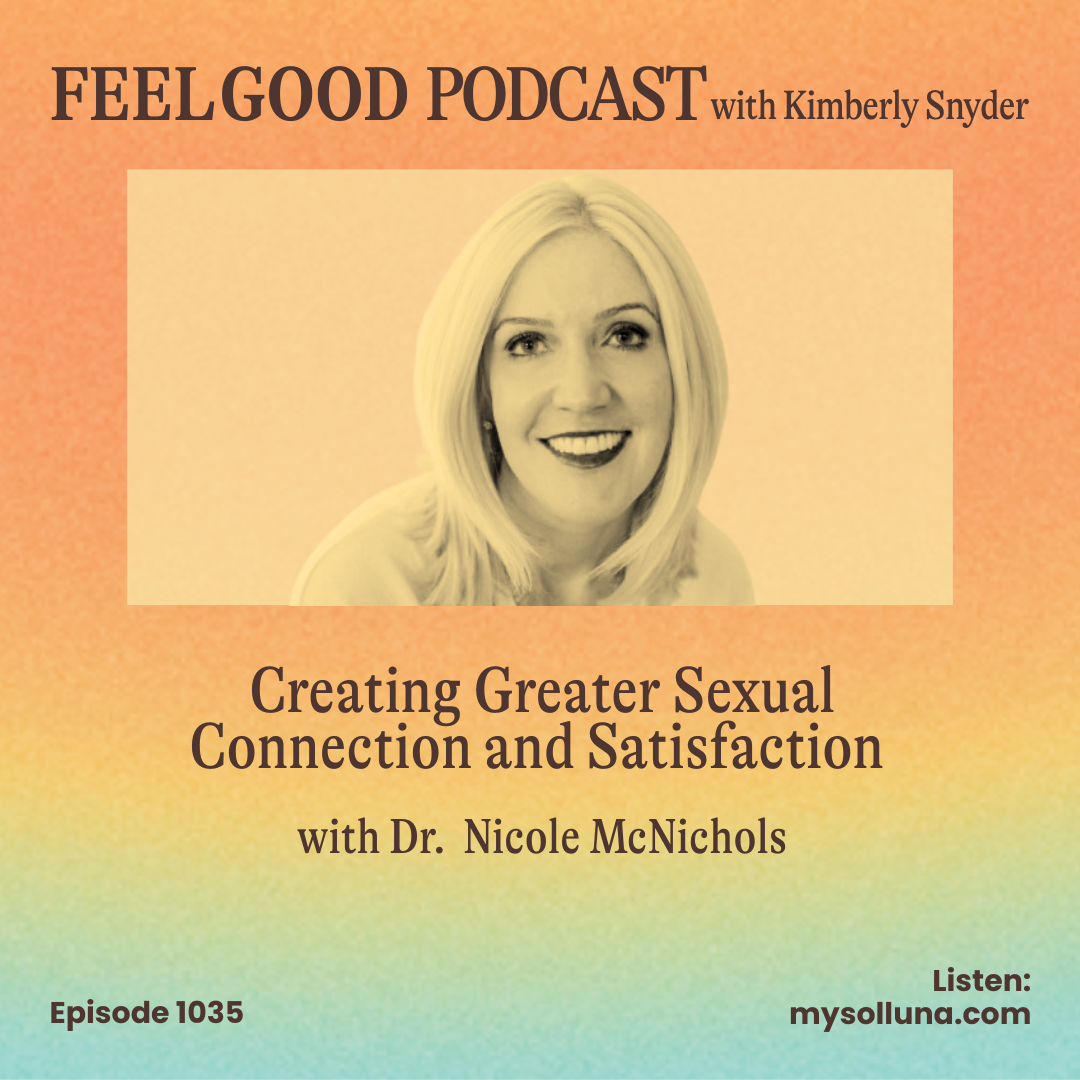
This Week’s Episode Special Guest: Dr. Nicole McNichols
Episode Summary:
In this engaging conversation, Kimberly and renowned Dr. Nicole McNichols explore the multifaceted aspects of sexuality, emphasizing the importance of sexual education, communication, and emotional connection in relationships. Nicole shares insights from her new book, discussing how better sex fits into the larger wellness conversation and the significance of understanding one’s desires and needs. They delve into topics such as the impact of parenthood on sexuality, the dynamics of casual sex, and the role of pornography in shaping sexual experiences. The discussion also touches on the rising trend of OnlyFans and its implications for women’s empowerment and sexual expression.
Dr. Nicole McNichols Resources:
Book: You Could Be Having Better Sex: The Definitive Guide to a Happier, Healthier, and Hotter Sex Life
Website: nicolethesexprofessor.com
Tik Tok: @nicole_thesexprofessor
Instagram: @nicole_thesexprofessor
Bio: Dr. Nicole McNichols is an internationally renowned human sexuality professor, author, and speaker whose groundbreaking course, The Diversity of Human Sexuality, is the most popular in the history of the University of Washington, enrolling over 4,000 students annually. She writes frequently for various publications including The Seattle Times and The Conversation, and she has a regular blog for Psychology Today. She is also the coauthor of the textbook Human Sexuality in a Diverse Society and the TEDx Talk “Students on Top: A Vision for 21st Century Sex Education.” Dr. Nicole McNichols received her undergraduate degree from Cornell University and completed her master’s in psychology at NYU and PhD in social psychology at the University of Washington. She currently lives in the Seattle area with her husband and three children. Follow her on Instagram and TikTok @Nicole_TheSexProfessor.
Chapters
00:00 Introduction and Book Overview
02:00 Sexual Wellness and Stigma
04:37 Pleasure Diversity and Sexual Fluidity
08:00 Communication Blocks in Sexual Relationships
12:00 Navigating Long-term Relationships and Intimacy
17:58 Desire Discrepancy and Emotional Exhaustion
23:04 The Importance of Connection and Intimacy Dates
29:00 Casual Sex and Modern Dating Dynamics
32:24 The Paradox of Sexual Freedom and Connection
39:17 Navigating Casual Sex: Empowerment vs. Disconnection
44:05 The Rise of Infidelity: Understanding Women’s Cheating Trends
49:01 The Impact of Pornography on Sexual Relationships
54:55 OnlyFans: Empowerment or Exploitation?
Sponsors:
LMNT
OFFER: Right now, for my listeners LMNT is offering a free sample pack with any LMNT drink mix purchase at DrinkLMNT.com/FEELGOOD. That’s 8 single serving packets FREE with any LMNT any LMNT drink mix purchase. This deal is only available through my link so. Also try the new LMNT Sparkling — a bold, 16-ounce can of sparkling electrolyte water.
USE LINK: DrinkLMNT.com/FEELGOOD
SBO PROBIOTICS
OFFER: Go to mysolluna.com and use the CODE: PODFAM15 for 15% off your entire order.
USE LINK: mysolluna.com CODE: PODFAM15 for 15% off your entire order.
[FEEL GOOD PODCAST RESOURCES / INFORMATION]
SOLLUNA PRODUCT LINKS
- Glowing Greens Powder™
- Feel Good SBO Probiotics
- Feel Good Detoxy
- Feel Good Digestive Enzymes
- Feel Good Starter Kit
- Feel Good Skincare
KIMBERLY’S BOOKS
- Chilla Gorilla & Lanky Lemur Journey to the Heart
- The Beauty Detox Solution
- Beauty Detox Foods
- Beauty Detox Power
- Radical Beauty
- Recipes For Your Perfectly Imperfect Life
- You Are More Than You Think You Are
OTHER PODCASTS YOU MAY ENJOY!
- How the Power Foods Diet helps with Weight Loss with Dr. Neal Barnard [EP. # 877]
- How Not to Age with New York Times best-selling author Dr. Michael Greger [EP. #873]
- Simple Ways to Use the Power of Herbalism in Your Daily Life with Rachelle Robinette [Episode #1026]
- The Importance of Nitric Oxide and How to Optimize our Body’s Production of it with Dr. Nathan S. Bryan [EP. #1022]
- Heart Healthy, Plant-Based Eating with Dr. Jenneffer Pulapaka [Ep. #1021]
- The Science of Longevity: Plaque Heart Scans, Cancer Screening, Glutathione & More with Dr. Julianna Lindsey [EP#1018]
Powered and Distributed by: PodcastOne
Transcript:
Kimberly (00:01.063)
Nicole, I’m so excited to chat with you today. And first of all, congratulations on your new book.
Nicole (00:06.286)
Kimberly, thank you so much. I’m so excited to be here.
Kimberly (00:10.569)
So I know you mentioned that you had written a textbook before on this subject, intercourse, sex, making love. What inspired you to write a consumer facing book?
Nicole (00:23.448)
Well, I have this large class that I teach at the University of Washington to about 4,000 students a year. And I realized after teaching this class, or I’m still teaching it, that the information about sex that we were learning in the classroom was having a profound impact on students’ lives, that they were reporting, feeling like they were better able to navigate their sexual relationships.
They were better able to think about the types of sex that they wanted to be having. They were more in touch with their pleasure zones. They felt more confident thinking about what they wanted in their long-term relationships or in their dating lives. And so I just realized how amazing would it be if I could bring all of this research in a really fun, excuse me, sorry. I just kept thinking how much fun and…
I just kept thinking how amazing it would be if I could bring all of this information to a wider audience because the reality is that whether you are in a long-term relationship, have been married for 20, 30 years, if you’re newly single, if you’re dating, if you’re even considering something like non-monogamy, all of us could be having better sex. And I wanted to be able to bring all of the incredible research that we have.
to as many people as are interested so that all of us could be having better sex.
Kimberly (01:51.719)
And can you share with us a little bit which you touch on in the book how better sex fits into the larger wellness conversation?
Nicole (02:00.138)
Yes, absolutely. to begin, I just want to say there is so much shame and stigma in general around this topic. I mean, we don’t really learn about sex. are unfortunately the product of a school system that has no federally mandated sex education. So whether we learn anything about sex really has to do with whether it exists in the state in which we grew up.
even when it does exist, it’s so often not medically accurate, only covering the basics of reproduction and STIs and how not to get pregnant, basically. It’s not teaching anything about healthy relationships or healthy sex. And the mistake and what that sort of shame and limitation reflects is just a broader discomfort with the topic. And we think of sex as something where
Kimberly (02:40.36)
Yeah.
Nicole (02:57.324)
You have to get lucky, you know, or it’s like save room for dessert. And we picture it as siphoned off in this whole area that’s separate from the rest of our lives. But the reality is that if we can learn to be sexually integrated, if we can feel empowered with all of the information that helps us to experience pleasure, helps us to have better orgasms.
helps us to sexually communicate in a really effective way with our partner, helps us to address all the larger issues within a relationship that feed into our sexual lives. Not only are we going to be improving our sex lives, we’re gonna be learning valuable skills that are gonna make us feel more integrated and empowered in just about every other element of our lives as well. So yeah, I’m a firm believer.
Kimberly (03:46.887)
Mm-hmm.
Nicole (03:50.37)
that it’s time to stop leaving sex in the corner, stop leaving baby in the corner, so to speak, and bring it out into the world so that people can feel empowered and confident in that area of lives because it’s definitely gonna carry over into other elements of their lives as well.
Kimberly (04:08.743)
I think it’s interesting how we do tend to fragment things in our society. And you talked about in the beginning of your book a little bit, how you had been interested in loneliness and isolation and some of these other human concepts of disconnection and how connection is such a nourishing part. We know it helps with our nervous systems. We know it helps us to feel that full flow of creativity. And so I love how there’s so much
Nicole (04:21.91)
Yeah. Yeah.
Kimberly (04:37.449)
non-judgmental information in here for all the different ways in which someone can express their sexuality. And also Nicole, I was thinking, if someone can have all this at their disposal, they can really play with this. And then there’s periods, and I have friends that are consciously choosing celibacy at the moment, right? And all just feeling like, hey, I’m actually gonna keep this energy inside and express it this way, but then not be rigid.
Nicole (04:50.894)
Mm-hmm, yep.
Kimberly (05:04.335)
either because there be a time where they also want to express it outwardly sexually so it’s sort of
Nicole (05:10.186)
I love that. I love that. And it just speaks to sort of a larger theme of pleasure diversity and just, you know, and as well as the fluidity of the types of experiences that we’re looking at at a particular time in our lives. And, you know, it’s interesting because celibacy absolutely is a rising trend in culture today. And, you know, I think it makes sense. And I think a large reason is that we are having a
Kimberly (05:16.617)
Hmm.
Nicole (05:39.096)
performative sex that is essentially imitating what we’re seeing in porn or even just what we’re seeing in, know, Bridgerton where, you know, a minute into penetration, the woman is having wild orgasms, right? And we’re carrying that forth and we’re using it as a false comparison and standard to measure against our bodies, to measure against the types of sex that we’re having. And I think that a lot of people
are feeling in the bedroom like I’m not able to show up in an authentic way where I’m asking for how I wanna be touched, right? In other words, I’m following the script. And so that is gonna make you feel lonely. That is gonna make you feel disconnected. And especially with the rising trend that we see of rough sex behaviors, which are…
Great if that’s authentically what you’re enjoying I have a whole chapter on my book in terms of how to incorporate kink but when we’re seeing a Rise in types of sex that are just rough that are really just copying what we see in porn no wonder a lot of people are like Whoa, I just need to take a step back here and really reevaluate like really become more centered really understand
Kimberly (06:40.413)
Yeah.
Nicole (07:00.96)
What is it that’s going to make me feel fulfilled? Not what I see in the media, not what I see in porn or what I see on Netflix, but what makes me happy? And so I feel like my book is the perfect sort of thing to read if you’re going through that period because the very purpose of it, I put forth this McNichols hierarchy of sexual needs, the very purpose of it is to help you.
say, okay, let’s throw out these scripts and learn about all of the tools and techniques that we need to be having the type of sex we authentically want to enjoy.
Kimberly (07:35.72)
Mm.
Kimberly (07:41.619)
So do you feel like one of the reasons, or if you could talk about some of the blocks to why we’re not having better connections sexually, I know you already sort of touched on communication, we’re communicating. So maybe we could start there and you could expand on some of the other blocks that you see commonly.
Nicole (07:53.099)
Yes.
Nicole (08:00.064)
Yeah, absolutely. Because again, we have this, you know, complete misconception that incredible orgasms and sex are going to happen just because we instantly know our partner’s bodies. And the reality is that sex is a skill set. It’s not, you know, sure, that guy, Eduardo, who did that thing with his tongue in Spain. I get it, right? There’s some people.
may seem like they just were born being good at sex, but the vast majority of people really need to lean into understanding having what we call in the research world a sexual growth mindset, meaning you learn, you communicate, you embrace failure. So, you know, what this looks like from a communication standpoint specifically is let’s say you’re in a long-term relationship. It’s about
Feeling comfortable, right? Like if I were to tell you to go home and do one thing tonight, sit down on the couch and have a conversation with your partner, not about what’s wrong with your sex life, but more about what’s going well, right? Ask the question, what’s the most incredible sex we’ve ever had, right? Use that as a launchpad because
It’s the foundation for curiosity.
Kimberly (09:25.865)
I mean, I feel like that sounds so wonderful, but for some women it might feel a little awkward to bring up. Like you said, there’s a lot of shame around the topic or shyness. And I think some women, I don’t know, that would feel a little bit of a stretch to say to their husbands, hey, remember that time when you said.
Nicole (09:41.332)
Yeah.
Well, to take a step back, right? The first conversation that needs to happen is to say to your partner, I love you. I care about our relationship. There’s so much in our relationship that is working well, but I feel like we could take our sex lives to the next level. And I know, right? Just acknowledge this is such an awkward topic, but…
Kimberly (09:48.968)
Yeah.
Nicole (10:14.4)
we need to talk about it anyway because sex is important, right? And I can tell you about reams of research where, you know, we look at sexual satisfaction in relationships and find that it really precedes increases in relationship satisfaction, right? We all know that relationship satisfaction and sexual satisfaction are important, right? Sex is important in a relationship.
Kimberly (10:35.101)
Yes.
Nicole (10:43.97)
but it actually precedes that increase in relationship satisfaction, which means that working on your sex life, saying to your partner, honey, I know this is awkward. I know this is hard. We can take baby steps, but let’s talk about this, right? Let’s put a conversation about sex on the table so that we can improve our relationship and make each other more happy, right? And then,
Kimberly (10:53.974)
and
Kimberly (11:01.673)
I’m
Nicole (11:11.564)
So there’s that larger conversation, but then there’s also the communication that can happen during the sex that you’re already having, right? In other words, using phrases or even just using nonverbal and behavioral forms of sexual communication, right? Moans, sighs, feeling like those small vocalizations, which we might dismiss as being meaningless,
actually go a long way in encouraging our partners to be tuned in to what’s working for us, what’s feeling good, what do we want more of, right? And we only tend to vocalize moans and sighs at two points, human beings, when we’re experiencing pain, but also when we’re experiencing pleasure. And back to your point about trying to calm your nervous system.
Kimberly (12:00.361)
Mmm.
Nicole (12:07.766)
which I talk about in my book is one of the key components to being able to connect with your partner, vocalizations during sex certainly do help to do that.
Kimberly (12:11.293)
Yes.
Kimberly (12:19.977)
I’d love to hear your perspective, Nicole, on, you know, we’re talking about connection and communication and getting close. And you talk about in the book, there’s different chapters about being in a long-term relationship or maybe having more casual sex. But this idea of we communicate and you can get really close together and be really present. And then on the other hand, you talk about…
kinkiness or fantasizing or bringing in role playing or, you know, for some people imagining they’re not with that person. But then it, I don’t know, there’s like this other layer of the fantasy and how like in your research and in your work, do you think that’s, I say there’s not one way to be healthy, but how we can, is that something that you would.
Nicole (12:56.998)
Yep. .
Kimberly (13:10.725)
communicate with your partner, make sure you’re on the same page, you can play in and out, you know what I mean? It’s just such a… for me to verbalize.
Nicole (13:16.56)
I do, I know exactly what you mean. I know I understand completely what you’re asking. you know, I would start by telling every couple in a long-term relationship that when we look really deeply at the research on what makes sex passionate in relationships, in other words, when you ask couples, right, who are highly sexually satisfied,
What do you do, right? Actually, you know, how do you keep sex hot? One of the about five or six variables that’s been identified is this notion of novelty. But here’s the thing, Kimberly, novelty does not mean to have to be swinging from the chandeliers or buying that dominatrix outfit. And I think that for a lot of us, that’s what our brains assume when we hear this idea that we have to be introducing novelty and it can feel.
Kimberly (13:52.947)
Mm.
Nicole (14:10.688)
really overwhelming and for a lot of people kind of not fun, right? And so I talk in my book about this idea of introducing micro novelty, right? Because micro novelty is an incredibly powerful way to keep the sex that you’re having interesting and hot and satisfying without feeling like you need to go do all of these insane things, right? And so examples of micro novelty.
might be as simple as trying out a new sexual position. It could be having sex at a different time of day than you normally do. It could be setting the mood in a slightly different way, which is another thing that couples who are highly sexually satisfied report really doing. It could be that you focus more on oral sex, another thing that couples tend to do who are highly satisfied, right? It could be that you…
Kimberly (14:56.658)
Yeah.
Nicole (15:08.6)
take turns sharing sexual fantasies if that is something that you feel comfortable doing. I do encourage all couples to do that, but only if that feels like a safe next step. But the point here is that it doesn’t have to be these wild changes. I mean, sometimes just having sex in a different location, whether it’s the pantry or going on vacation in a hotel room that can just feel…
Kimberly (15:22.023)
Wait.
Nicole (15:37.26)
Like you have that added element of newness that’s going to keep sex alive. Now, yeah, so if you want to do kink, I have a whole chapter on that. Absolutely. I’m all for it. But again, it needs to be authentic. It shouldn’t be performative. Meaning it can’t be something you’re jumping into because you’ve heard this idea that in order to be having satisfying sex, it has to be really kinky. It needs to be something because it’s generally driven.
Kimberly (15:43.005)
Yes.
Nicole (16:05.986)
by an authentic sense of sexual curiosity that both you and your partner have.
Kimberly (16:10.589)
Yes, and I guess everybody’s different, right? For some, for me, it’s more about deep presence and connection. And for some, it’s more role playing or having fun or these fantasies come in. And it’s so different for every person. We can’t judge.
Nicole (16:12.704)
Exactly!
Nicole (16:25.857)
Exactly.
And you know, I’m so glad that you brought that up because when we look at new definitions of sexual orientation, for example, there’s this whole idea that we should be including things like that within our definitions. In other words, some of us are programmed, right, or just wired to enjoy sex that’s slow and intimate and connected. And by the way, the research does show that couples who kiss during sex
Kimberly (16:56.488)
No.
Nicole (16:57.174)
are more likely to report higher levels of sexual satisfaction and women are more likely to experience orgasm, which makes sense because a lot of women want the pace of sex to be slowed, want that emotional intimacy and connection. But there are other people who are wired to want novelty and excitement and a little bit of risk taking and that’s okay too. But to your point, we’re diverse and that’s a beautiful thing. We are highly complex human beings. Why are we expecting that?
Kimberly (17:04.006)
Yes.
Nicole (17:25.644)
the type of sex that one person wants is the type of sex that another person wants. And even just to take that idea one step further, sometimes you want your sexual experiences to be different, right? Maybe sometimes you want that slow, intimate, connected sex. And maybe sometimes you want something a little risque or playful or makes you blush. And that’s beautiful too, right? The idea is to just embrace that and…
Remain curious about what it is that’s turning you on as well as your partner and keep it as an ongoing conversation.
Kimberly (18:00.649)
Well, I think having the conversation, even prioritizing sex, because I know a lot of people get tired, like literally parents, especially after a long day. And then it starts to be for some people a chore. And I was talking to my friend on the beach the other day and she was saying over and over, her husband wants to always have more sex and she’s just not feeling interested. And I said, well, that feels like a big gap.
Nicole (18:09.25)
Yes!
Nicole (18:15.907)
Yup.
Nicole (18:28.376)
Yeah.
Kimberly (18:29.103)
long time and like you said, I imagine it creates a lot of other marital stress if it’s not finding a way to meet where needs are satisfied.
Nicole (18:36.387)
Yup.
Nicole (18:40.394)
million percent. sexual desire discrepancy, which is really what you’re describing, is the number one thing that leads couples to go into therapy. just, yeah, yeah, it’s true. It’s true. And you know what’s interesting is that it’s not always the woman that is reporting less desire in sex. A lot of therapists report that it’s really about equal.
Kimberly (18:46.088)
Yeah.
Kimberly (18:51.677)
Wow, is that true?
Kimberly (19:02.13)
Love.
Nicole (19:04.986)
Some therapists even report that it’s more cases where men are actually having less of a sex drive. But I want to first acknowledge that when we look at data about low desire in women, just the sheer emotional exhaustion that exists in most women’s lives today is a major factor. And I can relate to this. I have three kids, two dogs.
Kimberly (19:05.245)
Yeah.
Kimberly (19:28.487)
Yeah.
Nicole (19:34.412)
I’ve been married for 22 years. My husband and I both have very busy careers. Our kids, we are very involved, extremely involved parents. They’re 17, 16, and 11. And so there’s, know, oldest one’s applying to college. You the youngest one is, you know, it’s making his way through high school. The younger one is switching to, you know, new middle school next year.
Kimberly (19:40.573)
Yes.
Kimberly (19:46.064)
How old are your kids?
Nicole (20:03.904)
It’s it’s, you know, and that’s not to mention, right? When the dog is, you know, puking and you’ve got to wonder what it just ate, or you’ve got to call the science teacher and figure out something, right? Or the laundry you’ve got, dry cleaning you’ve got to go pick up, right? And that’s, that’s what we see is that even though women have made huge advances in career, in family, in income,
Kimberly (20:16.752)
yeah.
Nicole (20:30.466)
they still are doing an overwhelming proportion of household labor. And so sometimes, and like what your friend is suggesting, it could be that when your husband turns to you for sex and you’re feeling tapped out and exhausted, it just feels like one more person’s needs that you need to take care of. And that’s a horrible feeling, right? And there can be a lot of guilt that comes with that feeling.
Kimberly (20:54.75)
Yes.
Nicole (20:58.452)
And first of all, I just want to normalize that that is the experience of a lot of women. But here’s the thing. There are ways that we can bring that up in our relationship that don’t feel accusatory and blaming, right? Because if we don’t talk about it, we are going to start really resenting our partners. And that’s going to lead a big division in our relationship. And no, you’re not going to want to have sex. But if you can just acknowledge that
a lot of those unequal divisions of labor are because of the messages we get from society and culture about what it means to be a woman and what it means to be a man. We can say, let’s not be a victim to this. Let’s be mindful, which specifically means, can we talk about what is on my plate and what I’m doing and what you’re doing and ways to make me feel less overwhelmed? And can we also talk about
you know, developing what decades of research by the Gottman shows is an enormous contributor to desire and sexual connection, which is developing your love map. Meaning, don’t want to, yeah, I don’t want to just know about your day. I want to know about your hopes and dreams. And I want to know how your girls’ dinner was last night. And I want to know what you’re, you know, thinking in terms of, you know, your…
Kimberly (22:07.753)
Hmm.
Nicole (22:23.418)
we’re redecorating the living room and I’m interested in that. And I also want to know what your hopes are, what your dreams are, what your insecurities are, what your anxieties are, because those filling in those buckets, understanding all those different dimensions of our partners, that’s actually going to cause us to experience increased desire. So if we can do that, suddenly,
Kimberly (22:48.041)
Yes.
Nicole (22:52.076)
you stop feeling invisible in your relationship, you start feeling like your partner is seeing you as a whole human being that has needs, that has desires, and suddenly your sexual drive might start to come back online, right? Suddenly it seems like something where now your partner wants to see you. And by the way, part of that love map is gonna be understanding how to make sex more pleasurable for you, right? Understanding what are your turn-ons. And so,
Kimberly (23:07.561)
Mmm.
Nicole (23:21.194)
If couples, I think, can try to unpack all of these pressures that are coming from society and culture in a non-accusatory blaming way and make each other feel seen, I think a lot of those discrepancies are going to start to be somewhat, at least, resolved. But yeah, I mean, and then we can launch into, of course, all of which I’m sure you’ve talked about before, the impact of perimenopause and menopause, right, with
Kimberly (23:32.073)
Mm.
Kimberly (23:38.035)
Yes.
Nicole (23:49.228)
declining levels of estrogen and progesterone, how that can really wreak havoc on your sex life, right? Amazing advances being made with HRT therapy that can be helpful. Or it could be that you’re just stressed out and exhausted. again, because you’ve been socialized to take care of everybody else’s needs, it’s something that’s happening just at the individual level where you just are feeling anxious and exhausted.
So it’s really being able to look at all of these different factors. And again, it comes back to what we were talking about in the beginning, Kimberly, which is that sex doesn’t just sort of exist in this separate domain, right? In order to feel attraction and connect with our partners, we need to come back and examine the underlying dynamics that might be making us feel somewhat invisible.
Kimberly (24:37.635)
Right. And it evolves and it shifts, like you said, that I think keeping the communication going is huge. And I can say in my own marriage, along the way, we started co-sleeping. At first, you know, we were co-sleeping with the babies and then they were in their cribs. But at some point, the boys came back in the bed and it worked really well for a while. And I loved having all the family and I am
Nicole (24:40.93)
Yes.
Kimberly (25:04.937)
mother, right? Always with the kids, except when they’re at school. And then at a certain point, it started and we would, you know, find ways to connect in different times, like you said, in different places. And that felt great. But at a certain point, it really started to not work for my husband. Communicate it and it took me a while, would say about a year for me to really listen. When he said I want the kids out of the bed. So we actually did it.
Nicole (25:06.221)
Yep.
Nicole (25:20.57)
Yeah.
Nicole (25:29.666)
Yeah, yeah.
Kimberly (25:32.613)
and we go back and forth to Hawaii. did it there and we didn’t recently here. And it was really hard for me, Nicole. think there was some attachment as the mother just having them always because it was little cuddle. But wow, he felt heard. And it wasn’t just to make love, but it was also for us to connect and talk with the thing every night and to have time without the kids as a couple. But it just feels like it brought back so much more.
Nicole (25:39.022)
Yeah. absolutely. Yeah.
Nicole (25:49.58)
Gas.
Kimberly (25:57.897)
energy and vitality and connection, which, you know, it’s like sometimes you don’t see clearly. I was hearing it, but wasn’t really hearing it. But when you really hear your partner and you make these shifts, it’s really healthy.
Nicole (26:02.791)
Yes, exactly.
Nicole (26:08.642)
Yeah. And Kimberly, I mean, I had a very similar experience. I didn’t co-sleep with my children, but for all three, I breastfed them for the first year. And that is something where they may not be literally in your bed, but you’re up all night during Elisa’s first couple months breastfeeding. And I was the same way. I I was all in on motherhood, right? And it’s joyful and it’s incredible, but it is all consuming.
Kimberly (26:19.494)
Yes.
Kimberly (26:24.957)
Yeah.
Nicole (26:37.934)
you know, at the end of the day, I would crawl into bed at night and feel touched out and feel exhausted. And I didn’t have a lot left for my husband. And I felt tremendous guilt about that. But it was just sort of where I was in life. And it really wasn’t until I did a little bit of sleep training finally, and which I know, you know, some people feel differently about. and, you know, and, you know, the most
But perhaps the biggest thing that really led to the biggest shift in our relationship, and I talk about this in my book, is that we started planning intimacy dates, right? Meaning we were putting sex on the calendar, but in a way where we weren’t expecting our bodies to simply shift into sex mode directly from productivity or mother or worker bee mode.
Kimberly (27:19.52)
Hmm.
Nicole (27:31.05)
And so, you we would do something, you know, we both love food. So we’d go out to dinner, right? We love food and wine, right? Or, you know, or we’d go for walks. Going for walks is a very therapeutic and a great way that we found to connect. Yeah, and so when you do things like that and you find time to connect, your nervous system sync up, which is critical to being able to start to have your body relax and go into
Kimberly (27:36.105)
you
Kimberly (27:43.891)
yeah.
Nicole (27:58.998)
a state of being where you can begin to be open to pleasure and sexual connection. So it’s really planning those intimacy dates. You know, and I’m, look, I’m a data nerd. And so, you know, if you look at the research on, well, okay, scheduling sex and to me, intimacy dates, got it. But like how often, right? The research suggests that couples who are having sex,
Kimberly (28:03.081)
Hmm.
Nicole (28:22.882)
once a week or more enjoy greater levels of satisfaction than couples who have and greater individual wellbeing than couples that have sex less than that. Now for AIN, once a week. So.
Kimberly (28:32.425)
once a week, which feels, you know, on the, I was gonna say it feels pretty minimal. That was not, okay, I was gonna say.
Nicole (28:37.122)
Do a bull or?
Nicole (28:41.358)
Yes, exactly. Exactly. I mean, that’s how I felt. was like, wait a minute. This is achievable, right? It’s kind of like, you I mean, you can ignore numbers, right? But like, I’m a dork. I love numbers. I love studies. You know, it’s the same thing with novelty. It’s like introducing one new thing a month, right? We tend to think you’ve got to introduce novelty every single time you have sex. No, to reap these benefits once a month.
Kimberly (28:51.443)
Yeah!
Kimberly (29:03.174)
Right.
Kimberly (29:09.313)
And every couple’s different, right? And I say that without judgment, where, you know, for us, it’s a lot of times a week connection. for my friend, who’s, we go weeks, you know, once a week is a beautiful start and accessible. And so, no right or wrong.
Nicole (29:11.18)
Every couple’s very different, yes.
Nicole (29:18.432)
Yeah, that’s amazing.
Nicole (29:24.951)
Yes.
Nicole (29:29.038)
It really is, yeah. there’s no right or wrong. And if you’re having sex more than that, that’s fantastic. It’s just that you shouldn’t be forcing yourself to have sex more than once a week if you don’t wanna be having it because that could actually backfire, right? As soon as we start introducing that kind of pressure and feeling like, oh my God, we’re not measuring up if we’re not having sex two or three times a week or every day. know, I’m here to…
Kimberly (29:49.385)
Right.
Nicole (29:58.294)
reassure you that that is not the case. you know, it’s also it’s, you know, yes, once a week, but it’s also totally normal to go through dips and, you know, valleys. It’s oftentimes, you know, I’m sure you’re like used to this too, where a virus might rip through your household, right? Or it’s like an extremely busy week or one of you is traveling. And so you don’t have sex for a week, right? Or, you know, or, you know, maybe even two.
And that’s okay, as long as you kind of acknowledge, okay, well, that was a crazy week and now we’re gonna spend this time prioritizing sexual intimacy and each other and connection and kind of get back on our sexual routine, not routine, but rhythm here, normal rhythm. So yeah, so frequency, it’s a tricky thing because I don’t wanna pressure people, but we do know from this research that somewhat regular sex,
Kimberly (30:43.571)
Yes.
Nicole (30:56.874)
is super beneficial to your relationship. It’s also important at an individual level, right? So much research coming out showing that sex and orgasms lead to everything from improved immunity, increased cardiovascular health, it protects against brain diseases, it helps, it even predicts longevity. So, you know, it makes sense to be prioritizing this, but you don’t need an astronomical amount of it in order to reap the benefits.
Kimberly (31:18.845)
Yes.
Kimberly (31:27.069)
Well, we’ve been talking so much naturally, Nicole, about connection and couples and keeping it exciting and alive and these deeper ways to connect, right, with conversations and talking about life. And I really relate to that. And because you’re so into the data though, I’d love to hear about data, let’s say in today’s world where there is more, or maybe it’s not more, maybe people are just more open about it, casual.
Nicole (31:49.39)
Yes.
Kimberly (31:57.127)
sex, where, you know, we speak about this vicariously through our friend who’s in LA and he’s on all these dating apps. And he talks about almost every first date he goes on. There’s sex, which feels a little surprising to me. And, you know, even though that may be common and everybody’s different, so there’s absolutely no judgment, you know how that could feel emotionally.
Nicole (32:12.072)
Yeah.
Kimberly (32:26.683)
If there isn’t that deep connection, if you could start to feel empty by having a lot of casual sex and also the accessibility of porn, which you mentioned, I know you talk about in the book or the site only fans being the voyeur watching and also for women and people that are putting out their sexuality and maybe reaping some financial benefit. so some, it feels empowering though. It feel empty. I don’t know. It feels like.
Nicole (32:38.93)
Yep.
Kimberly (32:54.427)
There’s a lot of ways people are playing with sexual energies today and I wonder what the research says.
Nicole (33:00.282)
No, a million percent. And so, you know, there’s sort of, there are a couple of really interesting paradoxes that the research really points to right now, which is that people are actually having less sex than they were 20 years ago. That’s primarily being driven by Gen Z. It tends to, yeah, it’s interesting. So even though,
Kimberly (33:19.261)
No!
Nicole (33:24.394)
we see sex everywhere, we’re sort of in a sex saturated culture right now, people aren’t having nearly as much of it as you think and everyone’s carrying around this perception that everyone else is having more sex than they are.
Kimberly (33:37.523)
Do you think people are masturbating more or do you think people are just not being sexual as much even though there’s this perception?
Nicole (33:44.53)
So there’s so many different things. could, yes, it could be that people are masturbating to porn and thinking, well, this is a lot easier than going out and risking myself and risking rejection and trying to find a partner. It’s, know, when you look specifically at the data though, it is correlated with increased, an increased number of men who are living at home and kind of a failure to launch, which is.
Kimberly (34:08.903)
Nicole (34:08.998)
I’m sure you’ve heard it in maybe this idea of a masculinity crisis that we’re sort of in the midst of, as well as less drinking among women, which one could argue is a good thing, right? And so maybe it’s just that we’re having less sex because women aren’t having sex that they never wanted in the first place, right? So that’s sort of another way to perhaps look at it. But the paradox here is that Gen Z in particular and millennials are having less sex, but
the sex they’re having is kinkier, right? In other words, when I talk to my students, know, first of all, I don’t think any of them, fewer than you would expect have had sex, least if we’re defining it in terms of penetration, and fewer, they’re having fewer experiences, but they all report that the last time, about 80 to 90 % of the ones that are having sex say, yeah, the last time we hooked up, it was rough.
meaning there was sexual choking, right? Which is sort of very omnipresent among young people who are having sex today. And people who report, felt like, especially young women feel like I felt like I was expected to act like a porn star. I felt like I was supposed to have this very exaggerated porn star.
response to the sex that we were having. I felt like it was rough and I got thrown around. And then men also report, I felt like I was being judged. I felt like I was expected to have no refractory period. And as soon as I came, I was supposed to get immediately hard again, which we know is physiologically not possible with what you see all the time in porn. So it’s no surprise that if that’s, and look, as an educator, I’m sort of in this tricky place.
because I want people to be having the sex they want to have, right? And I don’t want to be shaming people for any type of sex they’re enjoying. But when you see a behavior like that, right, particularly something like sexual choking, where nine and a half times out of 10, in the context of a straight relationship, it’s the man who’s choking the woman following a very gendered script, that is a bit concerning, right? Especially because we now have longitudinal data showing that
Kimberly (35:57.853)
No.
Nicole (36:27.692)
women who have experienced a lot of sexual choking can later on do, we do see differences in brain structure, right? When we put them into fMRIs. Yeah. And when I talk to my students, they’ll have, I know they’ll have this idea of, well, if I just, you know, cut off the blood supply on the side of the neck and not the trachea, it will be safe. No, any kind of restriction to bloods, you know, of oxygen to the brain.
Kimberly (36:39.524)
for.
Nicole (36:55.82)
can have damaging effects, but we don’t educate people about this. So anyway, back to your point, you can see why if those are the sexual experiences that women especially feel like are the only ones available, yeah, that kind of sucks, right? But, okay, but what I was going to say is that that does not mean that we need to categorize all casual sex as immediately being wrong or bad, right? And so that’s why I do
Kimberly (37:10.579)
Well, yeah, sorry, go on Nicole, yes please.
Nicole (37:25.582)
talk in my book about what are the things that you can do if you are like, let’s face it, in a phase of life where casual sex makes more sense for you, right? We now know the average age of marriage is 31. A lot of people are spending a lot of time in their twenties, you know, or, and a quarter of all 40 year olds are single. A lot of people are single and not having sex in the context of long-term relationships. And so yes, for them, how do they?
right, have sexual experiences that do feel good, that are satisfying. yeah, and so when we look at the data, right, what’s really clear in terms of casual sex outcomes is that about a third of people are, and I see this mirrored in my class with my thousands of students, that about a third of people are reporting that it was amazing. It was, you know, pleasurable, it was exciting, that…
Kimberly (37:59.847)
Great.
Nicole (38:22.444)
the game, the chase, was all very exciting and it was great. A third report that it was miserable, right? Kind of like what we’re hearing, people felt sort of taken advantage of, that it was cold, disconnected. Yeah, and about a third are in the middle. And when we look at, so what predicts when a sexual experience is gonna be positive versus negative, what we tend to find is that a lot of it comes down to what was…
Kimberly (38:35.581)
Yeah
Nicole (38:51.682)
the original motivation that you had entering into the sexual experience? Were you looking at it as something that was going to be fun and adventurous and pleasurable? Did you feel like you were able to speak up for yourself and communicate what felt good to you so that your pleasure was prioritized? Or did you feel like you really were actually hoping that it was going to be leading to something more meaningful, but
Kimberly (39:19.358)
Yes.
Nicole (39:20.098)
didn’t know how to speak up, right? Because we live in this culture of chill where we’re almost made to feel like if we ask for some kind of clarity about what the intention of the hookup is, that we’re needy, right? That that’s weak, that we’re not being sex positive, that we’re not empowered. But the reality is that some people are wired to enjoy casual sex, and some people are in a phase of life where it can be fun and they do feel confident doing it. And some people don’t, and if you don’t,
That’s great information to have about yourself. But don’t feel like simply because we live in this culture of chill that you need to settle for that because you have a right to be carving out and you can, I’m here to tell you that you absolutely can have the sexual experiences you want if they don’t involve casual sex, right? Yeah, yeah, go ahead. Yes.
Kimberly (40:11.099)
Right, right. I love that because it’s there’s so much data, right. And I was asking for data on this because these are trends, but beyond data is the individual, our intuition, what our hearts tell us is right. And we’re human. So maybe you try something, you try the casual sex, you’re in the dating game, you’re on the apps, and then you realize it really isn’t what you want. You’re looking for deep connection, you’re looking for partnership, and you don’t have to have sex on the first date.
Nicole (40:20.887)
Yes.
Nicole (40:26.785)
Yes!
Kimberly (40:38.761)
And like you said, maybe some people are in that phase of life. So it’s tuning into you.
Nicole (40:39.073)
Exactly.
Nicole (40:43.0)
Yeah, and so totally, and my message to those people is you are not needy for wanting some clarity. You should not feel that some ambiguously defined situationship or one night casual stand is the only thing that’s available to you because you want to know a really sad reality is that again, when we look at the data, the majority of people say they’re actually interested in a long-term relationship, but they also say,
that they feel casual sex is the only thing available to them. Which, you know, I mean, when you think about that, it means that there may be a lot of people out there who are also on the same page as you want that committed sexual experience. But because of, you know, this idea that we’re needy if we ask for clarity and that we should just be, you know, good to go and game for whatever comes our way, because that’s what a sexually empowered person does, that gets in our way.
Kimberly (41:14.855)
Wow.
Nicole (41:41.582)
A sexually empowered person has a sense of autonomy and freedom to choose the types of sexual experiences that work best for them, that lead to the most pleasure for them, and to not feel ashamed of asking for that. And so I try to teach my students, and I give phrases in my book about being used to saying phrases like, I can’t quite tell what you want, or I’m really into you.
but where do you see this going? And so people might hear that and think, my God, I could never ask that. Like, my God, that’s gonna make me seem so needy or vulnerable. But when you really think about it, if you just put that phrase out there, if you just let that hang in the air, I can’t quite tell what you’re thinking. Can you let me know? Or I’m into you, but I’m not as so into casual sex hookups. I’m just wondering where you see this going. Letting that hang in the air, pausing.
That’s powerful. That shows confidence. That is sexy. That’s hot. Doing that, letting the other person squirm for a minute. And here’s the thing, if they’re honest, which they should be, and they say to you, well, I don’t know. I haven’t thought about it really. That kind of gives you all the information you need.
Kimberly (42:44.744)
Yes.
Kimberly (43:04.413)
Yeah, direct and it’s authentic and it’s from your heart.
Nicole (43:07.284)
Yeah, exactly. And here’s the thing, even if they give that answer, maybe you decide to go through with it anyway, but at least you know, right? At least you’re there and you’re like, okay, this is not something that’s gonna be meaningful or you can be like, ew, right? I mean, that’s, you know, because it’s just, and I talk about this with my consent manifesto. I mean, we’re really in a place where we need to be bringing emotional honesty.
to our casual sex experiences so that people feel like they know where they stand, you know? Yeah, to any experience, yeah.
Kimberly (43:40.413)
any experience, any second. Well, Nicole, yeah, I’m really interested in your take speaking about this honesty on indiscretions and cheating and other research. I’ve read, I don’t know if this is updated, where women actually cheat more than men. And back to what we were saying earlier, how sexual satisfaction, in the context of the overall satisfaction of the relationship is so important.
And it’s really easy as an outsider to say, you know, we see all these scandals in the news to be like, I can’t believe that person risked their career and so many things just to sex with someone. And of course, can you talk a little bit about that connection? How, you know, how this happens on such a scale, how it could be prevented?
Nicole (44:16.281)
Yeah.
Nicole (44:22.808)
Sure.
Nicole (44:30.156)
Completely. So first of all, isn’t that finding interesting that there’s more women cheating nowadays than men, right? Yeah, yeah, yeah, yeah, absolutely. And, you know, first of all, it makes me think of data that’s very robust showing that over the course of a long-term relationship, what’s surprising to many to hear is that women actually get bored faster than men, right, in the context of straight relationships. In other words, novelty,
Kimberly (44:36.137)
Is that true? By the way, I don’t know I can break that down there.
Kimberly (44:57.607)
Mmm.
Nicole (44:59.918)
is more important to keep women’s desire high over the course of long-term relationships than for women than for men, which is really interesting. And might explain this cheating epidemic, right? But again, I think in a culture where women feel maybe empowered and alive, maybe they feel like
Kimberly (45:05.746)
Okay.
Yeah.
Nicole (45:28.0)
that’s something that they are interested in trying out. I don’t know.
Kimberly (45:34.185)
to be disconnected from the partner? You’re not emotionally as connected to their partner? Is that part of it? I mean, you’re mentioning novelty, but what about emotional connection? They’re not feeling as, I think for women, I’m thinking about myself, you need that emotional connection. So if that starts to wither,
Nicole (45:41.081)
I’m sorry, repeat the question.
Nicole (45:48.214)
Yeah, well, I think it’s just.
Nicole (45:54.356)
Absolutely, which goes back to what you were talking about, this level of emotional exhaustion and feeling tapped out and having the whole burden of household management, kid management, right? And then especially if your partner is someone that you start to feel like you need to take care of, it’s just another kid, right? That role, like, of course that feels really unappealing and you’re gonna start to turn outward. I think that with women advancing more in their careers and financially,
Kimberly (46:01.117)
Yeah.
Kimberly (46:12.284)
Yeah.
Kimberly (46:23.974)
Yes.
Nicole (46:24.31)
I mean, there’s sort of this, I mean, this is sort of a very cynical view of the world, but there’s a little bit of truth in this idea that the person who has less to lose in the relationship has the power, which is a little bit true. Although, how you define less to lose is extremely subjective. mean, it’s a very cynical view, but the point being that if you were to take that view,
Kimberly (46:37.874)
Hmm.
Nicole (46:52.064)
that women who are now earning more, feel more empowered, feel like they are not as dependent, don’t, in other words, have as much to lose, might feel like they can turn outward. And if we, the point, just to take this to a more positive place is that if we have tools to discussing these things with our partners, right? If we have…
the ability to try to dig into these complicated relationship factors and talk about sex and talk about what we’re actually looking for and build out each other’s love maps, then it might make cheating feel, you know, less appealing. So.
Kimberly (47:27.6)
Yeah.
Kimberly (47:32.915)
think so. mean, I think like we said, there’s plateaus and dips and valleys in any relationship. But if you continue to communicate and connect when there’s challenges and when things come up, instead of letting it get even more arid and just separated.
Nicole (47:39.36)
Yeah.
Exactly.
Nicole (47:47.829)
Exactly.
Nicole (47:51.796)
Exactly. Because there’s this false notion that you can only have hot sex when it’s with a new partner, which I think a lot of people think is what drives cheating. The reality, when you think about it, is that actually hot sex tends to get better with age. There’s been a lot of data showing that it is peaks in your 40s and 50s. And I can absolutely tell you I’m having the best sex in my life.
Kimberly (48:18.249)
I know.
Nicole (48:19.284)
But that really is because of this sense of confidence and the sense of knowing your body and knowing your partner’s body and over the course of a relationship, feeling comfortable to share like exactly what does turn you on and really getting to understand how your partner’s body responds. so when you have that, it can be hot and satisfying. I think that the reason that…
Kimberly (48:38.377)
Yes.
Nicole (48:44.78)
People cheat is more about that loss of emotional connection and feeling seen in their relationship, right? Not about needing a new part sexual partner, but really about that feeling of, don’t feel, I feel like my partner takes me for granted and I feel like I’m invisible in my relationship and this new person is making me feel seen and that’s intoxicating to that person, yeah.
Kimberly (49:03.817)
Right. Wow. And then what do you think about, you know, since you’re the research queen about the prevalence of porn and I don’t know if you can even get inside people’s heads, but they self-report this where they’re having intercourse, they’re making love with their partner, but they’re somewhere else, they’re imagining they’re their partner. that common? Does that happen because of porn?
Nicole (49:14.284)
Mm-hmm.
Nicole (49:26.188)
Yeah.
Exactly. yeah, it does. And I think that, you know, back to our casual sex conversation, that can happen a lot there where somebody is just like, let’s just act out, you know, that porn scene in my head without asking for the partner’s consent. And so, you know, porn is a very nuanced topic, right? Because on the one hand, yes, some people can absolutely develop a compulsive use of porn.
Kimberly (49:42.929)
Right.
Nicole (49:57.55)
Right? Where to the point where it gets in the way of your everyday functioning. It keeps you from being able to be present and mindful during sex, which is, we know from research that sense of mindfulness and presence and being embodied is the number one thing that you need to be doing to experience pleasure. Yes, exactly.
Kimberly (50:14.793)
Really here. Really with the touch. Really with your partner. Yeah.
Nicole (50:18.984)
Exactly. It’s the same, you know, sexual mindfulness, you know, this idea that it’s just like mindfulness in the rest of your life, but you’re bringing it back. You know, you’re in, you’re paying attention to your breath. You’re paying attention to the sensations in your body that you’re feeling during the sexual experience. You’re paying attention to your partner’s sexual cues. You’re letting both those things be your guide, right? That’s what leads to hot sex. But if you are, you know, using
porn as the script in your head for what you think it needs to look like, that is literally shutting off the part of your brain that’s capable of being mindful and turning on the prefrontal cortex that’s in charge of revving up your comparisons and decisions and all the things that are meant to be quieting. at this, yeah, and that can become, and so then again, a lot of the research on porn points to…
Kimberly (51:06.846)
Right.
Nicole (51:14.082)
this idea that when we look at at least poor, decent men, that it leads to the most problems when it’s being watched more out of a form of emotional avoidance. And so you have a generation of men that don’t know how to talk about the real things that are bothering them, don’t really know how to have conversations about what’s stressing them out. And so…
Kimberly (51:29.032)
Anyone?
Nicole (51:39.66)
Masturbation is a form of self-care, absolutely. It can feel good, it can calm your nervous system. But if that’s the only thing that you are turning to to make yourself feel better, yeah, it can become a compulsion. But what the research shows is that that’s happening for a far smaller percentage of people than we think. The data suggests it’s about half a percent.
Which is not nothing, right? I mean, that’s still one out of every 200 people. mean, it certainly does happen. But a large number of people who are experiencing problems with porn, really the main source of the issue they’re having is more about the insane amount of shame they feel about watching it, right? Sort of this cognitive dissonance.
that comes from engaging with a form of media that you inherently think is really unethical. If you believe that by watching it, you’re cheating on your partner, that can lead, but yet you’re watching it anyway. A lot of people end up in their therapist’s office diagnosing themselves with porn addiction when really they’re not watching much more porn than the average person. It’s just that they have such shame and they’re not able to talk with their partner about it. But I don’t want to throw out
Kimberly (52:46.575)
Right.
Nicole (53:04.014)
porn as being just categorically evil because there actually are some groups for whom porn can be useful, right? For example, couples who watch porn together, the data shows, actually report higher levels of sexual satisfaction than couples who don’t, right? So this idea that you can use it to turn both of you on, share clips, right? Use it as inspiration maybe for ideas. It also has been found to be helpful for women, right? Stir fantasy life.
make you feel normalized in your sexual desire. And it’s also been found to be really helpful for people who have queer identities because it’s normalizing all different types of sex that aren’t what you normally see in Netflix, but yet you’re realizing, my God, that does turn me on. That helps me to understand my sexuality and I’m gonna use that as a way to get turned on. So, you the problems with porn really are largely just coming from, again,
Kimberly (53:35.017)
Mm.
Kimberly (53:45.0)
Mmm.
Kimberly (53:50.387)
Yeah.
Nicole (54:00.172)
our country’s total lack of sex education and the fact that people are using those as scripts. And, you know, as you pointed out, kind of going into their sexual experiences with almost these like virtual goggles on of porn that are guiding their behavior rather than the authenticity we’ve been talking about. you know, porn in certain contexts are, you know, at the same time, a lot of people out there that the data show watch a whole lot of porn and who have no problems. So it’s just, yeah, it’s just, it’s a
Kimberly (54:13.468)
Right.
Nicole (54:29.784)
very mixed bag.
Kimberly (54:32.169)
I mean, I have to share with you, Nicole, I’ve never seen a porn. There’s no right or wrong. I remember one was on at a college party I went to and it just, I don’t know, maybe it steeped in my Catholic upbringing or shame. I don’t know, it just wasn’t something I was drawn to. And there’s no judgment because I know it’s out there, but it just is, it’s like a whole world.
Nicole (54:35.01)
Yeah, yeah, it’s okay.
Nicole (54:44.183)
Yep.
Nicole (54:47.615)
Yeah.
Nicole (54:51.84)
Yep. I mean…
Nicole (54:58.028)
Completely, completely. And the reality too is that most mainstream porn is really for the male gaze, right? I mean, it’s really featuring sort of these very gender stereotypical heteronormative tropes where it’s the woman, you know, she’s having multiple orgasms after, you know, penetration. Newsflash, only 18 % of women can have an orgasm from penetrative sex alone. So, you know, what we’re seeing in porn is not realistic about how female pleasure works.
Kimberly (55:05.705)
Yeah.
Nicole (55:28.056)
at all, right? But there are what are known as ethical porn sites, right? That are producing porn that does show better representation of bodies and is more about showing types of sex that actually is pleasurable for women. And so a lot of women and couples can find that those types of sites are really helpful. Like Belisama is an example of one, for example, Belisama Plus, yeah.
Kimberly (55:52.745)
Wow. Well, I could pick your brain all day, Nicole. I want to go back to one last question for you because it was a statistic that came across my desk about the OnlyFans. Right? So there’s an access point for women and I read a statistic, I think it was 18 to 22 year old women in America. There were some crazy high stat 12 % or 10 % were on OnlyFans.
Nicole (55:54.825)
Hehehehe
Nicole (56:04.555)
Yes.
Nicole (56:16.728)
Yep.
Kimberly (56:17.329)
millions of women. And so now there’s a point where women can be sexual and they can profit, they can make money from it. And I wonder the data around what that for that, you know, those women, how it affects their own sexual lives. You know, the data around it because it’s new and it’s, you know, I don’t know.
Nicole (56:34.701)
Yeah, I mean.
Nicole (56:40.384)
Yeah, no, it’s a really good question. And we don’t have a lot of data right now about exactly what the outcome is for women who are engaged, who are making money on OnlyFans. We definitely will probably see more of it just because as you pointed out, it’s exploding in popularity. I mean, at a personal level,
Kimberly (56:45.927)
Okay.
Nicole (57:04.878)
I have such mixed feelings about it. I actually had an OnlyFans model come and share her perspective to my class, Arikitsia, who’s very successful on the platform. And she gave an honest perspective. She was like, I’ve been scammed in this industry. It’s not as amazing as you think, like one in the average.
salary, the average amount of money that an OnlyFans model makes is about $2,000 a month, right? People think they’re gonna go on it and make millions of dollars. And then, she said, my advice to anyone thinking about this would be only do it if it’s literally the only job you ever wanna have because no matter what, it will follow you, right? People will know, it’ll get out there and it will impact your chances of future employment. And so, on the one hand,
Kimberly (57:51.005)
Yeah. Yeah.
Nicole (57:59.598)
It’s like, but then you hear about single mothers who are able to stay at home and make a ton of money and support their kid. I mean, that sounds okay for great, right? But it’s difficult, right? It’s difficult when you look at this, because again, if you are putting yourself out there, is that at some level, is it empowering or does it at some level start to feel masochistic?
And it probably kind of, you know, one of the things we’ve talked about is that it probably just varies so much individual to individual. But I just, I mean, I think it’s a really important question and it’s just, you know, something that we are probably gonna see more data coming out on soon. Yeah.
Kimberly (58:30.185)
Yeah.
Kimberly (58:45.545)
Well, I think like you said, it’s individual and at some level it’s like, well, I can make money from this. We’re all whole beings. And so much of this empowerment you’re talking about in the book is really about connection to what you like and you’re the partner. you know, these sites are kind of dangling that carrot. You can make money from it. And there’s no judgment, of course, but then there’s this aspect where you’re being watched and
Nicole (58:50.87)
Yeah.
Yeah.
Nicole (58:58.379)
Yes.
Nicole (59:06.847)
Yeah, yeah.
Nicole (59:12.884)
Yes, it’s exactly, and it’s, yeah, it is. And it’s so complicated, right? Because, I mean, on the one hand, you’re doing it from the safety of your home. You can close your laptop at any time you want, right? If you look at the chat rooms of many of these OnlyFans models that, you they report, and Ari Kitsch, you talked about this, you know, that people are actually much kinder to her, her followers, at least.
Kimberly (59:13.597)
People are kind of looking at you and so it’s feeding out and
Nicole (59:40.43)
And this generally tends to be true. But at the same time, what you’re putting out there is highly performative, right? And it can come back and impact your life in ways that I think a lot of young women who are doing it may not just be fully aware of. And so again, mean, all of this comes back, I don’t judge any of it. just want people…
Kimberly (59:57.757)
Right.
Kimberly (01:00:03.655)
Well, it’s your peer-referred book! Yeah!
Nicole (01:00:06.134)
I just wanna be happy people to be happy, right? And I want them to be making decisions where they have all the information and feel like they can choose what they wanna choose from place of authenticity and not from what everyone else is telling them they should want.
Kimberly (01:00:20.979)
Well, it was really clear to me, Nicole, when your book came across and I just opened up and read about the chapters and the subjects and the way that you embrace data, but also your heart and your intuition that this was a different type of sex book. And I really appreciate, again, I would say your heart led approach to this because it’s very nurturing is the word I would use.
Nicole (01:00:37.752)
Thank you.
Kimberly (01:00:49.957)
a gentleness, there’s an openness, there’s a loving quality to it. I love that you are in a mother, motherhood, wife position, but you’re also talking about it from all these different standpoints. So it’s really for everyone.
Nicole (01:00:58.505)
Hehehehe
Nicole (01:01:07.332)
Thank you, Kimberly. That’s probably the most amazing compliment you could ever give me about my book. Thank you. I mean, and that’s exactly right at the end of the day, I am a mom, right? I have a lot of love to give. I just want people to feel like they’re empowered with the information they have so that we can all be diverse and love diverse things.
Kimberly (01:01:24.348)
Yes.
Nicole (01:01:30.27)
feel empowered and not ashamed to have the sex and the sexual experiences that we want to be having.
Kimberly (01:01:35.421)
That’s right. And if we maintain that connection, it can grow, it can shift over time. You can try things, different points in your life. You can come to a committed relationship. can come out. Keep going. tell us, Nicole, where we can get your new book. You could be having better sex, the definitive guide to a happier, healthier, and hotter sex life and where we can learn more about your work.
Nicole (01:01:42.008)
Yes, exactly.
Nicole (01:01:57.954)
Thank you so much. So you can get my book at any retailer, know, Amazon, Barnes and Noble, your local bookstore, whatever you’re used to. There’s an audio book if you prefer that. And yeah, you can also, if you’d like to follow more of my work, you can follow me on TikTok or on Instagram at Nicole underscore the sex professor. So hope to see you there.
Kimberly (01:02:21.971)
Thank you so much again, Nicole, for sharing your wisdom and your beautiful heart with us. So appreciate this conversation and learning about so many different aspects of this. And everyone, thank you so much for tuning in. We will link directly to Dr. Nicole’s work on our show notes at mysaloon.com, her links directly to her book. I also encourage you to share this episode with anyone that you think.
Nicole (01:02:28.952)
Thank you, Kimberly.
Kimberly (01:02:46.825)
would benefit as we talked about earlier in the show. Sometimes people are shy to talk about this topic. Just like I’ve been talking about now, movements for years and some of the conversations can really help people’s lives. So I encourage you to share, to check out Dr. Nicole’s new book. Otherwise, I will also see you online at underscore Kimberly Snyder. I’ll see you on our Salooner website and we’ll be back here in a few days with our next interview.
Nicole (01:02:53.29)
Yes!
Kimberly (01:03:14.313)
Until then, take great care. I’m sending you all so much love.
Nicole (01:03:20.484)
That was awesome. Thank you.
0 Comments