
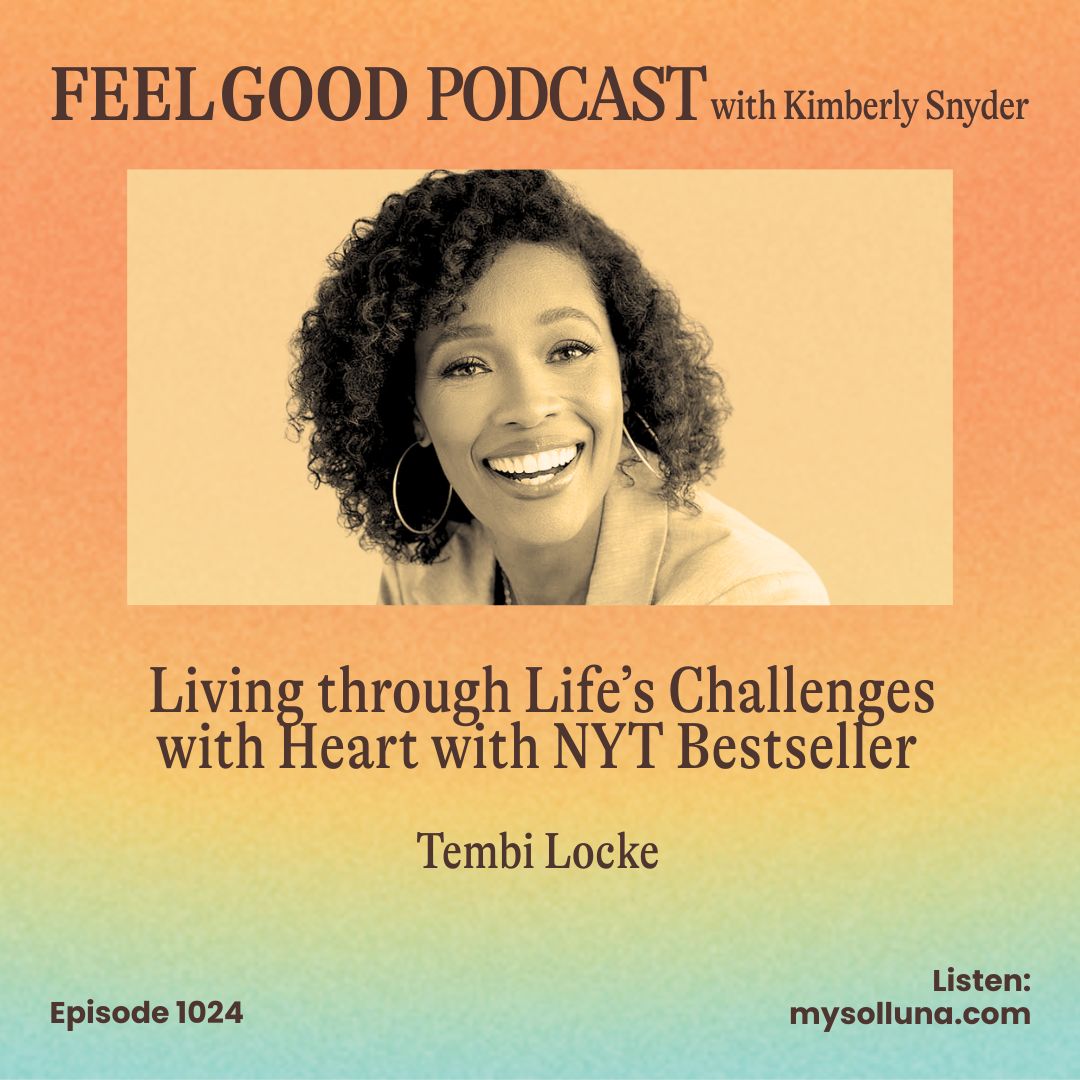
This Week’s Episode Special Guest: Tembi Locke
Summary:
In this heartfelt conversation, Tembi and Kimberly explore the profound themes of motherhood, loss, and identity. Tembi shares her journey through grief after losing her husband, the transformative experience of adopting her daughter, and the complexities of navigating life as a mother. They discuss the duality of joy and pain in parenting, the importance of embracing the present, and the significance of cultural identity. Tembi emphasizes the creativity inherent in motherhood and the need to honor all parts of one’s journey, including the past. The conversation culminates in reflections on love, loss, and the beauty of re-nesting into oneself as children grow.
About Tembi Locke
Tembi Locke is a writer, entrepreneur and thought-leader in creativity and resilience. She is a New York Times best-selling author, TV producer, actor, and screenwriter with a passion for connecting with her audience both on the page and on the screen.
In partnership with Hello Sunshine, Tembi served as co-creator and executive producer for the adaptation of her memoir, From Scratch: A Memoir of Love, Sicily, and Finding Home, for Netflix. The series, From Scratch, became an instant global hit, spending weeks on Netflix’s Top Ten List in over thirty countries around the world and earning six NAACP Image Award nominations and the prestigious Los Angeles Film Italy award. Her aforementioned memoir was also a Reese’s Book Club pick and an instant bestseller. Tembi and her producing partner and sister, Attica Locke, are currently under an overall development deal with Universal Television
In addition to her accomplishments as a writer and producer, Tembi is an accomplished actor with over sixty film and television credits. She most recently held a recurring role on Netflix’s hit show, Never Have I Ever.
Offscreen, she is a nationally recognized speaker, delivering keynotes on resilience, loss, creativity and the power of storytelling. Her TEDx talk has been viewed by individuals and nonprofits around the world. She launched her podcast, Lifted, which features dynamic women sharing their stories of what and who have lifted their lives. Through her work, Tembi aims to inspire people to embrace resilience, love, and the power of community.
Tembi Locke Resources:
Book: Someday, Now: A Memoir of Family, Reclaiming Possibility, and One Sicilian Summer
Website: tembilocke.com
Social: @tembilocke
Episode Sponsors:
LMNT
OFFER: Right now, for my listeners LMNT is offering a free sample pack with any LMNT drink mix purchase at DrinkLMNT.com/FEELGOOD. That’s 8 single serving packets FREE with any LMNT any LMNT drink mix purchase. This deal is only available through my link so. Also try the new LMNT Sparkling — a bold, 16-ounce can of sparkling electrolyte water.
USE LINK: DrinkLMNT.com/FEELGOOD
ANIMA MUNDI
OFFER: To get THE PUREST, MOST DELICIOUS, benefit driven Herbal Teas infused with harmonizing adaptogens go to Animamundiherbals.com and use code: KIM20 to get 20% off your purchase!
USE LINK: Animamundiherbals.com and use code: KIM20 to get 20% off your purchase!
Episode Chapters
00:00 The Power of Vulnerability and Change
03:06 Embracing the Present: Lessons from Sicily
05:53 Navigating Life and Death: The Cycle of Existence
08:58 Unpacking Identity: Beyond Labels
11:35 The Journey of Motherhood: Adoption and Attachment
14:39 The Urgency of Parenthood: A Journey Through Cancer
17:19 The Miraculous Connection: Adoption Story
20:30 The Duality of Joy and Pain in Motherhood
23:02 Returning to Roots: The Significance of Place
25:52 The Grief of Growing Up: Navigating Change in Motherhood
28:27 Navigating the Bitter and Sweet of Parenting
28:56 Honoring the Journey of Transition
29:58 Intentional Connections in the Re-Nesting Phase
31:09 Reframing Emptiness as Spaciousness
33:40 The Evolution of Relationships with Adult Children
34:37 Grief and Curiosity in Parenting Transitions
38:49 Opening the Heart to New Love
43:41 The Complexity of Blended Families
47:08 Redefining Creativity in Motherhood
50:56 Embracing Multicultural Identities
[RESOURCES / INFORMATION]
SOLLUNA PRODUCT LINKS
- Glowing Greens Powder™
- Feel Good SBO Probiotics
- Feel Good Detoxy
- Feel Good Digestive Enzymes
- Feel Good Starter Kit
- Feel Good Skincare
KIMBERLY’S BOOKS
- Chilla Gorilla & Lanky Lemur Journey to the Heart
- The Beauty Detox Solution
- Beauty Detox Foods
- Beauty Detox Power
- Radical Beauty
- Recipes For Your Perfectly Imperfect Life
- You Are More Than You Think You Are
OTHER PODCASTS YOU MAY ENJOY!
- Wellness Insights: How to Listen to Your Body for Nutritional Guidance [Episode 878]
- How the Power Foods Diet helps with Weight Loss with Dr. Neal Barnard EP. 877
- How Not to Age with New York Times best-selling author Dr. Michael Greger [Episode #873]
- How to eat to reduce anxiety with Harvard nutritional psychiatrist Dr. Uma Naidoo [Episode #867]
Powered and Distributed by: PodcastOne
Transcript:
Solluna By Kimberly Snyder (00:01.202)
Hi, Tembi. Thank you so much for joining us today.
Tembi (00:05.336)
Kimberly, my heart is full and we haven’t even started the conversation. So I’m excited to talk to you. I think that’s the word that comes to me. I’m thrilled and excited to talk to you.
Solluna By Kimberly Snyder (00:19.528)
I wasn’t expecting this, but I started to read your book and almost immediately I started crying and I could feel so much vulnerability and power. And I was saying to myself, don’t cry right away, gather yourself. But we all have different stories. But I think the one thing that we can all identify with is the pain of change.
which you’re bringing forward so much and especially with loved ones and our hearts through this process. So I just wanted to share with you in your voice when you’re reading the book, it was almost immediate.
Tembi (01:04.888)
I thank you for that. And I say thank you because thank you for being a reader who was willing to sit in it with me, sit in the story with me and allow my one story, particularly the experience that is the opening of the book that.
Solluna By Kimberly Snyder (01:25.523)
Yes.
Tembi (01:25.922)
very transformative moment that I dropped the reader into to sort of, I’m inviting them. And I remember writing this, I was writing it like I have to, whoever finds these words, my job is to make them come with me as I stand at this moment that changed my life.
And how do I bring them to a place they’ve never been, meeting a person they’ve never met before, inviting them into a story of loss, but also transporting them to a kind of magical, natural world. And it had those early pages had to do a lot.
I knew that as a writer, but more to the point, I knew it just at the level of the heart. And I thought, just have to like, I have to lay myself bare.
Solluna By Kimberly Snyder (02:18.921)
Yes.
Solluna By Kimberly Snyder (02:25.194)
Totally. Well, you definitely do. And what’s interesting because one of the first lines, and it really jumped out to me was where you talked about there is no, people in Sicily don’t talk about the future, right? So it hit me on a couple of different levels. It was saying, well, there’s this level of presence and here we are. And, you know, we can always worry about what’s it going to be like when my kids leave or.
Now my dad’s staying with us in the house in his seventies, like when my dad passes or what’s going to happen. And there’s also, well, if we’re right here right now, there’s also this aspect of embracing pain instead of trying to make it feel better because it’s something that I do in the future. There’s a lot of levels of that that I took in.
Tembi (03:10.434)
Yes, and I, you know, the thing, so I write in the book, for listeners who may not have heard the book or know about the story, but it begins in Sicily. And I use these words of my late mother-in-law.
And the fact, you know, she spoke Sicilian, I speak and spoke Italian with her. And at the opening of this book, I’m remembering this thing that she said to me, that in a language that is not my mother tongue, but that also makes me have to pause and think about…
Solluna By Kimberly Snyder (03:38.1)
Mmm.
Tembi (03:50.612)
What does it mean if a language doesn’t actually have the future tense? Like, what does that actually mean? Like, who, what does it mean to so sit in the present that you can’t even, you’re not even trying to find a verb or a conjugation of a verb that might be about the future. It’s just now. Now I will say Sicilians in,
very much have many different conjugation forms of the past. They can hang out in the past. like, there’s like the immediate past, the kind of past, the past past, the like really, really remote past. And they can hang out in that all day long. And I’m not trying to say that like, there’s ways to phrase what might happen. But I think what she was telling me and why those words came to me in that moment is,
Solluna By Kimberly Snyder (04:23.262)
Wait.
Tembi (04:41.27)
I was at a moment of big change and I was really asking a lot about what is about to happen. And remembering her words, gave me just the pause, the breath to slow down and just say, I don’t have to tackle it all right now. I just have to be. And boom, off the story goes.
Solluna By Kimberly Snyder (04:57.512)
Yes.
You know, you and I share having this juxtaposition of death and life a bit. My mom passed from cancer when my oldest son wasn’t yet a year old. So there was sort of that, I know you had to care for your first husband with cancer. Just sort of like dealing with that. And it’s really poignant when someone is literally passing and there’s a new child in, but we’re actually sitting in that.
all the time. It’s just maybe not so obvious or we don’t want to look and it can be scary and it can be painful but you know your story kind of shows that this is part of the reality of living all the time.
Tembi (05:44.872)
It’s all the time. It’s ever-present. My friend, Dr. BJ Miller, he has said often, we are all the dying. We are all the dying because we are all, that is how this story ends. mean, that is where we’re all headed. It is a part of the cycle of birth.
Solluna By Kimberly Snyder (05:57.961)
Yeah.
Tembi (06:12.918)
and growth and change and death. And when, like you, like me, when someone has known loss, but also death. And what I mean by that is the death is I set bedside with my husband as he was passing. So I had the privilege of experiencing something that
Solluna By Kimberly Snyder (06:36.146)
Yeah.
Tembi (06:42.41)
many people don’t get to experience and it’s a portal. It’s a portal. And so that’s the knowing death and knowing that release and knowing that transition and then knowing loss is what happens.
Solluna By Kimberly Snyder (06:45.832)
Yeah.
Tembi (06:59.2)
immediately thereafter and for the years and really for the rest of your life when you’re holding the love of that person. And so for those of us who have been up close or in that dance with life and death and loss and resilience and love, and as you say, to have a newborn baby in the presence of someone who is transitioning, you don’t ever forget that.
Solluna By Kimberly Snyder (07:18.152)
Yeah.
Tembi (07:26.762)
imprints you very deeply and I think it can inform how we go forward.
Solluna By Kimberly Snyder (07:33.194)
Yes, yes. Another part of your writing, your speaking that struck me was when you were sort of listing and contemplating and grappling all these self-identifications, which I think we all do, whether we’re aware it or not. You listed widow, new wife, mother, soon to be empty nester.
And as a student of yoga and Vedic philosophy, one of the things that, you know, we’re asked to always contemplate, know, Ramana Maharishi says, who am I? Who am I underneath all the labels? Right? So you’re going through all these changes and then you also talk about, I think you said there were seven different constructions of family you were creating because you were trying to connect. And I think it’s really natural that I was listening to that. I you know, I identify a lot with being mother and being wife.
But can you tell us through all the changes and all the outer connections that you were forging with family, what you learned about your heart and your true self and you underneath all of the labels? I mean, it’s a big question, but like some of the realization.
Tembi (08:43.09)
Sure, sure. I mean, I think the way into me beginning to sort of unpack that and answer that question, and by the way, I love the question. Like, I really love the question. So I think these, the many experiences that beget the labels, for example, being married, hence label wife, losing someone, hence label widow.
Solluna By Kimberly Snyder (09:06.27)
Yes.
Tembi (09:10.028)
mother, so on and so forth. The experiences that are underneath the titles or the labels. For me, when I listed them all out, they spoke to a range and a depth and a breadth of many different human experiences. And…
Solluna By Kimberly Snyder (09:10.132)
Yeah.
Tembi (09:32.384)
I could see underneath all of the labels, underneath or within each of the experiences, and particularly as they interwove with each other.
was the experience of a kind of capaciousness. My life, my heart was asked to stretch with each of these experiences in marriage, in death, in motherhood, in caregiving, in being a daughter, in being a sister, all the labels, right? There was this sense that for me in…
Solluna By Kimberly Snyder (09:48.051)
Hmm.
Tembi (10:13.344)
listing them out if you will, I could begin to see that my soul, my heart, each of us might have different words to assign, right, to this state of being, this who and what we are. But what I could see is that damn, like each of these experiences had forged me and formed me through fire, through grace, through love, and
I was stretched and I was bigger and I was more. I was more, I was more. Yes, I wasn’t less, I was more. But I had to go through the pain and feel the loss and unpack the label a lot before I could.
Solluna By Kimberly Snyder (10:45.48)
Yes. More than. Even more beyond any label, any word.
Tembi (11:10.046)
rest in the truth that was underneath it. That feels very esoteric of an answer and I hope that somehow that connects or resonates. Okay.
Solluna By Kimberly Snyder (11:18.562)
yeah. Well, there is this part too, where you talked about knowing very well attachment as a mother. And I really very much resonate with that. How you kept your daughter really close. We still co-sleep. The whole family does. There’s the four of us in the bed. It just feels very natural. Also in the Philippines, where my mom is from, that’s part of a way of life. It’s different in our culture, but it’s also what I saw growing up.
Tembi (11:43.906)
It’s.
Solluna By Kimberly Snyder (11:48.084)
with family members. So there’s too much of it. Exactly. Exactly. And then you got really vulnerable and talked about since, you know, had your daughter came right into your arms, you had adopted her. So you didn’t go through this sort of uncomfortable period, gestation, the sleeplessness, that all of that. Can you talk about that? First of all, the attachment and then, you know, and I just, you know,
Tembi (11:49.238)
It’s also what happens around the world. It happens around the world.
Tembi (12:12.59)
and
Solluna By Kimberly Snyder (12:17.534)
this being able to ask you these questions, Tembe, which feel really vulnerable out of curiosity and us sharing our circle of motherhood. Did you struggle with adopting your child? Did you try? Was that always your life choice? And did it feel like you wanted to cling even more?
Tembi (12:25.068)
Yeah. Yes.
Tembi (12:31.022)
Thank
Tembi (12:38.138)
Mm hmm. Mm hmm. my gosh. No, I love it. I love it. I love it. And you know, I will share because I think
Solluna By Kimberly Snyder (12:41.514)
There’s so much in there, I don’t-
Tembi (12:50.702)
I know there are people listening right now who know this experience and I know there are people right now who may have never considered this experience because of our conversation, might consider it. And there are people in the midst perhaps of the journey of adoption. So for us, for me and Sado, my late husband, you know, our journey, well, I always felt anew like…
Solluna By Kimberly Snyder (12:58.61)
Yes.
Tembi (13:18.806)
I always knew I would be a mother. That was never not a question. Never not a question. As a child, so much of my role play was around like the domestic life, motherhood, you know, I, you know, literally in my notebooks in like second grade, I was like writing down the names of like my future kids. Like I’m that person, right?
Solluna By Kimberly Snyder (13:21.897)
Yeah.
Solluna By Kimberly Snyder (13:40.597)
you had like the dolls you would take around with you.
Tembi (13:42.744)
Completely. it was I knew like it was on my heart. It was like it was I came into being Knowing that that would be a part of the journey. So it was never it wasn’t like will I or won’t I be a mother? so when when Saturday I Were first married we were just gonna go this will just happen right the mother you because you can see if you’ll it’ll just happen and And it didn’t right away, but we were not really worried about it. We were young And then he was diagnosed with cancer
Solluna By Kimberly Snyder (13:49.118)
Yes.
Tembi (14:12.99)
And in that process, for the listeners who know this, the chemotherapy meant that if we did want to conceive a child, you know, naturally, if you will, what we would have to, or with his, with his, you know, semen, basically, we needed to freeze it. You had to go through that process so that the sperm would be viable for.
Solluna By Kimberly Snyder (14:32.82)
Yes. Right.
Tembi (14:40.396)
know, insemination, conception, whatnot. And so we do that. And I write about this in From Scratch, the first book, we freeze the sperm and then we are in the throes of cancer. And it felt as though perhaps that was a distant dream, motherhood. And then I have credit, excuse me, I’m gonna drink some water. on.
Solluna By Kimberly Snyder (14:58.442)
Yeah.
Solluna By Kimberly Snyder (15:04.722)
Yes, please.
Tembi (15:07.372)
That may be the emotion coming up that’s so interesting.
Solluna By Kimberly Snyder (15:11.21)
There’s like so much in the throat. There’s so much energy coming through this.
Tembi (15:16.332)
I think when that happens, I always say when coughing, when things with a throat, something wants to come out.
Solluna By Kimberly Snyder (15:21.749)
yeah.
Tembi (15:26.488)
Thank you for your patience. it’s so interesting. Yeah, yeah, yeah. No, no, no, it’s totally fine. I’ll go back in. So.
Solluna By Kimberly Snyder (15:27.889)
no, please. We’ll a little edit on this part, so don’t worry.
Tembi (15:40.366)
So we freeze the sperm and it’s there. And for me, it felt like, well, that’s not a priority right now. It’s a priority is his life and his wellness and potentially something curative for him. And then we reached a point two years in where he was in remission. And I credit his oncologist.
Solluna By Kimberly Snyder (15:54.334)
Yes.
Tembi (16:09.752)
who said to us, go live your life. Whatever you want to do, go do it. We didn’t get out of the elevator and into the parking lot before we turned to each other and it was like parenthood. That was the thing that was on our hearts to do. And I think I needed, and I won’t speak for my late husband, but I know I needed in that moment, the permission.
Solluna By Kimberly Snyder (16:14.186)
Mmm.
Solluna By Kimberly Snyder (16:19.476)
Wow.
Tembi (16:39.32)
to become a mother because I felt as though cancer had somehow maybe robbed me of that possibility. Like, was it fair? Could I do it? What was gonna happen in the future? Going back to our original conversation, the future rising, right, was like, well, maybe that’s not for me. I don’t know. was very, but hearing the physician say this,
Solluna By Kimberly Snyder (16:46.654)
Yeah.
Solluna By Kimberly Snyder (16:51.572)
Yeah.
Tembi (17:03.126)
What it did was it made us double down on life and it was like parenthood. And we had a series of conversations and it emerged very quickly that we had zero interest in going and retrieving said sperm from said cryobank. I did not want to go down the journey of shots and lab coats and doctors and more appointments. We had just been two years in that and it was like an
Solluna By Kimberly Snyder (17:29.16)
Yeah.
Tembi (17:32.448)
And then I got home and I saw, I looked on my shelf and there were these books that I had gotten a couple of years before on adoption. And I’m like, my gosh, universe, thank you. And so we almost immediately, we identified the adoptive facilitator we wanted to work with.
Solluna By Kimberly Snyder (17:41.374)
Wow.
Tembi (17:56.17)
We went full in because we, if you have been through caregiving, if you have been through cancer, you understand there’s an urgency to time. So it was, we weren’t gonna like meander. We were like, we’re going right for it. And for us, the blessing that I can attest to is that it happened really quickly. When I say, when I say it happened quickly, I want to say,
Solluna By Kimberly Snyder (18:06.067)
Yes
Solluna By Kimberly Snyder (18:19.486)
How quick can it happen with a doctor?
Tembi (18:25.408)
And again, you know, my daughter is out of high school now, so I’m going back in my memory bank. But I know from the time that we have fulfilled all the paperwork and all of the sort of like background checks and all of that, and we were approved by the social worker, they’re like, okay, your application, everything is approved. We’d written the birth mother letters, we had put together the little dossier and they said, okay, you’re approved. And now let’s see what happens. It was.
less than seven weeks. And I had my daughter was in my arms. Yes. Yes.
Solluna By Kimberly Snyder (18:59.188)
Wow.
Solluna By Kimberly Snyder (19:03.015)
What?
That’s, I mean, that’s, I’ve never even heard of it taking so, you know, being so quick. And it just seems that intention, you the soul’s connection, because, you know, we all come from the same source. I know we know this.
Tembi (19:19.287)
Yes.
But no, but you know what, can’t, it bears repeating. We can’t say it enough. I feel like we should all put it on a t-shirt. We come from the same source. okay, we need, we need to message that into the world as frequently and as often and as deeply and as lovingly as we possibly can because so, so many parts of, of our collective psyche, we’ve forgotten it and we need to remember it. So yes.
Solluna By Kimberly Snyder (19:31.303)
Yes.
Tembi (19:49.474)
We all come from the same source. And I felt, I feel like my daughter, Zoella, Sado and I all coming together in this family unit was like, to source. was like, this was just supposed to be, this happened the way it’s, you know, and she’s, she, she’s in our lives and you know, we went through and I know, I know it kind of is miraculous. She was in, she was three days old and particularly she was three days old. and so we got the call the day she was born.
Solluna By Kimberly Snyder (20:03.114)
Thank
Solluna By Kimberly Snyder (20:10.034)
She was in your face. She was in your face. my.
Tembi (20:18.99)
her her you know we got the call the day she was born and i’m pausing only because i don’t share publicly parts of her story that is her story it’s her story to tell right but i can share my side of the things that happened to me as a mother which i think is you know the origin of your question which is what was that motherhood experience like for me that motherhood experience for me was quite literally being in a pilates class
Solluna By Kimberly Snyder (20:28.776)
Of course.
Tembi (20:46.034)
And seeing, you know, Sado, like in my peripheral vision, he like was walking up like through the glass window. I was like, what is he doing here? Why is he here? And he was like super excited. He’s like gesticulating like through the window. And I like, I was like, oh my God, what is happening? I go outside and he goes, she’s here. She’s born. She’s born. She’s here. And I was like, who, who? And then I knew she’s here. And we zipped home and…
It was like very quickly, we’re on the phone and there was a series of conversations. Tickets are bought and we’re on a plane and within less than 72 hours, she’s in our arms and we’re taking her home. And that’s the part of the story I can share. It’s right about it a little bit more from scratch. that…
Tembi (21:33.292)
And I write very specifically in my first book about that moment of connection with her, with her birth mother. She changed our lives, we changed her lives. We are in this eternal dance together as souls because we all came together and each of our lives was changed.
Solluna By Kimberly Snyder (21:49.631)
Yo.
Tembi (21:57.376)
in beautiful ways and in expansive ways through pain.
Solluna By Kimberly Snyder (22:03.038)
Yeah.
Tembi (22:03.8)
through pain, through loss, at the heart of adoption is loss, as much as it is also gaining. It’s both things. So in my story of cancer and loss in adoption there, I’ve always been, and I could see to your point about these labels, these places in my life where joy and pain.
loss and resilience, loss and expansion have all been that duality has always been present. It’s been present in my motherhood, it’s been present in my marriage, it’s been present in my career, it’s been present in my family of origin. Like I was, I could see in writing this book.
Solluna By Kimberly Snyder (22:41.0)
Ready
Tembi (22:55.276)
the ways in which my soul, my heart, my experience, my spirit has been called to hold the duality of holding on and letting go.
Solluna By Kimberly Snyder (23:05.66)
Yes. Well, it’s almost like Tembe, the union of opposites, right? Like the Bhagavad Gita talks about dropping likes and dislikes, and then there’s just this is-ness, which is really hard as a human. And there’s a line that, and I’m paraphrasing a little bit where you say, right, know, cracking open awoken me to the miracle of everything beyond this is great and this sucks and this is amazing and this, there’s just this life.
Tembi (23:26.488)
Great,
Tembi (23:35.936)
Mm-hmm, mm-hmm, mm-hmm. And you know, my goodness.
I feel blessed to have touched all the parts. I feel blessed to have touched the smooth and rough parts of life, because I think it’s made me more present to my own existence, the grace that is always around us, the light within.
Solluna By Kimberly Snyder (24:05.641)
Mm.
Tembi (24:11.586)
people I meet, you know, I just, it’s just, it’s, has made me more present. And also I will say that, you know, this return to Sicily in the book that I write about is about me returning to that physical place, which for me is a physical place that is also steeped in that duality, right? Of like, it’s…
Solluna By Kimberly Snyder (24:38.312)
Yes.
Tembi (24:40.608)
It’s lush and it’s arid. it’s like it’s a place that is an intersection of many cultures. It is both open and closed. The people can be open.
and can be closed to strangers. in Sicily, know, and that’s something I attempt to sort of like share with listeners is that this isn’t like, you know, me going on like a white lotus vacation to Sicily. I mean, no due deference to white lotus, but this is a different, it was a kind of a soul seeking.
Solluna By Kimberly Snyder (25:17.603)
Okay.
Solluna By Kimberly Snyder (25:27.364)
yeah. I mean, that definitely comes across with that context, but also the universality of the experience, you know, not the specific experience, but these feelings. And when you started to talk about the grief of your daughter growing up a lot, I feel like we don’t talk about that enough in our culture. And especially for those of us that really love being a mother.
And we have a lot of, you know, parent listeners right now. Um, and you, you you wanted to be a mother for so long. You’ve got your daughter. Can you talk about, and it’s still pretty new for you. I mean, she’s a year or two, whatever. Uh, can you share the grief juxtaposed with, you know, maybe some freedom or you use this term re-nesting, having spaciousness for yourself.
Tembi (26:07.298)
Yes.
Tembi (26:20.867)
Yes. my gosh. you know, no surprise here. I have a very sensitive attunement to loss and grief. I think that’s like the headline here, you know, based on all the things we’ve been talking about. And so as my daughter was, you know, nearing the end of high school, those feelings started to really well up in me.
Solluna By Kimberly Snyder (26:32.318)
Yes.
Tembi (26:47.584)
And I, interestingly enough, I didn’t know that I had permission to kind of have those feelings. They weren’t normalized, you know, you know? And I was like, but this is really rearing itself up. And it was kind of things like very specifically, like, you know, I found myself like missing the seven-year-old version of her.
Solluna By Kimberly Snyder (26:57.513)
Yes.
Tembi (27:12.59)
you know, and things we did when she was seven. And then like the grief around, oh my gosh, you know, that time when she was 11 and like, we did this. And I still had, and there was a drawer, I call it the closet drawer that had like the baby shoes, you know, it had like the blanket she came home with from the hospital. And I found myself, it was like the third time I was at the-
Solluna By Kimberly Snyder (27:14.611)
Yeah.
Solluna By Kimberly Snyder (27:32.202)
Hmm.
Tembi (27:36.056)
drawer in the closet that I’m like, okay, what’s happening here? Like it is like a regular Tuesday and she’s like in high school, getting ready go to a party and I’m at the drawer. I’m at the drawer with the baby shoes, okay? So like this is a telltale sign something is up and maybe I actually need to look at this and make space for this so that I’m not unconsciously just opening a drawer and like, you know, handling her baby shoes.
So.
I share that, you know, just anecdotally because I’m not alone in it. I have talked to so many mothers who have these feelings and then we’re like, well, what do I do with all? And usually it manifests with what do I do with the stuff? If you’re the kind of parent who has saved the drawings for kindergarten, which I did have, and I do have, if you have like the, truly, the third grade report, like, you if you’re one of those parents, then,
Solluna By Kimberly Snyder (28:13.725)
No!
Solluna By Kimberly Snyder (28:27.988)
Wait.
Tembi (28:37.966)
As they’re getting ready to leave potentially the nest, or even if they’re staying home and choosing to maybe go to college close to home or not go to college at all, you are very aware that you are at the end of a season of your motherhood, of their early childhood in a way that will never pass this way again. And it is happening. there is value.
Solluna By Kimberly Snyder (28:57.214)
Yes.
Tembi (29:06.944)
in being able to name that, to say it, to take a breath into it. It doesn’t mean that it’s all falling apart and everything is gonna be horrific. It just means you’re at an inflection point of really profound change for them and for you. And you’re joyous too. I mean, I was very happy for my daughter also. Like I’m happy that she’s…
Solluna By Kimberly Snyder (29:26.366)
Yeah.
Tembi (29:34.956)
you know, she’s going to the school she wanted to go to and she’s like figuring out what her dorm room is going to look like. And I’m all excited for those things. So again, it’s this, you know, duality or to use a Sicilian phrase, it’s agrodolce. It’s the bitter and the sweet side by side. And so I want to just say for parents, and I hope that someday now, you know, this book is a, it perhaps is like a conversation starter or
Solluna By Kimberly Snyder (29:51.487)
Yes.
Tembi (30:04.15)
it’s kind of giving the listeners permission to hang out a bit in the transition and to potentially think of like, what are rituals and things that a mother and a parent or any caregiver who was the primary caregiver of the child, because by the way, I’ve heard grandparents listen to this book and say, I needed this for me too. But like, what are the…
things that can be done to honor your journey. You’ve reared this person.
to the best of your ability. You have poured into them and now they are starting a new journey. You’ll be there. You’re forming a new relationship. It’s always there. It’s gonna shift and you have to, I have found, begin new ways to have connection with them as adult people, not as children. And I found in this transition in this, I call the re-nesting phase that you mentioned,
Solluna By Kimberly Snyder (30:52.69)
connection is always there, just going to shift.
Tembi (31:07.98)
in of relationship, in relationship to my daughter, it’s finding the touch points that both remind her of her early childhood. For example, we have like our Sunday morning FaceTime, she’s away, she’s on the other side of the country. But we do it because that’s exactly what we would do Sundays at home and we’d have the pancake breakfast, right? When she was right there at home. So we just sort of like slotted in that same time and in our separateness, we find togetherness.
Solluna By Kimberly Snyder (31:27.89)
you
Tembi (31:37.858)
And we had to sort of arrive at that very intentionally because you’re finding intentional ways to keep connecting with your child as they are individuating and moving further away and into their lives.
Solluna By Kimberly Snyder (31:51.954)
And also Tanbe, can you talk about this, I felt it when my mom passed, almost like a void. I can feel empty and it’s like, all this time that you spent with your daughter or helping her take her to activities or whatever you were doing, now there’s this void which can feel lonely maybe at first or empty or kind of sad. And if you’re there yet, this realization will actually, it can be pure potential.
And I can turn it inward or outward or, you know, all the different ways and how you worked with that empty list.
Tembi (32:26.626)
Yeah, yes, yes. And it is said, know, yes, people use the term empty nest. how I came to the phrase of re-nesting is I was sort of had sort of bristled with this idea of like, my whole life is like empty. Like, because the house didn’t feel empty. My motherhood didn’t feel empty suddenly. So I just couldn’t quite wrap my head around the term empty nesting. It felt like a re-
Solluna By Kimberly Snyder (32:41.854)
Yeah.
Tembi (32:56.11)
Um, a reframing and, um, a reclaiming in some ways, parts of myself for myself. So that time did you’re talking about the emptiness. One very literal, pragmatic example is my time in the carpool lane, right? All my time in the carpool lane. I now had that time. I had seven 30 to eight 15, which was like the, the drive and drop off time.
Solluna By Kimberly Snyder (33:05.64)
Yes.
Solluna By Kimberly Snyder (33:17.001)
Yes.
Tembi (33:26.958)
And I remember that was a hard part of each morning for me, that first like four or five months that she went away. I was like, Oh my gosh, what do I, what do I do? What do I, how do I fit this for like all these years? This is what I was doing. And it, it, came to me that I could use that time to be in relation to myself, that I could use that time to, you know, if you will drop into myself, not drop her off, but drop into myself.
Solluna By Kimberly Snyder (33:45.076)
Yeah.
Tembi (33:56.364)
and see what does Tembi need today. So that is just a very, hopefully for anyone listening, is a pragmatic reframing of the emptiness that you do feel. So you feel the emptiness. It has changed. There is, but then I began to think of it as spaciousness.
Solluna By Kimberly Snyder (34:05.705)
Yeah.
Solluna By Kimberly Snyder (34:15.433)
love that.
Tembi (34:16.32)
spaciousness. What can I do with the spaciousness and what do I want to pour in? And I think that it’s important for mothers and for fathers.
for parents, any guardian to know. I think that our children’s evolution is the opportunity for us to return to ourselves, to re-nest into ourselves. Because what we then have to offer is greater wisdom and a stronger foundation that they can return to, to ask questions of, to seek wisdom from.
Solluna By Kimberly Snyder (34:40.446)
Mmm.
Tembi (34:56.654)
to help inspire them. My mother has said,
Tembi (35:07.008)
In raising our children, we want to help them orient themselves toward whatever is their North Star, whatever is their North Star. And then our job is to help them get on the toward it. And so I can help her more if I’m more grounded, more nested in myself.
Solluna By Kimberly Snyder (35:19.722)
Hmm.
Tembi (35:35.694)
And that’s the opportunity that can happen around this phase of parenting.
Solluna By Kimberly Snyder (35:42.1)
That is such a beautiful, I love the word spaciousness. It feels like expansive. Do you think Tembe, for those of us, you know, I never contemplated it until this exact present moment, but when you lose a parent, as when I lost my mom, it’s really heart wrenching, but there’s also…
Okay, and unnaturalness in a way. She was in her seventies. We know at some point we’re going to unfortunately lose our elders. And if you go through really horrible breakup or you lose your husband, it’s no partner. There’s an inequality. The partnership came together. But do you think there is a difference or it’s all different, but when your child grows, because you spent so many years in the caregiver role, do you think there’s always going to be a piece of your heart?
that, I would say it doesn’t get over the grief or, I don’t know how I’m phrasing it, but it’s, there’s a sense of like, okay, the parents are gonna go, we know that, but when your child is still alive in the world, you have this different relationship.
Tembi (36:46.114)
Mm-hmm.
Tembi (36:50.242)
I think the way I would answer your question is that yes, I do always feel, I mean, I kind of said it like that missing that seven year old version of her right now, right now, Kimberly on my iPhone, literally like the saved homepage, like the screen, the screen page. It’s exactly that. And I think that comes from this idea that, know, just like
Solluna By Kimberly Snyder (37:02.047)
Yeah
Solluna By Kimberly Snyder (37:10.536)
Hello.
Tembi (37:19.426)
we are nesting into different parts of ourselves. When I see her sometimes as the young adult person that she’s becoming, I know that within her is that seven-year-old her. And I know sometimes as a mom, parts of me are wanting to connect to that young person. In her, sometimes that young person is her is wanting to connect to me. And so…
I’m aware that she’s both gone and present. It’s the strangest thing. And I just share that to say that it’s okay. It’s okay. It is. And we don’t quite get over it, but I also, at the same time, I feel like, oh my gosh, I remember that era. Ah, the tenderness of it. In the same breath, in the same breath, I’m like,
Solluna By Kimberly Snyder (37:51.508)
Yeah.
Tembi (38:17.292)
And who is this person that’s emerging in front of me? So I hold the grief and the curiosity side by side. Like who is the new in-person emerging? Because we haven’t met yet. I don’t know who she’s gonna be. Like this is kinda cool. And I don’t know, I hope that listeners can take from this kind of…
the understanding, the awareness that you can hold both things at the same time and one does not have to negate the other. My husband’s, my husband Robert, my new husband, his stepmom, she sends all of her adult sons, I’m laughing, but she sends them, they’re literally in their 40s, she makes them Easter baskets every year, still.
Solluna By Kimberly Snyder (38:48.754)
right
Tembi (39:10.158)
And it’s filled with both kitty eggs and candy, but then she’ll put some adult thing in there. And I think it’s a mother’s way of honoring some part of herself that enjoyed that phase of their life and their timeline together. And so she just does it every year, which I think is hilarious. And by the way, they like getting them. Like they’re seven-year-old selves, these grown men. They like getting the Easter basket. They do.
Solluna By Kimberly Snyder (39:19.23)
Wow.
Solluna By Kimberly Snyder (39:37.288)
Yes.
Tembi (39:39.982)
And so to me, like the Easter basket is a perfect metaphor for like holding both. I miss the young things, that early timeline that we shared together, that is long gone, long past, because you’re in your forties now. But I also want you to remember that every year on Easter, so I do this thing and it makes me feel good. It makes them feel good and it hurts no one. So like, joy, joy.
Solluna By Kimberly Snyder (39:40.713)
I love it.
Solluna By Kimberly Snyder (40:01.83)
beautiful. I love that. And you you mentioning about your, you know, new husband and that’s also that holding of grief with your, love that’s still there with your old husband. then I imagine a mix of moving on. Is this okay? Is it opening your heart again to new love? That’s a whole other.
Tembi (40:24.012)
Yeah, I mean we
Kimberly, could, I mean, shall we do another part? Should we do another? Cause I can talk about this. We can do part two on that. But the headline is exactly in what you just said, which is, you know, I did not know I would repartner. It was, I really felt, in the first, certainly in the first like three, four years that Sido, after Sido’s passing, I thought, you know, I had a tremendous connection and a profound love in my first.
Solluna By Kimberly Snyder (40:32.122)
I already did part two on that.
Tembi (40:57.26)
marriage. I was very blessed. I was very blessed in every sense of that word with his presence and his love in my life. And I thought, well, I’ve seen enough rom-coms. thought, well, that I had the great love. Like I had it. And also like, who am I to think like that’ll have something like that could possibly happen again. Like I literally, I was like, well, and I kind of thought to myself, maybe, you know, I’ll
Solluna By Kimberly Snyder (41:12.612)
That was it.
Tembi (41:24.844)
I’ll partner, I’ll re-date, but I’ll wait until my daughter’s grown, she’s out of the house. It was not for me, for me. And by the way, this is just my theory. I know many widowed people who are very eager to date and re-partner on their own timeline. But my experience was such that I was just like, don’t know. I didn’t know if I could open my heart. I didn’t know what that would look like.
But someone said to me, and I really am happy you asked this question because I like sharing this, it was a gift that was given to me, so I wanna put it back out in the world in that reciprocal way. And someone said to me, know,
Solluna By Kimberly Snyder (42:01.183)
Yes.
Tembi (42:12.224)
If the heart has known love.
Tembi (42:17.088)
it will recognize it again.
Solluna By Kimberly Snyder (42:18.749)
Mmm.
Tembi (42:21.26)
You don’t have to go looking for it. You don’t have to, you will know it. You are almost said differently, and these are my words, you your heart is wired for it. And so that for me was like a reframing around the possibility of invite, like I will know it if I see it.
Solluna By Kimberly Snyder (42:45.95)
Yeah.
Tembi (42:47.35)
And so I share that for anyone who is after, you know, on the other side of a loss or having…
even I guess perhaps even a profound breakup for whatever reason, you’re, you’re, we’re wired for that connection. And I was, I, I, you know, I write in this book in Someday Now about how Robert came into my life, how I was not looking for him. And he met, we met each other.
Tembi (43:23.254)
I think our souls were in contract to take the journey of what it means to.
open yourself up and hold the heart space for the relationship you are forming and the future you will make together, but holding also the lives that happened before you met. So Robert, you know, there are pictures of Sadr all over our house.
Solluna By Kimberly Snyder (43:54.386)
Hmm.
Tembi (43:56.238)
we talk about him all the time. You know, I write in the book, you know, there was a father’s day. were on a trip, my daughter, Robert, myself, Robert knew it was father’s day and he asked the hotel to set up a table for us to have a mother daughter dinner in honor of Sado on the beach. And he just said, I think you guys need this time.
Solluna By Kimberly Snyder (44:00.17)
Wow.
Solluna By Kimberly Snyder (44:19.773)
Wow.
Tembi (44:25.068)
you need time to honor, he was her father. And that doesn’t negate that Robert is a father figure in his life. He is now her stepfather. He’s the bonus dad. But it is not replacing. It is standing in the presence. And he has said, I wish I knew your father. I would like to think we would be friends. You know, it’s things like…
Solluna By Kimberly Snyder (44:41.992)
No.
Solluna By Kimberly Snyder (44:50.632)
Wow, what an amazing kid.
Tembi (44:53.486)
But we’ve worked to get there. And that meant that I could not hide my grief from him. We might be driving, we’re dating, and he would say, what’s going on? And I said, well, I don’t know if it’s OK to say this, I’m really something. I just saw something. Or in that song, I just thought of something, and it reminded me of Sado. And I think we have to in partnering after loss. We cannot relegate our grief, our past.
Solluna By Kimberly Snyder (45:13.002)
Hmm.
Tembi (45:23.01)
whole part of our human experience. Shove it in a closet, lock the door, and like not share that with the person that we’re asking to share a life with.
Solluna By Kimberly Snyder (45:36.106)
And Tembi, because you also had such a profound connection with Robert, was there a part of you that wanted to adopt with him and share that parenthood experience?
Tembi (45:47.31)
You know, I think we probably had some early conversations about that. And I think we very, I think we pretty quickly, know, Robert is a first time dad to Zoella. And he said, you know, I love being her dad. And he said, I just I love being her bonus dad. And, and, and he also was like,
Solluna By Kimberly Snyder (46:08.746)
Yeah.
Tembi (46:12.674)
And maybe I’m old. I’m too old. I’m you’re so not old. You’re in your white people. People become parents in their 40s all the time. What are you even talking about? know? He’s like, I think I got this one right. I think I’m doing this one okay. Like, I don’t know that I wanna, yeah. So I, you know, we kind of like, you know, we felt complete. We felt complete. We felt complete. And that was just a really, really nice. my gosh, Kimberly. Kimberly’s like,
Solluna By Kimberly Snyder (46:20.266)
Oh yeah, 70s sometimes.
Solluna By Kimberly Snyder (46:30.952)
It felt complete as is.
Solluna By Kimberly Snyder (46:35.89)
I love that.
Solluna By Kimberly Snyder (46:42.986)
We always go to have me like, you know, these questions I’m asking you, like, thank you for being so open to answering them. I literally this morning in the kindergarten play yard, I was talking to this mom and she’s pregnant with her fourth and she’s like, I’m just going to keep going, keep going because we love it so much. And then there’s two other moms and they have their one five year old and they’re like, I feel so good with one.
Tembi (46:43.862)
Yeah.
Solluna By Kimberly Snyder (47:10.388)
So it’s just like an interesting, and I have too, know, it’s just interesting to just hear that perspective of all the different ways in which we get to that place of feeling complete.
Tembi (47:21.666)
Complete yeah, and I really it was so interesting. You know I always thought like two kids three kids and You know my life circumstance is how I became a mother we’ve talked about that, but when I met Zoella Our eyes locked I thought my gosh like to be mother to you is as complete as it gets for me and I think that is just our
Solluna By Kimberly Snyder (47:48.074)
Wow.
Tembi (47:51.902)
just who we are and our, our souls match. And it felt complete. It felt done. I didn’t, and I can’t say if I had, you know, parented another child, I might’ve been like, I don’t, I will never know. But that sense of like our eyes locked and I said, okay, and now this is what this is. We are doing this. And she is so, you know, I, I often say, and she, know,
She’s like, mom, you know, but she, there’s a way in which to be in her gaze, to be in connection with her. that’s she’s had that since she was an infant. I remember holding her in the crib, picking her up out of the crib and her eyes locking with me. And I was like, was like instant and there’s a depth there. And I thought I am a good mother.
And there’s probably a of me that thought like, I’m a good mother to one. I might be like a bonkers mother to two or like, you I knew.
I felt that I could show up as my best, full, most expansive self with her and that felt
Solluna By Kimberly Snyder (49:10.236)
my God, Temi, heart is just leaping in all different directions. This is another way in which I feel the cleansing of numbers. In our culture, which is so pervasive, for me it was weighing myself every day and wanting to be skinny and then eating disorders and throwing the scale out and then just numbers. it’s like, people are like, I have five kids, I have one.
the fullness of your heart, the fullness of the motherhood experience. It doesn’t matter if you have 10 or you have one. And then you have also channeled this incredible creativity into your books and your work and creating a Netflix series, all this creative power. And so thank you so much for sharing that. And also…
There’s many ways to be creative because people write in to us all the time that maybe don’t get the experience. They wanted to be a mother and they weren’t able to have that experience, but now they’re creating in different ways as well. Right? So it’s like breaking free of all that.
Tembi (50:08.782)
Absolutely. And also to add to that, there are mothers who are like, I’m not creative. And I always say, you’re a mother. That is like one of the most profoundly creative things to ever do, is to like show up in motherhood, require such intense creativity that often is overlooked by our society. It is diminished. It is not named. And you can…
Solluna By Kimberly Snyder (50:21.716)
Right.
Solluna By Kimberly Snyder (50:27.625)
Yeah.
Solluna By Kimberly Snyder (50:34.12)
Yes.
Tembi (50:38.311)
not be the caregiver of a child, whether you birth the child or you’re an adoptive mom.
And you can parent and mother.
many things and people in life. You can mother stories into the world. You can mother ideas into the world. You can mother neighbors, children in your village. There are many ways to be creative that are tethered to motherhood and are not about motherhood. And I just think we need to just like…
Solluna By Kimberly Snyder (51:06.185)
Love it.
Tembi (51:20.802)
get off this very, as you say, the numbers, this sort of limiting, finite, constrictive, descriptive, it has to look one way, zero sum, binary way of thinking about life writ large. Like reframe it and go in a different direction. Like go follow the impulse. I think that is the thing I have learned about.
Solluna By Kimberly Snyder (51:31.71)
Yeah, linear.
Tembi (51:49.496)
My journey in my life is that I have to some degree for whatever reason, because of experiences I have had or of my own choosing, I had to push aside any expectations. I had to move away from what society said was this is the way it is. I was 31.
with an ill husband, an under employed actress, you know, in a biracial, multilingual household, there was no path. Like, I’m just like, wait, what? Like, you know, so I had to make it up. Yeah, I’ve got to make the life.
Solluna By Kimberly Snyder (52:33.088)
yeah, this is all of that competition.
Tembi (52:39.084)
I’ve got to stitch together?
through my own internal listening and intuition and seeking guides, looking out into the world for who is doing a little bit of what I might want to do and kind of forming my own path. And that can feel lonely. It can feel not in lockstep with society, but it also can feel very beautiful and very freeing and very authentic and very singular to you, to you. And that’s beautiful.
Solluna By Kimberly Snyder (53:10.538)
That is so inspiring to me. And that’s like a whole other aspect, which also came up and we’ll save that for our next conversation. And it brings up, know, for me with an immigrant mom from the Philippines and my dad being white and growing up in a white place. And I write about this in one of my books. It was constantly, what are you? What are you? You’re the exotic one. Are you Mexican? Are you Indian? Like, what are you? And I was like, I’m a human.
Tembi (53:37.378)
have a story to share on that. So talking about Sado, talking about Zoella. So Zoella is biracial. She is African American and Filipina. Yes. Yes, yes. And she’s parented by an African American woman and a Sicilian dad. And Sado was pushing her in the stroller, went to like a little play date place. One of these like, you know,
Solluna By Kimberly Snyder (53:49.204)
Come on!
Tembi (54:03.958)
gym type kid, know, where they go with the balls and the kids like jump around. And the person who was doing the intake, like looked at him, looked at her in the stroller, looked at him, looked at her. And they were like, she was like, huh, I don’t see you in her.
Solluna By Kimberly Snyder (54:04.841)
Yeah.
Tembi (54:23.584)
And he said, we’ll look harder.
Solluna By Kimberly Snyder (54:27.338)
Well…
Tembi (54:30.934)
And let me tell you, let me tell you the best answer and the most, it’s like, because all of the way the world, or the way people based on their framing, their experience, their own limited imaginations are asking families, intercultural, biracial, multilingual families.
Solluna By Kimberly Snyder (54:47.007)
Yeah.
Tembi (54:58.946)
to reduce themselves, you know, to fit in. And he was like, dig deeper, do deeper work, stretch your imagination. It’s not, what? You know, that sense of claimant, think it’s so important for adoptive families, for multicultural, multiracial families, for us to…
Solluna By Kimberly Snyder (55:02.996)
to fit in.
Tembi (55:29.282)
We claim all parts of who we are. We’re doing that every day. That’s just our normal over cereal. First thing in the morning. We are claiming all the parts of who we are. And to stand in that truth as we move in the world and to be asked to sort of like…
Solluna By Kimberly Snyder (55:31.497)
Yeah.
Tembi (55:49.416)
reduce us down to the sum of our parts. We’re not here for that. It’s diminishing. And so I just love Sado’s answer. Look harder. And look harder.
Solluna By Kimberly Snyder (55:53.853)
Ugh.
Solluna By Kimberly Snyder (56:02.024)
I mean, Temi, I’m getting goosebumps all over. Thank you for being a way-shower in so many ways. Here’s how we deal with re-nesting multicultural household. You know, not the number of children you have, being creative as a mother, by forging your own path. I mean, there’s so many aspects of the heart of inspiration in your work. I could talk to you forever. There’s so many sub-topics. And like I said, you’re
Your work has just touched me so much. Can you share with us where we can listen, watch, read, and also at the end, share with us what you’re creating now, what you’re excited about, where we can stay along with the journey and keep following along.
Tembi (56:51.522)
Well, first of all, I wanna just echo this conversation has been.
Tembi (56:59.33)
deeply moving and I’m very grateful to you. So thank you. I’m gonna just begin by saying that.
Solluna By Kimberly Snyder (57:05.546)
Thank
Tembi (57:06.326)
And then you can find me. The Instagram is a good, you know, sort of beginning, top level, easy place to find me. My website temblok.com. And I have a small podcast called Lifted, but the thing I’m working on right now, I have some television and work that I’m doing. My new book, Someday Now, is out. It’s an audio book. We’ve been talking about that.
Solluna By Kimberly Snyder (57:31.656)
Yes.
Tembi (57:32.504)
but I’m starting a sub stack so you can find me over in sub stack very soon as well.
Solluna By Kimberly Snyder (57:34.634)
Solluna By Kimberly Snyder (57:38.645)
So many amazing ways to connect and thank you everyone as well for tuning in on our show notes, mysaluna.com. will link directly to Tembe’s site for books, for work, everything that we just talked about. So please go over there and check it all out. Also, I encourage you to please, please share this episode with anyone that you think would benefit from this conversation, which I think is many different people, many women, many.
mothers, grandmothers, women, and people that would resonate with grief with all the topics we talk about. This is such an amazing conversation from the heart. And this is what we’re here for, to support each other and to share. So thank you again, Tempe, so much for your enormous, vulnerable, huge, powerful, clear heart. We appreciate you so much.
Tembi (58:32.151)
Thank you.
Solluna By Kimberly Snyder (58:33.586)
And thank you everyone. I’ll be back here in a few days as well. See you on social at underscore Kimberly Snyder. Till then take great care and sending you all so much love.
0 Comments