
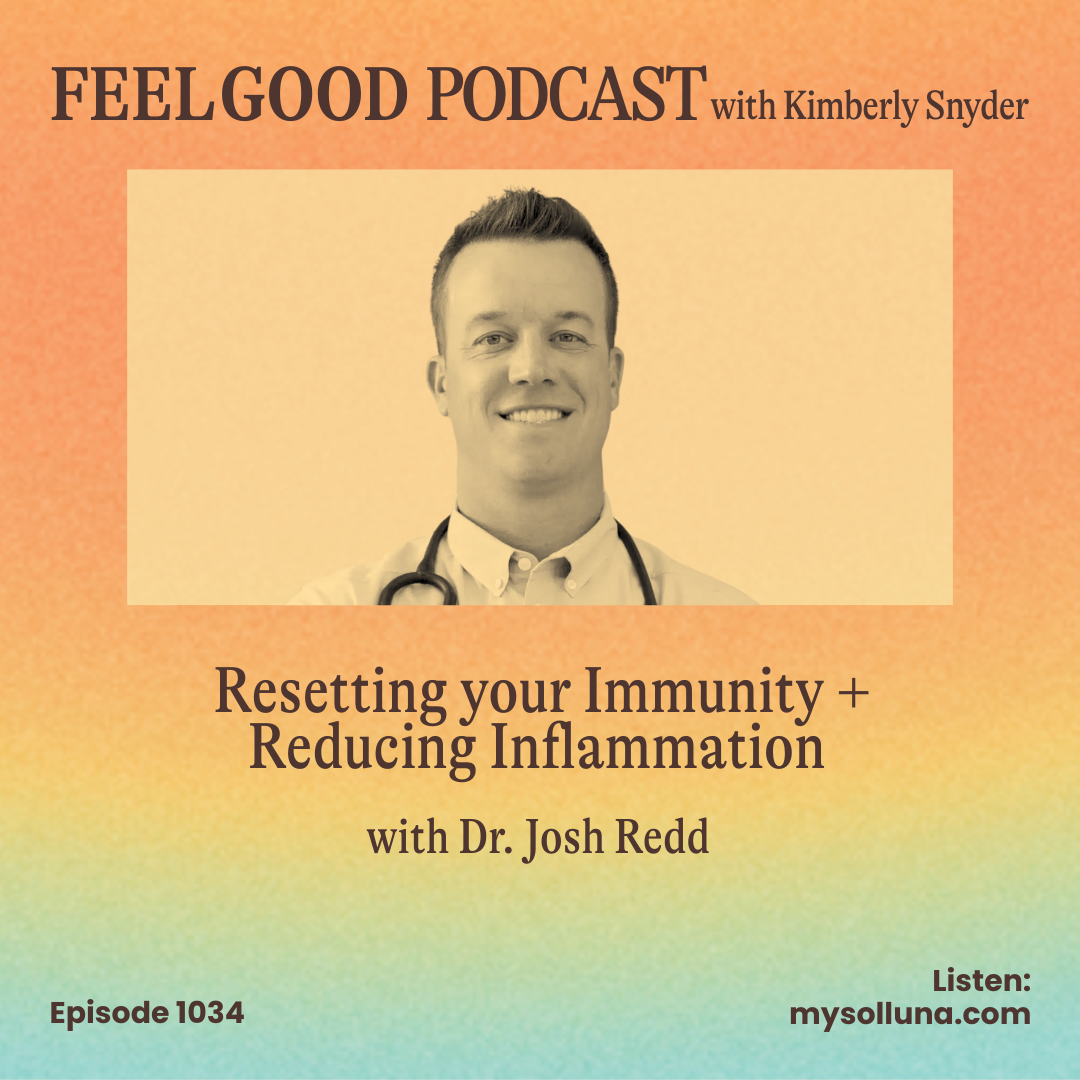
This Week’s Episode Special Guest: Dr. Josh Redd
Episode Summary:
In this conversation, Kimberly and Josh Redd delve into the critical topic of inflammation, exploring its prevalence, symptoms, and the various health conditions it can exacerbate, including autoimmune diseases and fertility issues. They discuss the impact of diet, gut health, and environmental toxins on inflammation, as well as the promising role of stem cell therapy in managing chronic inflammatory conditions. The conversation emphasizes the importance of education and proactive health management, encouraging listeners to take control of their health through informed lifestyle choices.
Dr. Josh Redd Resources:
Website: DrJoshRedd.com
Book: THE 30-DAY INFLAMMATORY RESET: A Complete Guide to Healing Your Immune System
Social: IG:@drjoshredd TikTok{ drjoshred
Bio:
Dr. Josh Redd, NMD, MS, MPHb, is an industry leader in functional and personalized medicine. With over 12 years of post-graduate education—including two master’s degrees and two doctorate degrees—he brings an unmatched depth of training and experience to his patients. His expertise in regenerative medicine includes over 1,000 precision-guided injections for spinal, joint, and soft tissue treatment, helping athletes and active individuals optimize performance and accelerate recovery.
He holds an MS in Human Nutrition and Functional Medicine, an MPHb from Johns Hopkins (with an emphasis on molecular biology and immunology), and a Doctor of Chiropractic from Parker University. Most recently, he graduated from naturopathic medical school and completed his residency in regenerative medicine and stem cell injections through Bastyr University.
Dr. Redd is the founder of RedRiver Health & Wellness, one of the largest functional medicine clinics in the U.S., with eight locations across Utah, New Mexico, Nevada, and Idaho, and PalmaVita Clinic, a regenerative medicine and athletic performance center in Spanish Fork, Utah.
EPISODE SPONSORS:
FATTY15
OFFER: Fatty15 is on a mission to replenish your C15 levels and restore your long-term health. You can get an additional 15% off their 90-day subscription Starter Kit by going to fatty15.com/KIMBERLY and using code KIMBERLY at checkout.
USE LINK: fatty15.com/KIMBERLY
Chapters
00:00 The Rise of Inflammation Awareness
03:04 Understanding Inflammation Symptoms
05:59 Inflammation’s Impact on Children
09:00 Autoimmunity and Inflammation
12:02 Dietary Influences on Inflammation
14:51 The Role of Gut Health
17:59 Environmental Toxins and Inflammation
21:30 Big Picture Health Strategies
23:53 Cooking and Nutrition Control
25:25 Understanding Stem Cell Therapy
28:56 Stem Cells and Inflammation
31:55 Innovations in Stem Cell Treatments
34:19 Insurance and Accessibility of Treatments
[RESOURCES / INFORMATION]
SOLLUNA PRODUCT LINKS
- Glowing Greens Powder™
- Feel Good SBO Probiotics
- Feel Good Detoxy
- Feel Good Digestive Enzymes
- Feel Good Starter Kit
- Feel Good Skincare
KIMBERLY’S BOOKS
- Chilla Gorilla & Lanky Lemur Journey to the Heart
- The Beauty Detox Solution
- Beauty Detox Foods
- Beauty Detox Power
- Radical Beauty
- Recipes For Your Perfectly Imperfect Life
- You Are More Than You Think You Are
OTHER PODCASTS YOU MAY ENJOY!
- How the Power Foods Diet helps with Weight Loss with Dr. Neal Barnard [EP. # 877]
- How Not to Age with New York Times best-selling author Dr. Michael Greger [EP. #873]
- Simple Ways to Use the Power of Herbalism in Your Daily Life with Rachelle Robinette [Episode #1026]
- The Importance of Nitric Oxide and How to Optimize our Body’s Production of it with Dr. Nathan S. Bryan [EP. #1022]
- Heart Healthy, Plant-Based Eating with Dr. Jenneffer Pulapaka [Ep. #1021]
- The Science of Longevity: Plaque Heart Scans, Cancer Screening, Glutathione & More with Dr. Julianna Lindsey [EP#1018]
Powered and Distributed by: PodcastOne
Transcript:
Kimberly (00:00.728)
Well, hey, Josh, thank you so much for joining me from Utah, I believe you said. So all our conversations, Josh, are really intended to, of course, support people’s well-being, their vitality, the quality of their life. And I love how we’re going to focus on this inflammation conversation, which you dig into so deeply in your new book, because it’s quite shocking how prevalent
Josh Redd (00:05.78)
Thanks for having me.
Kimberly (00:30.176)
inflammation is today. Maybe it always was there, but everybody seems to be talking about it now. We know there’s modern influences which may be more exacerbated than in the past, like toxin levels. But do you think that it’s something, Josh, that was sort of always under the radar and now it’s gaining more traction and conversation?
Josh Redd (00:52.045)
No, and you know, I’ve had a clinic for the last 17 years. We’ve probably have one of the top autoimmune clinics and we’re seeing a significantly increased spike of inflammation just within our patient population. But I think over the last 40 years, we’re seeing inflammation get grow and things that induce inflammation are getting more and more. We’re surrounding ourselves with inflammatory lifestyles, inflammatory products, and it’s just getting worse. And inflammation is really the mechanism of almost all disease in our
Kimberly (01:04.565)
Hmm.
Josh Redd (01:21.573)
country. And so this is a topic that we definitely need to talk about. And it’s something that we need to address if we want to improve our public health policies, inflammation is really the root of what’s going on there.
Kimberly (01:22.754)
Yes.
Kimberly (01:34.67)
Well, at the beginning of the book, you talk about symptoms of inflammation. And sometimes I think it can be challenging for people to distinguish, I’m chronically fatigued. This is part of normal aging. Or people think they’re having normal PMS symptoms or menopausal symptoms. Whereas as you point out, the inflammation underneath can be exacerbating these conditions. So how would a lay person
start to distinguish what’s normal and what’s more heavily linked to inflammation.
Josh Redd (02:07.897)
Yeah. So you mentioned perimenopause symptoms. When we’re going through perimenopause, inflammation will significantly exacerbate perimenopause and make those symptoms way worse. Just simply calming down perimenopause or calming down inflammation will improve perimenopause quite substantially. Just improving inflammation. You could have joint pain, intestinal problems, brain fog and fatigue. When you’re depressed, that’s a really common symptom of inflammation. Back in the old days, we used to think
decreased neurotransmitter, we just replace it with another neurotransmitter and that’s how we treated depression and mental illness. Now that we’re learning that a lot of mental illness is derived by brain inflammation and as we improve the brain inflammation, we improve the overall mental illness and the problems that they’re struggling with. In children, it’s really sad when we deal with inflammation in children, it could be neurobehavioral type issues, slow learning, problems at school, ADD.
Kimberly (02:48.27)
Thank
Josh Redd (03:04.579)
all those different signs and symptoms that we see with our children. It’s kind of a scary thing for us when we deal with children with high inflammation is that it can minimize the growth of their brain. And if you don’t improve it overall, by the time they get 25, their brain can’t develop anymore. So the likelihood of having long-term issues just simply from brain inflammation in children can be extremely high. They’re more likely to be incarcerated, more likely to get divorced.
more likely to have neurobehavioral type issues long-term. so inflammation can present in a variety of different ways. And it’s something that we need to look at and we need to address and we need to improve as best as possible. The heartbreaking thing for me is when we start to see inflammation in our children, look at what our kids eat, for example. They wake up and for the most part, they’ll have pancakes or cereal for breakfast, which is inflammatory and causes problems with blood sugar levels. Then they go to school and they might have, you know,
chicken nuggets and milk, then they come home and they might have some candy and then their dinner, who knows what that looks like. But they’re literally living this inflammatory lifestyle that’s causing problems with the brain, the hormones, the gut, you name it. And these kids are really struggling too. Same thing with adults, right?
Kimberly (04:05.379)
Yeah.
Kimberly (04:19.968)
Hold on Josh, before we move on from that topic, because that section did really stand out to me in the book where you listed some of the conditions with children that correlates with inflammation or in some cases can it be causative. The first one you list was autism. It’s 350 % elevated inflammation or whatever that number was. Have you found in your research that if the parents are more inflamed,
If the child very early in life is inflamed, can actually be, and I know autism is a complex topic and probably multifactorial, but exacerbating or potentially causative.
Josh Redd (05:02.235)
When we see those children suffering with autism in our office, it’s almost 100 % likely that their parents have some type of autoimmune condition, ironically. Yes, we see a really common correlation with parents with autoimmunity and children that are suffering with autism. And as we improve the inflammatory component in those suffering with autism, we see a lot of incredible strides and improvements just within their condition specifically.
Kimberly (05:07.319)
Yeah.
Kimberly (05:12.23)
Really? Wow!
Josh Redd (05:31.887)
But when somebody is extremely inflamed as an adult and is suffering with inflammation during their pregnancy, they can increase the chances of autism as well. And you’re right, autism is a subject we wanna be extremely mindful of and cautious with just when we speak about it, right? It’s multifactorial. There’s so many different things that can cause it and trigger it, but we do see a significant correlation with autism and parents with autoimmunity for sure.
Kimberly (05:32.162)
Mm.
Kimberly (05:50.764)
Yes.
Josh Redd (05:59.855)
which is probably one of the largest inflammatory conditions in our country right now. And almost 20 % of our population now has auto antibodies attacking some form of tissue, which is absolutely crazy.
Kimberly (06:14.15)
We hear so much about the rise of infertility and sperm motility, just so many things. And then you also hear about the prevalence of autoimmune conditions. So perhaps there is some sort of link.
Josh Redd (06:29.818)
For sure. So let me give you this. Inflammation will degenerate the lytic cells of the testes in men, which will in turn cause sperm problems and infertility issues as well. Also, inflammation will increase testosterone production in females from the theca cells of the ovaries, which will actually induce more problems with infertility as well, right?
Kimberly (06:42.915)
Wow.
Kimberly (06:50.187)
Kimberly (06:55.01)
like decreased ovarian reserve.
Josh Redd (06:57.932)
Yes. And then at the same time, what we see is that when somebody has, let’s say blood sugar imbalances and cortisol defects, that significantly improves or increases inflammation, which will steal away reproductive hormones and put them into cortisol. So somebody who’s living an inflammatory lifestyle will have their reproductive hormones stolen away and converted into cortisol just because of high inflammation. Right. And then we talk about autoimmunity. Autoimmunity is derived by
Kimberly (07:22.414)
Wow. And we’ll get to some good news, because I know this sounds to our listeners like lot of doom and gloom, but it is so important to be aware. And there is a really empowering message that we have to share, but it is important to create this awareness. So please go out,
Josh Redd (07:39.451)
Yeah, and you’re so right to someone that might be listening to this podcast and be freaking out and concerned and worried. But here’s what’s really cool is we’ll have a patient that’s struggling with severe inflammatory conditions, severe autoimmune conditions, infertility, you name it. And we’ll put them through this inflammatory reset. And within 30 days, they went from having zero to five good days a month to like 20 to 25 good days a month. A lot of these individuals just aren’t educated on what causes inflammation, how to find inflammation, how to attack it.
Kimberly (07:53.73)
Yeah.
Kimberly (08:03.266)
Ready.
Josh Redd (08:09.444)
properly, but once they do, they’re the expert in their own health and their quality of life can be significantly improved and impacted, right? And so you’re 100 % right. There’s so much that can be done. This can be scary and problematic, but then look at the same time, sometimes just talking about these things can bring people hope. Cause we see the sickest of the sickest people come into our clinics.
And they literally feel like they’ve lost all hope. They feel crazy. They’ve been told that they’re normal. And in reality, they’re a complete wreck. And there’s so many things that you can do that’s better than just here’s a pill for your symptoms and I’ll see you in six months. Right? We want to get to the mechanism of why these patients feel bad. And when we do that, their quality of life is substantially better. And for the first time in their lives, they’re like, this makes sense. I finally have hope back. I’m finally the expert in my own health. I don’t have to have anyone dictate what I do or what I don’t do.
Kimberly (08:46.766)
Exactly.
Kimberly (09:03.576)
So Josh, let’s say someone does actually have a condition, right? I met a woman on the beach the other day in Hawaii and she and her husband have been married for a year. They were helping me and my kids build this river in the sand and she shared with me, we were there for a whole day with them on the beach and she said, I really wanna be a mom, she’s 28 years old, she just got diagnosed with MS, right? And then I think about my friends that have Crohn’s.
or rheumatoid arthritis or endometriosis or PCOS, a lot of the conditions you mentioned in the book. So we can say you can have a condition, but at the same time, you can manage it with lifestyle. And there is hope to feel better. There is hope to have healthy babies. They don’t have to preclude you. Cause she was distraught saying, have MS and you know, these figures, the stats.
Josh Redd (09:55.515)
Yeah. No, a thousand percent. There’s so much that we can do to help these individuals significantly improve, dampen their autoimmune response and their inflammatory response, and then have them carry and hold and birth an incredible, healthy baby, right? And then here’s the, yeah. Yeah. But here’s the cool thing too.
Kimberly (10:19.074)
Okay, that’s what we want, healthy babies.
Josh Redd (10:25.114)
This is why educating our population is so important because we say that it’s familial and that it’s genetic and that it’s just gonna get worse and worse and now my kids might have it all and they’re gonna get worse and worse. But what’s cool is we can unwind this and we can correct it and we can start implementing real therapeutic principles within our home for our kids so that it minimizes their chances by having a severe autoimmune condition down the road, right? So that they can be in control of their life.
Kimberly (10:51.181)
Yeah.
Josh Redd (10:55.182)
and their health better than most doctors do. So for example, like my kids, I have a 17 year old boy and then I have four little girls down to 10 and it is the best. But the most likelihood of them developing autoimmune disease just as females is about a one to seven likelihood, right? A lot of females will develop an autoimmune disease in their lifetime.
Kimberly (11:05.336)
Ha
Josh Redd (11:21.636)
But that’s with the really crappy ultra-processed diet. That’s with our high stress lives. That’s with them not being educated on what causes all this stuff. So my kids right now, they know more about nutrition and diet and lifestyle and how their environment impacts them than probably most doctors, and I’m being dead serious. And they know what to do and what not to do. And we don’t force them to eat certain way. We don’t force them to do a certain thing. They feel significantly better.
when they’re eating gluten-free. They feel significantly better when they’re not eating inflammatory foods. So they’re in the kitchen creating stuff, making stuff, doing all those things based off of, they know what food helps them feel better and what foods don’t, right?
Kimberly (11:50.53)
Yes.
Kimberly (12:05.464)
And, Josh, are your kids, is your family dairy free?
Josh Redd (12:09.625)
For the most part, are. know, conventional dairy, there’s, here’s kind of the cool thing. With my clinic, we probably see anywhere from two to 300 patients a day throughout my 10 clinics across the country and around the world, really. We see some of the sickest patients you could possibly ever see. They’ve been neglected by everybody else up to this point and they come to us just like grasping for answers and help, right?
And so we kind of have our own research center within our clinic. And what we found is some of the most inflammatory foods based off of our testing and our patient symptoms is gluten and conventional dairy. We see that those exacerbate an immune condition tenfold. We see that that induces inflammation like crazy. The way that we create wheat, for example, and we create bread and make bread in our country compared to what we did 40 years ago.
Kimberly (12:40.6)
Mm.
Kimberly (12:50.135)
Yes.
Kimberly (12:57.143)
You right.
Josh Redd (13:04.255)
is extremely, extremely inflammatory. It’s not even like real bread anymore. It has the nutrient kind of, let’s say like a tablecloth or napkin pretty much, right?
Kimberly (13:13.318)
glycogen, like all these things that are added in the gliadins, like all the preservatives.
Josh Redd (13:15.223)
Yeah.
Yep, yep. We had the glyphosate, which causes so many problems. We fortify it with folic acid, which is actually a severe issue. The reason why is because if we have a methylation problem of the liver, which about 40 % of our country does, we can’t break down folic acid. And so folic acid tends to build and get bigger and bigger and bigger throughout our body. And then it causes anxiety, depression, flares up the, flares up an immune condition. It causes more inflammation. just, there’s so much that goes into it.
Kimberly (13:44.379)
and
Josh Redd (13:47.246)
Then we store our wheat sometimes for two years and it produces a mold that produces an aflatoxin, which then flares up our immune response and causes issues with our immune system. And then we take out the protein, we add fiber, or we take out the fiber, take out the protein and we add sugar. And that’s our bread on the shelf. It’s not even real food anymore. And this is one of the, no, go ahead, go ahead.
Kimberly (14:08.978)
What do you think about, sorry, Josh, like homemade, Blue Zones in Greece is making their, you know, handed down sourdough from scratch, where there’s starter and it doesn’t have any of that. Because being gluten-free myself, but going to Europe and having that type of bread, I don’t seem to have the same response.
Josh Redd (14:25.337)
Totally. Yeah, and most of our patients don’t either. Most of our patients can fly to Europe and have bread in Italy, for example, not have any issues. They come back like, I ate so much pasta and had bread and pizza and I can never have that here. And I felt great. I actually lost weight. I lost inflammation, right? But you’re right. If you’re not a celiac disease patient, you can get away with homemade sourdough from those…
Kimberly (14:38.446)
Thanks.
Kimberly (14:52.941)
So.
Josh Redd (14:54.603)
generational wheats and things like that for sure. It’s way healthier than what we do, know, conventional bread. But just so you’re aware, so our kids, we don’t really eat much dairy and we don’t really eat much gluten here. We don’t, if our kids want to do it, great, they can. But now our kids feel a lot better when they’re gluten free for sure. And for the most part, dairy free.
Kimberly (15:06.99)
Right.
Kimberly (15:19.342)
Great. Well, loved how, yeah, there’s so many notes I took when I was reading your book. I love how you highlight, of course, fiber and gut health as well. I thought it was interesting you had this section on protein insufficiency, Josh, because everything I see seems to feel like people are overloading protein these days in different ways and sometimes at the detriment of focusing on whole foods.
and fiber, unfortunately. Not in every case, but sometimes I see people, protein shake, protein bars, protein, protein, protein, and now they’re eating more fragmented foods. Don’t you, culturally you see that, right?
Josh Redd (15:58.618)
Totally. No, I agree with you 100 % where we kind of have a mixed population where we have a portion of our population that is significantly protein deficient. They barely eat any protein and that causes unrhythmic blood sugar levels. That causes blood sugar instabilization. That stresses out the adrenal glands. That causes other problems there. But then we have another group where you’re right. They’re doing protein with everything and it’s not even real protein. It’s just…
fragmented protein like you said, and then they have little to no fiber, they have little to no vegetables, little to no fruit, little to no any of that stuff. And then the gut microbiome stays stagnant. And then we have tons of gut issues too, just from that, right? Guess how long it takes to change the gut microbiome if we eat the same foods every single day.
Kimberly (16:32.224)
Yes.
Kimberly (16:50.358)
the same foods every single.
Josh Redd (16:51.511)
Yeah, if we’re eating the same foods over and over and over, guess how much it takes to destroy the gut microbiome and really impact it in a negative way. It takes three days. Yeah, three days.
Kimberly (17:05.038)
I was going to say one day, three days. Well, let me tell you something, Josh. My husband tried the carnivore diet and he did his blood work before and afterwards, his calcium score in six months. And as you said, there was very little fiber, very little antioxidants, just organs and meat. And it just tanked his health. It was insane. And so thankfully he does eat fiber now. He is an omnivore, but I personally saw.
the effects of just focusing on protein.
Josh Redd (17:36.601)
Totally, totally. Yeah, that can definitely cause a lot of problems. But here’s the things for us too. Every patient, every person is significantly different. What flares you up is gonna be different than what flares your husband up and what flares the other patient up. So what’s cool is we can kinda cater this to the individual and what helps them feel the best. And it can be different from one patient to another. What flares up, you know, the inflammatory response can be different. But the best part about what we do here in this book,
Kimberly (17:46.158)
course.
Josh Redd (18:04.961)
It’s going to take you through a program to where you’re educated, you know what to do and what not to do. And then you really base off your diet, how you feel. And after 30 days, as you add foods back in, you’ll know instantaneously whether something flares you up or whether it doesn’t. And you can kind of build this program based off of how you feel. And it’s significantly better than obviously eating this, you know, a high
highly processed diet full of sugar and that’s that.
Kimberly (18:40.494)
Well, it’s sort of like with the food allergy conversation, Josh, we know so many people are talking about food allergies and issues with different types of foods. We’re inflamed, so then the foods are bothering us. But then as we strengthen our microbiome, we should be able to ingest a wider variety of food. So you’re suggesting in book, you can eliminate certain foods, rebuild the strength, and then reintroduce those foods. So it’s a very fluid.
Josh Redd (18:59.33)
Yeah. You’re exactly right.
Kimberly (19:08.782)
program in terms of introducing back more variety.
Josh Redd (19:12.246)
Yeah, and I’ll explain this too. As we become really, as we eat the same foods over and over and over, our gut microbiome becomes stagnant and we actually will be more intolerant to foods than if we ate a variety of foods. So when we have a patient that’s really inflamed and their autoimmune condition is really flared up or their inflammatory condition is really flared up, they might have a list of 15 foods that they react to.
Kimberly (19:24.215)
Yes.
Josh Redd (19:37.214)
Once you calm all that stuff down and you improve the intestinal membrane, you improve digestion, you improve overall inflammation, they might only have two foods that they react to, which is so cool, right? So your food intolerances can simply change based off of inflammation and based off of your intestinal permeability and all that stuff as well.
Kimberly (19:47.584)
Right. Right.
Kimberly (19:54.339)
Right.
Kimberly (19:58.22)
Right, which of course, like you said, what’s exciting and empowering is that it really does improve as we improve our overall lifestyle. So speaking of which, I love how you have a section on toxins, which, like where do we begin? Everything we’re putting on our bodies, in our homes, but I can’t help but call out one of these toxins, and you mentioned as well the dioxin, Josh, which,
Josh Redd (20:06.638)
Yeah.
Kimberly (20:25.558)
Some reports I’ve read say 90 % come in through animal foods because they persist in the environment. And so they bioaccumulate as you go up the food chain, even with pasture-raised meat.
Josh Redd (20:37.804)
Yeah, that is definitely true. And so you need to be really cautious about that process for sure, because the dioxins can flare up the inflammatory component and it can also cause problems with hormones. It can cause problems with our gut. It can cause problems with our brain. It can cause a number of things too. For us though, when we have a really, really sick patient, I think the biggest goal, it’s not really because they’re eating, you know,
Kimberly (20:53.037)
Yeah.
Josh Redd (21:07.008)
certain types of meat or things like that or they’re not eating the lactar of, it’s really based more off of they’re exposing themselves to a variety of different environmental toxins. They’re eating really, really bad diets. They’re eating things, they might not be eating sufficient enough. They have really unstable blood sugar levels. And as we start to improve those, their overall resilience starts to improve and they can get away with some of those things without having a severe impact, right?
Kimberly (21:21.344)
Great.
Kimberly (21:36.822)
Yes, it’s looking at the big picture.
Josh Redd (21:39.447)
Yeah, the biggest goal for us is not to restrict you from a gazillion things. The biggest goal for us is to do things to help improve immune resilience and then to teach you and educate you and show you what to do and what not to do so that you can be the expert in your health moving forward. And in doing so, you don’t have to live in a bubble, right? I think sometimes there’s so many different environmental toxins that we expose ourselves to. I like to, with our patients, I like to just tell them, hey, what’s one easy thing that you can swap?
or change out, that’s not gonna overwhelm you and let’s work on that. And as you master that, then we can work on the next thing. And as you master that, we can work on the next thing. And we just slowly and steadily improve this process so that we’re not like overwhelming you mentally and physiologically just trying to live in this, know, environmentally stable thing, right? And then like…
Kimberly (22:31.63)
Yeah, I get it. It can start to feel restricting. But you know, Josh, one thing that I feel is such a simple solution, and maybe not everybody’s open to it right now, but I found how often can we eat at home, right? Because then you’re controlling, you’re avoiding seed oil. And in restaurants, you know how they’re pouring hot sauces in these plastic containers, and there’s just so much out of your control. It’s not always organic, whatever it is. So
I don’t know, I find when people are able to use simple recipes and eat at home, even if it’s one meal more or a couple meals more a week, you do have more control over toxins in your health. What do you think?
Josh Redd (23:10.917)
I think you’re 100 % correct. I think that’s absolutely right.
Kimberly (23:15.252)
Well, that’s why, of course, in your book, you have so many different recipes. You and I were chatting before we recorded. I love that there are lots of plant-forward recipes, plant-based recipes, and there’s also recipes for omnivores. you
Josh Redd (23:27.478)
Yeah. Yeah. Tons of, there’s a variety of recipes based off of how you eat, right? And you can kind of pick and choose what’s best and base that off of what you like the best and navigate that, you know, for your own needs and how you eat too. So whether you’re omnivore or whether you avoid me altogether, there’s a variety of different ways that we show you in this book, how to eat and what to eat. And there’s just a few different things that you can do and a few different strategies that you can add that can make a significant impact for your health.
whether you eat more meat or whether you eat no meat at all, is great, which is what we tried to do.
Kimberly (24:00.294)
Well, who’s doing the cooking in at your home? Is it your wife? Do you like to cook for all of your kids?
Josh Redd (24:05.272)
I barbecue and I cook sometimes when she’s obviously not here. Our kids do a ton of cooking now. My wife’s done a really good job at teaching the kids and helping mentor them how to cook. And so our kids make dinners for us. We’ll wake up in the morning, our kids will have breakfast ready for us. Lunch and snacks and I mean, yeah, our teenagers do an incredible job. They cook more than I do for sure. I love the barbecue. I love cooking.
Kimberly (24:21.344)
What? These teenagers are cooking for you?
Josh Redd (24:35.307)
know, smoking and doing those types of things. But our kids cook a ton. And my wife, you know, she’s incredible. She loves cooking as well. Yeah, it’s great.
Kimberly (24:46.85)
Did she help you with any of these recipes?
Josh Redd (24:49.153)
She did, she helped a ton, which is great. And not only that, she’s helping me cook them on a consistent basis. So we’ll do videos on my social media on some of our favorite recipes and where we’re in the kitchen cooking and it’s pretty cool, yeah.
Kimberly (25:04.748)
Wow. Well, I also wanted to bring up that you’re an expert, Josh, in stem cell therapy. And there’s a section in the book where you talk about that. Could you inform us a little bit about it? Who could benefit from it? think a lot of us hear about it. It’s even offered at certain med spas and clinics. And it’s hard to know what is authentically going to help, what we’re just spending money on. Can anyone get these IVs?
Obviously, we’re focusing on inflammation, but just in general. That’s big topic to throw at you, but I love how you talk about it in here.
Josh Redd (25:37.014)
Yeah
Josh Redd (25:42.348)
Here’s what’s really cool is stem cell therapy can be life-changing for a variety of conditions It does so many beneficial things and we can do stem cell IVs Where we you know inject exosomes? Into the blood and it bypasses the blood-brain barrier and can have significant therapeutic benefits on the brain And then we can also you know have therapeutic benefits in the heart and the lungs But then we can also inject stem cells in localized areas of dysfunction like joints the spine
Kimberly (25:51.608)
Right.
Josh Redd (26:12.095)
all the elements there too, which is great. With stem cells, we used to take bone marrow and fat and cycle down stem cells and then inject those back into the body and we could see lots of benefits. What we’ve been doing now is we’ve been injecting umbilical cord stem cells so somebody can deliver a baby and then they can donate their umbilical cord. And then we take that umbilical cord and cycle down the stem cells from there and then we can inject them into those areas and it’s inducing
a ton of growth factors and cytokines and regenerative cells that allows the body to start to heal itself and start to regenerate itself and improve, which is quite, quite fantastic. Having the combination of what we do and the patients that we see with stem cell therapy is just taking our clinic to a whole new realm and a whole new level for sure. I love the stem cell aspect of it.
Kimberly (27:04.942)
Well, what about non localized? It makes sense you’re putting in the joints, but what if you’re doing it generally through an IV? What can that help with?
Josh Redd (27:11.627)
We love that. And a lot of people will do that. A lot of our patients that are suffering with inflammation and chronic autoimmune conditions, we’ll do stem cell therapy every about three months through IV. And that’s great because we’re injecting stem cells into the vascular system. And then those stem cells, those growth factors and cytokines and regenerative cells can migrate throughout the body and induce the body’s healing cascade.
Kimberly (27:16.846)
Right.
Josh Redd (27:40.183)
to improve and to improve certain areas and areas of dysfunction. It also significantly decreases inflammatory cytokines, which is great. Lots of people don’t realize that we could look at somebody who has really high inflammatory markers and is struggling with a lot of inflammation, and then we can do a stem cell IV and then retest and see that their inflammatory markers improved quite substantially just from a stem cell IV. We love stem cell IVs for sure.
Kimberly (28:06.158)
Well, what about going back to the earlier conversation I had with the woman with the MS who was wanting to get pregnant or say for all the women out there, their partners have low sperm motility or endometriosis. How can stem cells help with fertility issues?
Josh Redd (28:23.243)
Yeah, so one, decreases the inflammatory cytokines. One, it can improve the body’s overall healing response, which is great. So infertility, autoimmune conditions, depression, all those different things. Stem cells can have an impact for those. But we like to use it as just one tool to an added puzzle, right? So as we do that and we work on, let’s say, blood sugar imbalances and hormone dysfunction and the gut-brain barrier and other things,
Kimberly (28:38.734)
Mm.
Kimberly (28:43.075)
Yes.
Josh Redd (28:52.351)
in conjunction with the stem cell IVs, it could be a significant therapeutic thing that we can add in that will be one added tool to our belt, I guess you can say.
Kimberly (29:03.0)
Yeah, it’s nice to take that approach where it’s not the magic bullet, I think, seeing a 360. Yeah, tell us what you’ve seen. Tell us some things.
Josh Redd (29:11.359)
It’s powerful though. Like let me tell you right now, we do something. Yeah. We do standard ozone and we do stem cell IVs for something called SERS. Have you heard of SERS before? So SERS is a condition where you have this chronic inflammatory response that’s just, it’s almost unstoppable and it’s one of the hardest conditions to improve.
Kimberly (29:26.654)
No.
Josh Redd (29:37.715)
It’s linked to like Lyme’s disease and mold and not immune conditions. But sometimes these individuals just don’t get help anywhere else. They can make significantly significant dietary changes, know, nutrition changes, environmental changes, and have little to no impact because this inflammatory cytokine response is so high. But what we found is that with these individuals that are almost untreatable with certain cases, they can significantly improve with stem cell IVs and then also with
Kimberly (29:37.731)
No.
Kimberly (29:56.503)
Wow.
Josh Redd (30:07.039)
standard ozone treatments, where we basically take their blood out of one arm, it gets ozonated, it goes through a laser, and then it gets filtered, and then it goes in through the other arm, and you can filter about a third of your blood volume in one sitting, but it significantly decreases inflammation and improves these individuals’ overall health. It helps with bacterial infections, viral infections, mold exposure, all these things that can be really hard to
Kimberly (30:09.282)
Mm.
Kimberly (30:22.884)
my god.
Kimberly (30:35.95)
Just taking toxins out of the blood literally
Josh Redd (30:36.992)
What’s that?
Yep, yep, 100%. And then you couple that with stem cell IV therapy and we’re seeing these individuals that even for us, we see the sickest of the sickest patients in the world and we improve our patients’ lives so much better. A lot of our patients will have anywhere from zero to five good days a month and they’ll end up having 20 to 25 good days a month. But then there’s this underlying small percentage of people that actually have SIRS that even with that, they just don’t improve.
But what we’re finding now with stem cell IVs and with the standard ozone is now these people that were almost impossible to help improve are now improving quite dramatically with these therapies. It’s really cool. And it’s only getting better every year. And that’s kind of the cool thing. The things that we used to do five years ago are actually substantially different than the things we do now. We don’t want to be stagnant practitioners where we treat you like this 1960 model form of treatment.
Kimberly (31:18.253)
Wow.
Josh Redd (31:33.166)
and we just heard you around like sheep and treat you all the exact same, right? I mean, the biggest goal is for us to consistently be learning and educating ourselves and find out the new and best therapies out there that will help these patients where they can’t be helped anywhere else. And we’re seeing incredible things with stem cells and, you know, with centered ozone. At Johns Hopkins, when I was there, my professor’s lab, he could sever a mouse’s spine and make it quadriplegic, and then they could inject stem cells and it could fully walk again.
Kimberly (32:02.168)
Come on. Well, also that’s really mean to the mouse, but it’s also amazing to hear.
Josh Redd (32:02.954)
Yeah, yeah. So.
Josh Redd (32:08.959)
Yeah, totally. Totally. But what’s really cool is we’re obviously not there yet from a stem cell standpoint, but it’s getting there, right? And every year, the therapeutic benefits that come from stem cell therapies is just improving and getting better and better and better. Now, we have to be really mindful about what we’re utilizing the stem cell. So the way that we treat patients is everything that we do is with guided therapy.
The stem cells that we use are approved by a ton of different agencies that just make sure that the efficacy and the potency and they’re done and made the right way. So we have to kind of jump through all those hurdles. You can get stem cells from other places that could end up causing problems or issues or that aren’t as effective as people lead you to believe. So we wanna make sure that we’re…
Kimberly (33:00.056)
They can actually cause negative effects if you get the wrong.
Josh Redd (33:03.73)
It can, yeah. It can, yeah. we just, you know, for us, we just want to make sure that we’re using the most effective and the best form of stem cells that we can and that we’re using the right labs that are approved by a gazillion different agencies, and vetted and tested and all those things as well, right? But what’s cool is that it’s getting better every year and, you know, in 20 years from now, it’s going to change all of healthcare, in my opinion. It already is.
And that’s one of reasons why I was that, you I already had eight autoimmune clinics and functional medicine clinics across the United States. And I remember I was in my class and we were going through that research and going through what they were doing. And I immediately just stopped at my tracks and said, I got to go back to medical school so that I can start doing stem cell therapy. And so I did just knowing that it’s going to completely change all of healthcare moving forward. And it will, and it already is changing quite rapidly on how we.
help those that are suffering without immune conditions and inflammatory conditions. And now even athletes, now I see quite a bit of high profile athletes who are injured, don’t recover well. Even during the season if they get injured, it will cut the timeframe down of them and getting back onto the field quite drastically as well. So it’s such a fun, awesome world that’s just getting better and advancing quite rapidly right
Kimberly (34:02.318)
Easy.
Kimberly (34:26.478)
Well, from an access point, is it covered yet by some insurance or if anyone’s listening to this and they’re interested, it a pretty high entry point or is there a ballpark you could give us if someone’s like, I’m so.
Josh Redd (34:37.814)
Yeah, so like for a stem cell IV, you’re going to pay anywhere from like $2,500 all the way up to $6,000 depending on what you actually do. And unfortunately, insurance won’t cover it. Insurance is one of those things that kind of makes people worse over time instead of getting better. It’s kind of strange. It will take 20 years for them to even consider stem cell therapy. They’re kind of a… We find now insurance companies are one of those things that is wrong with the system.
Kimberly (34:45.966)
Right.
Josh Redd (35:06.432)
We see a lot of severe chronic patients and they kind of dictate what these patients can and can’t do, what these doctors can and can’t do. For example, a lot of these patients, they’ll go to their doctor. The doctor can spend 15 minutes with them. That’s what insurance will cover. The actual insurance will dictate what medications that doctor can give the patient, which is insane. Even if the doctor thinks they need to be on a different medication, the doctor’s hands can be tied and they might have to give a medication that the insurance
Kimberly (35:06.766)
Yeah.
Kimberly (35:25.013)
Right. Right.
Kimberly (35:32.365)
Yeah.
Josh Redd (35:35.826)
says or requires. And so these patients aren’t getting the best care. They’re not getting in-depth treatments when they should. And that just causes problems. So let me give you an idea. I had a patient who was suffering for a year because she had severe pain in her head. And half of her face was going numb and paralyzed. And then it started to go through half of her body as well. And she had been to a ton of different neurologists throughout the country.
She came to me just pleading for any type of help. I started to do neurological exams and started to do different physical exams, just testing stuff. And her husband stopped me and it was like, it took me like an hour and a half, right? And her husband stopped me and was like, whoa, I just want to tell you not one of the neurologists that we took her to actually did and performed any of these tests. Like they didn’t even touch her, which is insane, right?
The old school way, we used to touch our patients and do neurological exams and do physical exams and really assess in depth what parts of the body that are functioning, what parts of the brain are functioning, what parts aren’t, right? But insurance is one of those reasons of why these doctors have their hands tied. And the doctor can do a 15 minute appointment and you can only do so much within that appointment time frame. And there we are, right? And so to go back to your question, insurance doesn’t cover it.
Kimberly (36:49.059)
Right.
Kimberly (36:57.229)
Mmm.
Josh Redd (37:01.93)
They probably won’t ever cover it for a long time, but it is getting cheaper and less expensive each year as well. We’re finding new ways to improve this and to make it less expensive. And there’s a lot of things that we can do to help with the patient too. So the access is, it can be expensive, but if it’s done the right way, it can help improve that patient’s quality of life.
Kimberly (37:18.146)
Yeah.
Josh Redd (37:26.53)
and all that and it’s just going to get better and better and it’s going to become less and less expensive but I would imagine that patients will pay cash for stem cell treatments for 20 years to come.
Kimberly (37:26.992)
yeah.
Kimberly (37:38.456)
What about ozone therapy that you mentioned?
Josh Redd (37:41.398)
Love ozone therapy, but that’s not covered by insurance either. But ozone therapy is pretty inexpensive. You can do standard ozone for a few hundred dollars. You could do eBoo, is about six standard ozone treatments in one, where you filter a third of your blood volume in one sitting. You can do that for around seven to $900. And that’s great, yeah. But if a patient can afford it, even the seven to $900 one, they could do standard ozone.
Kimberly (37:49.518)
Wow.
Kimberly (38:01.592)
Really.
Josh Redd (38:09.814)
which is pretty inexpensive and really effective. And you can do that one more consistently over a prolonged period of time and have just the same benefits.
Kimberly (38:18.732)
Wow. Well, I could see how much you lit up, Josh, when we started talking about stem cells.
Josh Redd (38:23.061)
I’ll be injecting, you know, it’s funny. I’ll be watching a movie or I’ll be watching TV or a sporting event. And then the next week that actor or that professional athlete’s in front of me in my office and I’m injecting them and instead of recovering in six weeks, they recovered in three weeks. And so I’m in there injecting people and doing what I do. And I think I had the best job on planet earth. It’s so fun.
Kimberly (38:27.007)
you
Kimberly (38:52.462)
So your clinic is in Utah, but you manage clinics nationally? Is that right?
Josh Redd (38:58.601)
Yeah, so my autoimmune clinics, I own eight of them and they’re in Utah, Nevada, Albuquerque and Boise, Idaho. And then I have a longevity clinic in Spanish Fork, Utah. But our autoimmune patients, we see patients from all over the world. We see patients that are suffering with inflammatory conditions from all over the world. We just need access to labs and we need to be able to mail you things. And a lot of them we can talk over the phone and go through that too.
Kimberly (39:09.302)
Okay.
Josh Redd (39:27.425)
but then we’ll have people that will fly from all over the world to see me for like the stem cell treatments and for the longevity stuff in Spanish for Utah. Yeah.
Kimberly (39:35.214)
Wow.
Exciting. where can well first of all, congratulations on your new book on all this exciting work you’re doing Can you tell us where we can find out more about you your clinics and also get your new book? the 30-day Inflammatory reset a complete guide to healing your immune system. Dr. Josh read
Josh Redd (39:50.889)
Yeah.
Josh Redd (39:57.831)
Yep, I love that. I love that. They can find me at drjoshred.com and then we have our autoimmune clinic and inflammatory clinics that are redriverhealthandwellness.com. And yeah, we have our book, The Inflammatory Reset. I’m on social media as Dr. Josh Redd, RE with two Ds. And yeah.
Kimberly (40:18.776)
Amazing. Well, congrats again and thank you so much for sharing some of your wisdom with us, Josh. Really fascinating. And I know that so many people will benefit from learning more about inflammation and all these healing modalities. So thank you so much.
Josh Redd (40:34.963)
Well, thank you for having me. really appreciate it. And welcome back from Hawaii.
Kimberly (40:39.258)
thank you. It won’t be long before we go back. Well, everyone, thank you so much for tuning in. I really encourage you to share this episode with anyone that is suffering from inflammation, autoimmune, as Dr. Josh and I talked about. It’s so prevalent. Parents could benefit from hearing this, so please share the episode. The show notes are at mysaloonah.com. We’ll link directly to Dr. Josh’s new book and his work and his websites.
Josh Redd (40:42.281)
I love it.
Kimberly (41:06.964)
and his handles, please go over once again, mysaluna.com with two L’s. I’ll also see you on social media at underscore Kimberly Snyder. I’ll be back here in a few days for our next episode. Till then, take great care of yourself and thank you so much for being part of the community and sending you all much love.
Okay.
0 Comments