
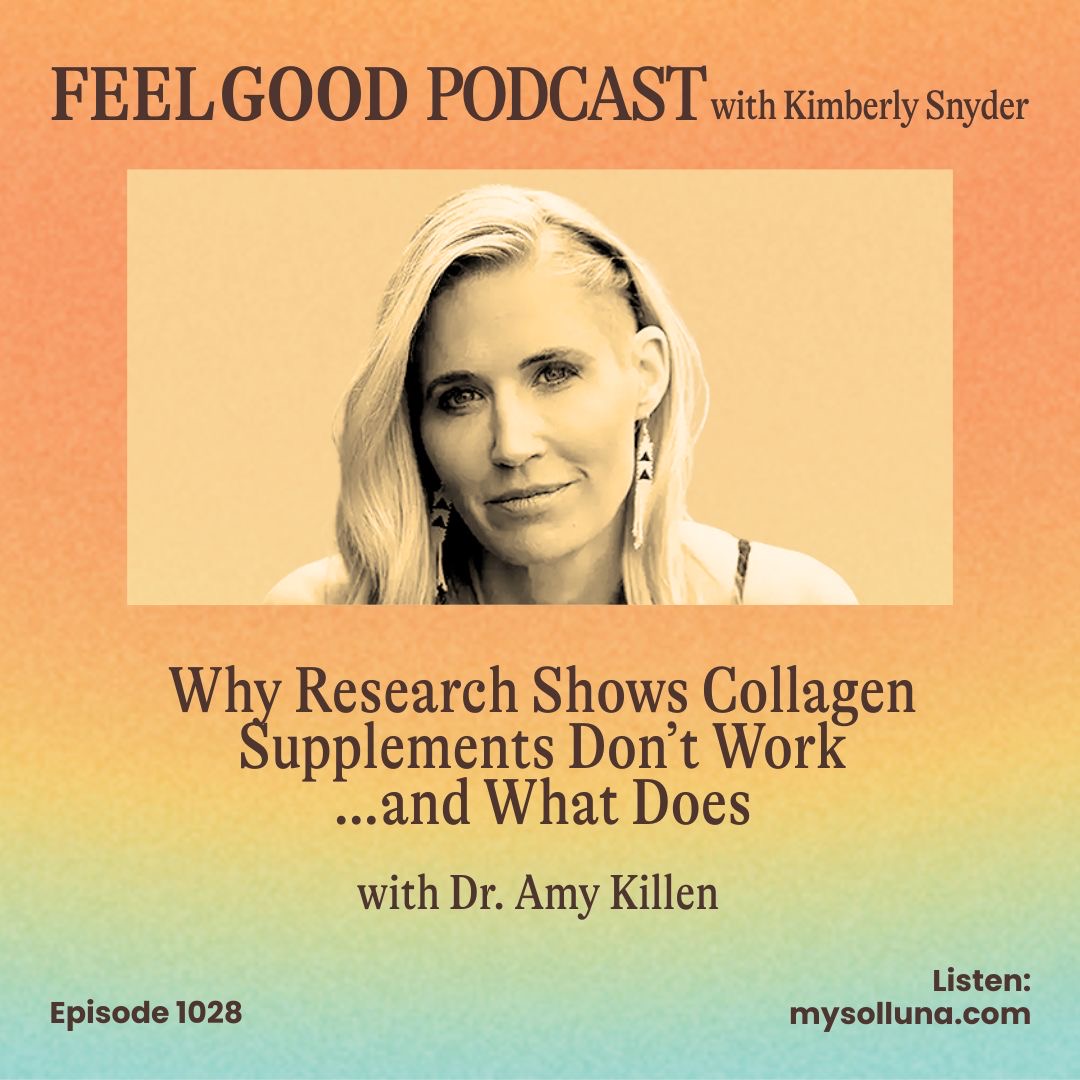
This Week’s Episode Special Guest: Dr. Amy Killen
Summary:
In this enlightening conversation, Dr. Amy Killen discusses the evolving landscape of wellness technologies and supplements, focusing on collagen, hormone replacement therapy, and the importance of ovarian health. She emphasizes the connection between inner health and outer beauty, particularly skin and hair health, while also addressing the role of lifestyle factors such as diet, stress, and sleep. The discussion extends to the potential benefits of peptides, the impact of sugar and caffeine on health, and the significance of melatonin for sleep. Dr. Killen empowers listeners to take control of their health and well-being through informed choices and lifestyle adjustments.
About Dr. Amy Killen
A leading longevity and regenerative physician, entrepreneur, speaker, clinical practice owner, author, and frequent media guest, Dr. Killen has become an outspoken advocate for empowering people to look and feel their best by combining lifestyle modification, integrative medicine, body-identical hormones, peptides, and regenerative therapies.
Dr. Killen, a former emergency physician, has firsthand experience with the bureaucratic obstacles that can delay critical treatments from reaching patients. Driven by a passion for healthcare innovation, she is dedicated to making effective yet underutilized diagnostics and treatments widely accessible. Dr. Killen is committed to transforming healthcare through entrepreneurship, education, and patient empowerment.
She is also the founder and CEO of the Human Optimization Project (HOP), a longevity-focused supplement company dedicated to providing women with unique, science-backed products designed for convenience and effectiveness. These easy-to-use, portable solutions target aging at the cellular level.
Additionally, Dr. Killen is the co-founder and Chief Medical Officer of Humanaut Health, a cutting-edge longevity clinic franchise. Humanaut Health combines hormone therapy, peptides, regenerative medicine, lifestyle medicine, and advanced diagnostics to deliver a tech-enabled, proactive approach to health optimization.
In her Utah-based practice, Docere Clinics, Dr. Killen and her colleague, Dr. Harry Adelson, pioneered the Full Body Stem Cell Makeover, one of the most innovative regenerative procedures currently available.
Guest Resources:
Website: www.dramykillen.com, Hopbox.life
Social: @Dr.AmyBKillen
Episode Sponsors:
FATTY15
OFFER: Fatty15 is on a mission to replenish your C15 levels and restore your long-term health. You can get an additional 15% off their 90-day subscription Starter Kit by going to fatty15.com/KIMBERLY and using code KIMBERLY at checkout.
USE LINK: fatty15.com/KIMBERLY
GLOWING GREENS POWDER
OFFER: Go to mysolluna.com and use the CODE: PODFAM15 for 15% off your entire order.
USE LINK: mysolluna.com CODE: PODFAM15 for 15% off your entire order.
Episode Chapters
00:00 The Rise of Wellness Technologies
03:03 Collagen: The Controversial Supplement
05:58 Skin Health and Inner Wellness
09:04 Hormone Replacement Therapy: A Deeper Dive
11:51 Understanding Testosterone in Women
15:07 The Role of Ovarian Health
17:57 Peptides: The New Frontier
20:45 Sugar and Women’s Health
23:50 Caffeine: Friend or Foe?
26:50 Melatonin: The Sleep Hormone
29:44 Hair Health: Addressing Hair Loss
32:47 Empowerment Through Knowledge
[RESOURCES / INFORMATION]
SOLLUNA PRODUCT LINKS
- Glowing Greens Powder™
- Feel Good SBO Probiotics
- Feel Good Detoxy
- Feel Good Digestive Enzymes
- Feel Good Starter Kit
- Feel Good Skincare
KIMBERLY’S BOOKS
- Chilla Gorilla & Lanky Lemur Journey to the Heart
- The Beauty Detox Solution
- Beauty Detox Foods
- Beauty Detox Power
- Radical Beauty
- Recipes For Your Perfectly Imperfect Life
- You Are More Than You Think You Are
OTHER PODCASTS YOU MAY ENJOY!
- Wellness Insights: How to Listen to Your Body for Nutritional Guidance [Episode 878]
- How the Power Foods Diet helps with Weight Loss with Dr. Neal Barnard EP. 877
- How Not to Age with New York Times best-selling author Dr. Michael Greger [Episode #873]
- How to eat to reduce anxiety with Harvard nutritional psychiatrist Dr. Uma Naidoo [Episode #867]
Powered and Distributed by: PodcastOne
Transcript:
Solluna By Kimberly Snyder (00:01.226)
Dr. Amy, thank you so much for joining us here today from Utah, right?
Amy Killen MD (00:05.902)
Yes, yes, I’m in Salt Lake City, Utah.
Solluna By Kimberly Snyder (00:08.534)
It’s amazing how connected we can be wherever we are. I was thinking about, I’ve been excited to talk to you for a couple of weeks. I feel like this is such an exciting time for all the new technologies and wellness products and wellness modalities. But there’s also so much confusion out there about what works and what doesn’t and what people should be spending money on.
So it’s exciting, but it’s also an interesting time, isn’t it?
Amy Killen MD (00:40.32)
It is. It is. hard to know what’s good and what’s not sometimes. There’s so many options out there these days.
Solluna By Kimberly Snyder (00:46.87)
And I know you speak to many subjects, but I want to start with one supplement, which we’ve all seen that just blew up, which is collagen. And I always was, I suspected something was going on with it, Amy, because it just sort of seemed a little strange. And I didn’t know if we would actually do anything to eat collagen. It was sort of like this idea, you have to eat hair to grow better hair versus nutrients that support it.
I read a really interesting article you wrote about how the research seemed promising and then more started to become uncovered. Can you share a little bit about your findings?
Amy Killen MD (01:27.342)
Yeah, collagen is one of those things I’ve kind of changed my mind about. And I don’t think it’s bad by any means. I think it has purposes. I think it’s still probably good for, especially for joints and like musculoskeletal health. But I have changed my opinions about collagen for skin health in that I don’t think we have as much data as we thought we did. So there were a series of studies over the last couple of decades on collagen for skin health and…
The short version is the initial kind of meta-analyses where they bring all the studies together from like 2021, 2023 were very promising. And it seemed like, you know, taking collagen in orally as a powder or drink or whatever, you know, could actually improve skin hydration and elasticity and make people look a little bit fresher. And so, you know, I’d been recommending collagen for years based on all of those initial studies. But a new study, our review article came out in 2025 that basically, you
made me little bit weary about those early results. What they did was they took all those initial studies and they categorized them by who was funding the study. So if it was industry funded, if it was the college and company was funding it, it went in one bucket. If it was not industry funded, it went another bucket. And they found that all the studies essentially that had good results were industry funded. And if you looked, took those off the table, then collagen did not seem to really improve skin health.
So it’s still, I think the jury is still out. Like we still have more to learn, but at this point, I’m not a hundred percent convinced that collagen is the panacea we thought it was for skin.
Solluna By Kimberly Snyder (03:03.476)
Right. And in your work, Dr. Amy, I know, you know, so many of us want to look good, like you mentioned, people want to look fresh, they want their skin to look good, they want their hair to look good. But also on a deeper level, and I’ve always believed this, your skin and your hair and these outer markers, if you will, for beauty do have relevance to your inner health, your organ health, what’s going on in the cellular level. Can you speak to that as well?
Amy Killen MD (03:33.218)
Yeah, absolutely. think the skin is just one more visible marker of health in general. So absolutely, I think the foundation is always going to be the same things that make us healthy, know, clean diet, exercise, sleep, you know, all those kinds of things. For skin, getting some sort of protection from UV light, especially in the skin that’s exposed to UV light over and over again is important for aging, for slowing down aging.
Solluna By Kimberly Snyder (03:52.907)
Yeah.
Amy Killen MD (03:57.09)
But we always want to start from the inside, but as a sort of midlife woman, I also am very, conscious of like, what else can I do besides live healthy?
Solluna By Kimberly Snyder (04:07.092)
Yes. And what else would you say if someone wants to go beyond collagen? Like you said, might be great for joint health, but the reasons people, a lot of people were buying those products was because they wanted to improve skin elasticity. So beyond healthy diet, what have you seen that actually does have merit?
Amy Killen MD (04:21.388)
Yeah.
Amy Killen MD (04:26.104)
I mean, the biggest things that we know work, we know that sunblock works. So like, like a mineral sunblock, like zinc oxide or titanium dioxide. It sits on top of the skin, doesn’t get really absorbed into the skin. And you know, I think that that’s really important as just put it on every day before you go outside. I’m a big fan of the sun, but I also think we have to protect the, especially the face and neck and those areas. So that definitely works. Yeah.
Solluna By Kimberly Snyder (04:32.444)
huh.
Solluna By Kimberly Snyder (04:47.189)
I’m laughing because I just came from Hawaii. I’m like always trying to wear a hat because to be honest, Amy, you know, I try with the sunscreen. I put it on the face, but you know, the hat is always in my, our farm cars. So I try to keep that consistent.
Amy Killen MD (05:01.612)
Yeah. And you know, mean, some sun is healthy. Like we know that some sun exposure is very important for overall health. know the population that gets sun tend to have lower risks of diabetes and multiple cancers and heart disease and all kinds of things. So some sun is important. It is also one of the biggest drivers of aging in the skin. So the other thing I really like, I think that retinoids have a lot of evidence behind them. They’re one of the best studied.
Solluna By Kimberly Snyder (05:05.762)
Yes.
Amy Killen MD (05:28.438)
ingredients for skin health. And that’s like retinols or a treatinol and retinoids and things like that. And you can get those over the counter or you can get prescriptions for stronger ones, but we know those work. And then good antioxidants applied topically to the skin as well as taken orally can also be helpful. Like astaxanthin, for instance, it’s a great, it can be taken orally and it has great skin benefits and also some sun protection benefits actually. And you can also apply it topically. So things like astaxanthin, vitamin C, vitamin E.
Some of those have really good research for both oral and topical applications for skin.
Solluna By Kimberly Snyder (06:03.562)
And he still holds, Dr. Amy, that if we’re trying to get pregnant, if we are pregnant, we should avoid retinoids.
Amy Killen MD (06:10.86)
Yeah, avoid retinoids, especially the stronger ones. Always talk to your doctor before you’re taking anything, certainly orally. I don’t know about what the research is right now on the weaker topical retinols when you’re pregnant, but I would definitely talk to your doctor first.
Solluna By Kimberly Snyder (06:27.328)
There’s also a lot of conversation around hormone replacement therapy these days. There’s a lot of conversation, menopause, perimenopause. Is one of the benefits, because I’ve heard different things of taking hormones, can that improve your skin and bone health as well?
Amy Killen MD (06:45.326)
Yeah, absolutely. we lose… So women during perimenopause, which you know is about five to 10 years before menopause, and it can start as early as 35 or so and still be normal, perimenopause, estrogen and progesterone start to go down. And estrogen especially is very important for your skin. It helps your body to maintain the collagen in your skin. In fact, when you go through menopause, you lose 30 % of your collagen in your body system-wide.
Solluna By Kimberly Snyder (06:55.54)
Yeah.
Solluna By Kimberly Snyder (07:04.758)
Mmm.
Amy Killen MD (07:15.552)
it just drops off a cliff because it loses the estrogen signal that is required to keep the collagen in the tissue. replacing estrogen whenever it’s time to do that, usually it’s late perimenopause or early menopause, can really help to preserve skin elasticity and hydration and structure and all of those things.
Solluna By Kimberly Snyder (07:15.552)
Wow.
Solluna By Kimberly Snyder (07:36.426)
What if you’re in your 30s and you don’t have any of these symptoms yet? You you still get your period every 28 days and your moods are stabilized, you’re sleeping well, you don’t have hot flashes. When would be a signal that says, hey, you might want to explore these hormone replacement options?
Amy Killen MD (07:56.206)
know, if you’re in your thirties and you’re feeling good and your cycles are good, you’re, probably good. Like you don’t necessarily have to go do anything at that point. In general, it’s usually people when they get a little closer to the forties or when you’re starting to have symptoms, like you’re all of sudden, you can’t sleep at night, especially like the two weeks before your period, or you’re really irritable or you’re having really bad PMS pain or symptoms. Um, there’s a lot of different kinds of symptoms often in the, in the weeks before your period that will signify that, that progesterone is starting to go down and that you might.
Solluna By Kimberly Snyder (08:03.285)
Yeah.
Amy Killen MD (08:25.826)
want to talk to your doctor about replacing that. That’s the first hormone we usually replace. Or other changes, libido changes, weight changes. There’s so many different things that can happen during that timeframe. But if you feel great and everything is going as scheduled, then you don’t necessarily have to worry about your hormones in your 30s.
Solluna By Kimberly Snyder (08:39.574)
Thank
Solluna By Kimberly Snyder (08:43.126)
But by 40s and 50s, it’s something to explore.
Amy Killen MD (08:47.862)
Yeah, usually, I I recommend at least talking to your doctor about hormone optimization therapy once you get close to menopause because these hormones have so many long-term health benefits. So not even just treating symptoms, but also preventing osteoporosis or preventing dementia or heart disease or some of these things that are more common in women and especially become common after you lose estrogen and the protection of that. even if you’re not having symptoms,
Solluna By Kimberly Snyder (09:06.193)
Bye.
Amy Killen MD (09:14.818)
you know, by mid forties or so, I would recommend talking to your doctor about kind of game planning, how you’re going to approach hormones later on.
Solluna By Kimberly Snyder (09:22.848)
Well, maybe some women would need a different doctor or a more specialized hormone doctor because, you know, some doctors don’t seem to know that much about this, the general practitioner. With a sigh.
Amy Killen MD (09:32.726)
Yes. know, unfortunately doctors, yes, doctors I know it’s so frustrating. Doctors only receive about like less than two hours in the U.S. less than two hours of training in menopause throughout their entire medical career. Now OBGYNs may get a little bit more and I think we’re starting to see more awareness around this. But like when I went through and most doctors went through, we didn’t talk about menopause. We didn’t talk about replacing hormones.
And so most doctors that are out there just haven’t had the education. And unless they’ve taken it upon themselves to take courses and go through programs, they just really don’t know that much about what really happens during these transition periods for women and why it’s so important to talk about them.
Solluna By Kimberly Snyder (10:19.254)
What are some of the questions someone should ask a potential doctor? What should they look for? Because again, that becomes confusing. And I’ve also seen Dr. Amy people giving advice and then you look a little deeper and they’re chiropractors or there’s something that is not there. They still are a doctor, but something that’s unrelated. But maybe they did do the courses. So who knows? I don’t know.
Amy Killen MD (10:36.28)
Yeah.
Amy Killen MD (10:41.378)
Yeah. Yeah. think that, you know, making sure that you have a medical provider who is able to prescribe drugs in general is important. You chiropractors can’t prescribe most drugs. So they’re going to be, they’ll have a, they have a toolkit that they can use, which a lot of them are very smart and very informed, but their toolkit is not going to include prescribing hormones. So sometimes that will bias them a little bit. Like they’ll, they’ll, they’ll say, well, you shouldn’t do hormones because X, Y, and Z, but part of it is cause they can’t prescribe hormones.
But I would say, talk to doctors and ask them what their experience is prescribing these body identical or bioidentical hormones, which is what we want, and how open they are to it. And are they offering it to most of their patients, or is it just a small number of patients who take it? Are they trying to not just treat symptoms, but also prevent future diseases with these hormones? I think it’s also important.
And also, talk to your friends if you have people, other friends in the space who have gone to doctors and get recommendations from them, because it can be really hard. It can be hard to find a good doctor, I think.
Solluna By Kimberly Snyder (11:45.408)
Do you think that with telehealth now, you can meet with a doctor online, you can send in blood work, it sort of opens up the field, doesn’t it?
Amy Killen MD (11:54.55)
It does. think it’s definitely getting easier. And, one of my companies is Humanaut Health and we have in-person clinics and then we’re building out the telehealth as well. And we do hormones and longevity medicine, but there are a number of other companies that just do telehealth and they do a great job. And I think that, I do think that there’s more availability of these services, but they are usually cash pay. Like you’re not usually using insurance to pay for these. And so obviously that’s not going to work for everybody.
Solluna By Kimberly Snyder (12:22.464)
Right. So going back to the hormones for a moment, testosterone is something that we usually hear for men, know, replacing their testosterone as they age as well. What about for women? This is an interesting topic.
Amy Killen MD (12:34.971)
you
Yeah, yeah, you know, it’s interesting. Women actually have more testosterone in their bodies than they do estrogen. When they’re younger, like when you have before menopause and really even after menopause, we make more testosterone and we have more testosterone in our bodies at any given point than we do estrogen. And yet.
Solluna By Kimberly Snyder (12:55.446)
after you start getting your period or pre-mences.
Amy Killen MD (13:00.202)
once, yeah, once, once like from puberty on your body’s making testosterone and you know, we think of testosterone as being a male hormone, but it’s really just a human hormone. We all have it. We all need it. And so absolutely. think that, you know, offering it as, you know, replacing it in women can be important. Not all women will need testosterone replacement. Some people continue to make it and it’s testosterone is a little different than estrogen and progesterone because it doesn’t like fall off a cliff at.
Solluna By Kimberly Snyder (13:03.818)
Wow.
Amy Killen MD (13:29.782)
at menopause. Your body still makes testosterone even as you age, but you’re just making less and less each year. So it’s similar to men. You just make less and less and less as you get older.
Solluna By Kimberly Snyder (13:40.16)
So once you get on that train of hormone replacement therapy, how often would you have to get checked to see if the dosages need to be tweaked or how you continue? Because it sounds like there’s changes that progress.
Amy Killen MD (13:51.672)
Yeah.
Amy Killen MD (13:57.366)
Yeah, you know, and yeah, so usually I recommend patients get seen every three months in the beginning and get lab work done and see your medical provider every three months. And especially in those early months, you’re going to have some adjustments to these medications because there’s not a single, you know, no, no one dose is going to work for everyone. And there are different ways to take the hormones that you can take them as a pill or a patch or a cream or a trochee under your tongue. There’s all these different methods.
Solluna By Kimberly Snyder (14:03.724)
wow.
Amy Killen MD (14:24.054)
and each one has pros and cons and each one works differently in different people. So there’s a lot of kind of adjusting and tweaking that happens during the first three, six, nine, 10 months or so that you’re on hormones. But then once you get on something where you feel good and your levels are pretty steady, then you can space your visits out a little bit more if you want to.
Solluna By Kimberly Snyder (14:45.482)
What do you think, Dr. Amy, about our grandmothers and our great grandmothers that went through menopause? I just think about my grandma in the Philippines. I don’t, I mean, people didn’t talk about it as much, but she didn’t seem to complain that much about it. Do you think with microplastics and pollution, it’s harder on our hormones and shifts, or do you think women just didn’t discuss their challenges as much because they didn’t have the technology? Yeah.
Amy Killen MD (15:12.386)
Yeah, I think that’s a great question. I don’t know the answer for sure. I know that we’re not going into menopause earlier necessarily. Like we do know that like endocrine disruptors and microplastics and toxins in the environment can affect our ovaries. And people who have a lot of exposure to those things can go into menopause earlier by about two and a half to three years. So that is a problem, but like population wide, we’re not necessarily going in earlier than, you know, our grandmothers did. But
Solluna By Kimberly Snyder (15:31.51)
Hmm.
Amy Killen MD (15:41.73)
whether or not they had as severe a symptoms, I don’t know. I think that they probably were just really tough and they just didn’t talk about it.
Solluna By Kimberly Snyder (15:49.522)
Right. Now speaking of ovarian health, which is also another issue, fertility is an issue. Just so many issues now that I feel like in the last 10 years are being talked about. People are doing IVF in their 20s. What’s going on with our ovaries?
Amy Killen MD (16:09.678)
You know, the ovaries are really the pacemaker of our female body in terms of determining how quickly you age and kind of how well you age. you know, we don’t talk a lot about ovarian health, but the ovaries are much more than just a reproductive organ. So certainly we need them to ovulate and have eggs and to make babies. But because you’re making these hormones, estrogen, progesterone, testosterone in the ovaries, as well as, you know, 40 or so other chemicals that are being made,
the ovaries kind of decide how quickly the rest of your body is going to age. And it’s interesting, but I think, you know, as far as fertility goes, you know, there are, think a lot of it is environmental. A lot of it is, you know, the, the endotoxins and the, the liquid disruptors. And I also think that the lifestyle is a big part of it. We know that stress, for instance, has a very direct result on ovarian health and ovarian function, sleep, diet, exercise, you know, all the things that we know are important.
Solluna By Kimberly Snyder (16:43.168)
Wow.
Solluna By Kimberly Snyder (16:51.798)
controls.
Amy Killen MD (17:07.392)
All of those are sending messages to the ovaries to help the ovaries decide, you know, kind of how healthy they could be and then whether to ovulate or not. And so there’s a lot of things that go into it, but the ovaries are very receptive to everything that you’re doing in your life, better or worse, to make yourself healthier.
Solluna By Kimberly Snyder (17:27.092)
that interesting. I wonder what traditional Chinese medicine says, the emotions associated with the ovaries because, livers, anger and spleen is sadness, but I’ve never heard that about ovaries being an indicator of your overall aging. That’s so interesting.
Amy Killen MD (17:43.148)
Yeah, I don’t know either. I don’t know much about the Chinese medicine, but I think that we haven’t paid enough respect to the ovaries over the last, you know, hundreds of years. And finally, researchers are saying, this is really important for how women age, not just fertility, but also how we age. So I think that they’ll finally get some respect and we’re studying them, but it’s about time.
Solluna By Kimberly Snyder (18:04.022)
So something as simple as respecting circadian rhythms and wearing blue-light blocking glasses and things like optimizing your sleep can really help ovarian health.
Amy Killen MD (18:14.594)
Yeah, Overe, you know, when you, the ovaries are really interesting. know, every month you release one egg, right? But what people don’t know is that up to a thousand other eggs start to develop throughout the month. And the only one is chosen to ovulate to get released. But the other ones, all the other 500 or thousand eggs that started to mature, those will die.
So basically every month you’re losing up to a thousand or so of these very precious eggs, which is horrible. I know. And then when you run out of eggs, that’s when you hit menopause. And so the question that researchers are asking is, can we slow down the rate that we’re losing these eggs? Can we have fewer of these precious eggs start to develop? we’re testing drugs, like people are testing drugs like rapamycin. How does lifestyle affect this?
Solluna By Kimberly Snyder (18:43.151)
It’s like a fish with all the eggs, you know.
Solluna By Kimberly Snyder (18:50.88)
Right?
Amy Killen MD (19:07.462)
because once the eggs start to, whenever they die in the ovaries, it’s called atresia, they start to release these inflammatory signals. And so it makes all the ovary, like all the rest of the ovary becomes like a less hospitable place to the future eggs. So there’s a lot of things that are happening in the ovaries that are reflective of health. Some of it’s just genetics, but there’s a lot also reflective of your health. And so we know that we can move some levers with the ovaries, but we don’t have control over genetics, obviously.
Solluna By Kimberly Snyder (19:35.99)
Oh, it’s interesting again, back to my grandmother from the Philippines who lived in a very rural existence and she had healthy babies, Amy, to 48. Right. that was, started at 18, had a few, took a big break, went back to school and started at 36, I believe, and had six more.
Amy Killen MD (19:45.666)
Wow, that’s amazing.
Amy Killen MD (19:56.462)
How many she have total?
Solluna By Kimberly Snyder (19:58.089)
She had eight, but one died in infant mortality. Was it very, very early on. But NAD, I read some interesting research about how that can help with ovarian health. What’s your opinion on that?
Amy Killen MD (20:03.224)
Wow.
Amy Killen MD (20:14.626)
Yeah, there are some animal studies that NAD precursors like NMN or NR might be helpful in improving ovarian health, as well as some of the other kind of longevity supplements that are out there. Some of the antioxidants may be helpful in reducing the oxidative stress in the ovaries and help as well. Melatonin is another one that’s been studied and has some good animal research for it, as well as like DHEA, which is another oral hormone that we can take. So there’s a lot of animal data.
Unfortunately, we don’t have a lot of human data yet that these are particularly healthy for us long-term for ovarian health. We just don’t know.
Solluna By Kimberly Snyder (20:53.386)
Now this is a big question Amy, and I know it’s individual and it’s complex, but another big trend out there is peptides. And it seems like when you go down that rabbit hole, there’s so many. And for the person that’s like, I want this and I want this, then you can suddenly start taking all these different peptides. I am not as well versed. I don’t take peptides myself right now, but wow, I have friends that are taking all sorts of things.
Amy Killen MD (21:21.773)
Yeah.
Solluna By Kimberly Snyder (21:22.634)
Can they counteract? Do we need all these different peptides? Do they work? I mean, I’m sure that research is also ongoing.
Amy Killen MD (21:29.526)
Yeah, mean, peptides is a whole category of these molecules that are essentially just short proteins. So a peptide is just like a few amino acids long. So it’s a very short protein strand. And most of the ones that are talked about widely are also made by your own body. you know, essentially can we replace some of these peptides that they all do very different things and they all, you know, will bind to receptors and have very direct actions in the body. And I guess the short version is there are, there’s hundreds, maybe,
Solluna By Kimberly Snyder (21:57.334)
Yeah.
Amy Killen MD (21:58.488)
thousands of peptides out there and they all do different things. Most of the research on most of the peptides is primarily in animals, although certainly, know, peptides like the GLP-1s, which is Ozempic, you know, and Monjaro, those are peptides. And those, of course, have really good strong human data on them at this point. So I think peptides are fascinating. We use them a lot at Humanoid, but you also do want to have a medical provider who understands them because there’s so many of them, like you said.
They can have interactions. are some of them you want to cycle. You you use, do them for four or six weeks and then you stop them for a period of time. Some of them you can do every day. So it’s, it’s a whole thing that you want to have someone that really knows what they’re doing.
Solluna By Kimberly Snyder (22:42.442)
And also you still wanna maintain the healthy lifestyle habits. Like we said, you still need a healthy diet, you still need to exercise, you still need to sleep. It’s not like a magic needle.
Amy Killen MD (22:52.064)
It is not. Yeah, it’s all always start with the foundational stuff. I think of peptides as being, you know, like an icing on the cake or maybe it’s the sprinkles on the icing on the cake hormones or the icing and the peptides are more like sprinkles. But so, you know, those things can be helpful in situations, but that’s not the thing you reach for first when you’re looking for help.
Solluna By Kimberly Snyder (23:11.03)
Right, right. It’s like the layer, layers up. Can you talk a little bit about sugar, Dr. Amy? We hear a lot about sugar for different aspects of health, but specifically for women’s health, ovarian health, of the hormones, some of the topics we’ve been discussing so far. Refined.
Amy Killen MD (23:15.533)
Yeah.
Amy Killen MD (23:31.918)
Yeah, I I think that keeping your blood sugar in a healthy range is very important for longevity. We know that. Certainly simple carbohydrates and actual sugar, like table sugar, if you get too much of it can affect your blood sugar and can cause problems down the line with more rapid aging of all different parts of your body, your ovaries, your blood vessels, your brain. So maintaining a healthy blood sugar is really important. I don’t want people, I don’t like the idea that
we shouldn’t have any sugar. I mean, I think that that’s a little crazy that, you know, to say that all sugar is bad all the time, but it’s like anything else. you, know, moderation is important. know, knowing how sugar affects you specifically is important. Tracking it potentially, like putting on a glucose monitor can be really helpful or at least getting blood work, you know, every three to six months and making sure that your markers of insulin sensitivity and resistance are in a healthy range. So certainly follow it, but you know, I like a dessert at night if I’m
Solluna By Kimberly Snyder (24:03.413)
Yeah
Amy Killen MD (24:27.648)
if I’ve been pretty good all day, you just don’t want to go overboard with those things.
Solluna By Kimberly Snyder (24:32.574)
Yeah, I mean, we were just in Hawaii. As I mentioned, I love fruit. We’re eating papayas off the tree and guavas, but in a fiber-filled form, not the juice, with the whole fruit. And that feels really good in the body as well.
Amy Killen MD (24:40.194)
Yeah. Yeah.
Yeah, absolutely. Fruit, think, is amazing. Certainly, you could do too much of it, but it’s really hard to get too much fruit. Unless you’re diabetic, most people are not eating too much fruit. I’m not worried about that.
Solluna By Kimberly Snyder (24:57.354)
Bradley fruit and fiber, because another big trend with protein, Dr. Amy, I see a lot of people just having protein bars and protein shakes. We need protein, but there’s so much, you know, unprocessed foods that can come with that. And then people aren’t as focused on fiber.
Amy Killen MD (25:07.501)
Yeah.
Amy Killen MD (25:18.146)
Yeah, I think protein and fiber, especially as I get older, know, as I get closer to 50, which is like next month, I start thinking more and more about, you know, how I need to be eating every day. Like how much protein am I getting? How much fiber am I getting? Like those are the two things that I really pay attention to for myself and my patients, especially midlife kind of and older women, because fiber we know is important in so much as far as disease prevention, cancer, heart disease, obesity, diabetes, and then protein we know is important for building muscle and maintaining muscle.
And that’s one of those things that your body doesn’t store those amino acids in any form except for your muscles. So if you’re not eating the protein, then you can break down your muscles, which is obviously not what we want.
Solluna By Kimberly Snyder (25:52.086)
right.
Solluna By Kimberly Snyder (25:59.638)
What do you think of amino acid supplements?
Amy Killen MD (26:02.83)
I think that they’re fine. think that, you know, getting amino acids either from like an amino acid supplement, it’s an option. I don’t think it’s any better necessarily than just getting it from, you know, a steak. But certainly if you need to, if you can’t get enough from food, I think that supplementing is a fine option.
Solluna By Kimberly Snyder (26:19.446)
How bad is caffeine for, I keep saying ovarian health because I loved how you made that a central point and for women in general.
Amy Killen MD (26:28.833)
Yeah.
You know, I don’t, a good question. I don’t know if I’ve seen much published on caffeine for ovarian health. I think I’m a fan of caffeine. I don’t think it’s bad. I think certainly you can do too much and maybe there’s, you know, don’t want to do it, you know, after 2 PM or so, depending on how quickly you process it. Some of us are fast processors and some people are slow processors. It’s good to know that, but I think that caffeine has its place, but we probably shouldn’t overindulge too much. And certainly if you’re
Solluna By Kimberly Snyder (26:43.027)
you
Amy Killen MD (26:58.35)
If you’re taking a lot of caffeine because you’re just super exhausted and you can’t get through the day and all of that, it’s good to know, like, well, why are you so tired? And get back to what’s actually going on versus just drinking a lot of Red Bulls.
Solluna By Kimberly Snyder (27:11.222)
Well, I only started drinking coffee a few years ago because as you and I were chatting, we started to grow cacao and we visited some farms around and the coffee is grown there and I just fell in love with the plant. It’s very strong. And then sometimes I read things about how it can affect just your overall your adrenals and your body’s functioning. So I’m cognizant of it. But I also think it’s a very powerful plant.
Amy Killen MD (27:24.077)
Yeah.
Amy Killen MD (27:38.936)
Yeah, I think that I like coffee, I like cacao, I think that caffeine has its place. I don’t have any concerns about it for most people, but certainly if you have high blood pressure, if you do have adrenal problems, if you have problems sleeping, there are some cases where you want to limit or get rid of caffeine, but for most people, I think it’s perfectly fine and certainly can be helpful.
Solluna By Kimberly Snyder (28:01.418)
Well, so on the flip side, we see a lot of supplements now with melatonin. And I know you had mentioned that earlier. And again, I’ve read some conflicting things. Certainly these brands are saying it’s okay to take. know people that take it regularly and then some saying, you know, watch out, you don’t want to take melatonin too often because then your body will produce it. What do you, what do you think about that?
Amy Killen MD (28:20.888)
Yeah.
Yeah, think that melatonin, it can be helpful for sleep, but it’s also a very strong antioxidant, which is probably why it was helpful in some of those animal ovarian aging studies. And I do think it has a place in it for some people. Not everyone responds well to melatonin. Some people, it makes them more wired. Some people has no effect in terms of sleep. And of course, the dosing is all over the map. mean, some people fall asleep and can’t wake up at 0.5 milligrams.
Solluna By Kimberly Snyder (28:42.677)
Hmm.
Solluna By Kimberly Snyder (28:52.054)
my gosh.
Amy Killen MD (28:52.108)
Some people take a hundred milligrams and it has no effect. And so there’s a very wide dosing range. I don’t worry as much as some people do about, you know, if you don’t, if you take too much, then you won’t make your own. I certainly if you take a hundred milligrams a day, you probably won’t be making your own, but I’m treating mostly women who are kind of midlife women. And one of the hormones that really goes down as you get older is your ability to make melatonin. And so your body’s not making as much as it was, which is part of the reasons that older people have a hard time sleeping.
Solluna By Kimberly Snyder (29:16.414)
Amy Killen MD (29:21.976)
So I think that replacing that, if it’s helpful for them, I think it’s great.
Solluna By Kimberly Snyder (29:26.682)
that’s great to know because some of these products or mints or powders have five milligrams, which seems like a sort of a hefty amount if you’re not being prescribed melatonin.
Amy Killen MD (29:33.39)
Yeah.
Amy Killen MD (29:40.686)
Well, first of all, a lot of the over-the-counter products, as you know, they’ve done tests and especially melatonin, that many of the over-the-counter melatonins don’t have any melatonin in them or they have a very small amount. So it is important to get it from a good source, a company that you or your doctor trust. But I tell patients, start with something like 0.5 or 1 milligrams and then just kind of march up a little bit. I tend to stay less than 10 milligrams from most people unless I’m
Solluna By Kimberly Snyder (29:52.246)
crazy.
Solluna By Kimberly Snyder (30:08.694)
We’re not. Yeah.
Amy Killen MD (30:09.814)
Once I’m doing some kind of like strong antioxidant protocol with them. And if it’s just for sleep, usually I stay, you know, less than 10 for most people, but you’ll find kind of a sweet spot. Like it’s, very personal. Some people, you know, three milligrams is perfect. Four is, you know, is not, and two is not. Like you really have to kind of experiment.
Solluna By Kimberly Snyder (30:27.86)
Wow. Finally, Amy, it’s like asking an encyclopedia for questions. I blast questions at you all day, but we started talking about collagen skin health. I this is really going to, I think, the vulnerable side of women because we want to continue to look good and we know it’s correlated with our inner health. But the other part is hair. And there’s so much hair loss nowadays, hair thinning.
hair breakage, hair not growing. I see so many articles about hair. And I also looked at some of these top hair selling supplements. And a lot of them are essentially, know, multivitamins to an extent with some other ingredients in them. But can you tell us a little bit about why you think this, first of all, the phenomenon of why women are experiencing so much hair loss and hair thinning?
Amy Killen MD (31:22.37)
Yeah, and I don’t know if it’s more than it was in previous generations or not. Again, it may just be an awareness that we talk about it more, but we do know that about 50 % of women in midlife will notice hair loss, hair shedding. So half of people, half of women will notice hair loss just from midlife. A lot of it’s hormone changes. Estrogen is very good for your hair. And so when estrogen starts to go down, then the hair follicles change.
Solluna By Kimberly Snyder (31:34.72)
Mmm.
Amy Killen MD (31:49.262)
and you’re more likely to lose those follicles and to enter kind of a dormant hair phase. So estrogen loss is very bad for hair, but also progesterone and testosterone have roles in hair. Cortisol is also horrible for your hair. You when you have very high cortisol for very long, because you’re stressed out and you’re dealing with your multiple to-do lists and you know, all of these things, that is definitely something that will cause hair loss over time. All the environmental, all the…
chemicals and toxins and things in the environment is bad for hair. Like all the things that are bad for us is your hair follicles are very sensitive to those things. And so they, yeah, so they’re like little barometers to kind of what’s happening in your personal life, your physical life and the environmental life.
Solluna By Kimberly Snyder (32:25.206)
much.
Solluna By Kimberly Snyder (32:34.314)
So do you think it’s more macro though, again, the diet, the stress, the sleep versus people spending a lot of money on these specific hair growth supplements?
Amy Killen MD (32:45.838)
think it’s both. tell my, I do, I treat a lot of hair loss and I tell my patients, if you really want to regrow hair, you have to like throw the kitchen sink at it. It is not just one thing. So maybe we’re doing topical minoxidil, which you can get over the counter. Maybe we’re doing an oral minoxidil, which is a prescription. Maybe we’re doing red light therapy caps, which do work and can be really effective. Maybe we’re doing injections with like PRP or stem cells or regenerative.
Solluna By Kimberly Snyder (32:56.042)
Mmm.
Amy Killen MD (33:15.502)
you know, things like that in the office every so often. Plus we’re working on lifestyle, plus we’re working on, you know, making sure they’re getting clean, clean diet and blocking certain hormones and things. So there’s a lot of things that can go into it. And there’s lots of different causes of hair loss too. So figuring out what’s the reason, you know, with testing and with a good history and even a scalp biopsy, if you have a dermatologist and then going down how to treat it. know it’s a lot.
Solluna By Kimberly Snyder (33:18.666)
Wow.
Solluna By Kimberly Snyder (33:38.159)
my gosh.
Solluna By Kimberly Snyder (33:42.198)
And also, I’m just thinking breakage, taking care of your, mean, for me, it’s the basics, getting less sun, washing the salt water out because otherwise the ends get more split and break, which I guess is for any human.
Amy Killen MD (33:47.553)
Yeah.
Amy Killen MD (33:52.054)
Mm-hmm.
Amy Killen MD (33:56.344)
Yeah, totally. Yeah. And the sun, like you mentioned, the sun, is not great for your skin over time is also the same, also not great for your hair follicle. causing the UV damage, causing oxidative stress, and it’s essentially causing DNA damage in the cells around the hair follicle, just like it does in your skin. the sun is causing this damage. And if you don’t repair it by either wearing sunblocks and hats and then taking maybe antioxidants or applying them.
then that can cause hair loss as well.
Solluna By Kimberly Snyder (34:29.094)
Well, thank you so much, Dr. Amy, for sharing about so many different topics. As soon as I ask you a question, there’s right there the information, the knowledge, right there to share. Is there anything I didn’t ask you or we didn’t cover that you feel might benefit our community today?
Amy Killen MD (34:50.09)
think the main message I like to tell people is that we have, all of us have so much more control over how we age, how we feel, our health, than we sometimes think that we do. And I think in the old days, used to kind of, we used to think that our doctors were gonna keep us healthy, and now we understand that we have to keep ourselves healthy and our doctors are there just to kind of help guide and to be a resource if things go really bad, but it’s really on us to stay up on.
keeping ourselves healthy and staying up on the knowledge. I hope it’s empowering, not stressful, but we do have a lot of control.
Solluna By Kimberly Snyder (35:26.102)
Well, I think it’s really empowering how you kept going back to these lifestyle basics, which definitely are in our control, and then saying, OK, well, then we can think about peptides or hormone replacement therapy or things on top. But the basics are tried and true. We’ll support our hormonal health, our ovarian health, our bone health. And I think that’s really empowering. And then to take the time to learn about other modalities if we feel called.
Amy Killen MD (35:38.424)
Yeah.
Amy Killen MD (35:48.813)
Yeah.
Amy Killen MD (35:54.83)
Absolutely, basics are still the basics.
Solluna By Kimberly Snyder (35:57.78)
Well, Dr. Amy, where can we find out more about your work and keep connected to you?
Amy Killen MD (36:05.838)
So I have a website which is dramikillen.com, K-I-L-L-E-N. And then I’m also very active on both Instagram and Substack. I do articles every week on Substack and then I do a fair number of posting on Instagram. So it’s dramikillen on those areas.
Solluna By Kimberly Snyder (36:23.016)
Amazing. Well, thank you again so much for sharing your wisdom with us. We really appreciate you coming on.
Amy Killen MD (36:28.802)
Thank you, this was super fun. Have a good day.
Solluna By Kimberly Snyder (36:30.614)
And everyone, thank you so much for logging on today and listening or watching. I really encourage you to share this interview with anyone that you think would benefit, another woman in your life, a colleague, a friend, because all of this is meant to empower, as Dr. Amy said, and the more we share with each other, the more we can support each other. We’re on our show notes at mysaloon.com. We will link directly to Dr. Amy’s handles.
website. So please check that out. We’ll also link to other articles and shows I think you would enjoy. be back here in a few days. I’ll also see you on Instagram at underscore Kimberly Snyder. Till then, take great care and sending you all so much love.
0 Comments